

The Brief | The Epstein Files Get Messier as Names Surface and the Redactions Start Raising Bigger Questions
Unredacted documents, algorithm mistakes, Maxwell’s clemency play, and why transparency without context is creating more confusion than clarity.

It’s Hump Day!
Sorry, The Brief is late. Substack went down this morning. Also, it took a minute to get my brain cells activated again after they were deprived of oxygen after this morning’s workout.
This morning I finished the first book of C.S. Lewis’s Space Trilogy, “Out of the Silent Planet.” I will be sharing my thoughts on it on the Sunday Desk.
Also incase you missed it:

In today’s Brief:
Epstein files get messier: Massie/Khanna review unredacted docs, DOJ starts unredacting names, and an FBI memo lists “co-conspirators”—including Les Wexner, but it gets complicated.
ICE/CBP go to the Hill: Democrats lean into “secret police” rhetoric, Republicans defend enforcement, body-cam numbers come out, and DHS funding heads toward another cliff, minus the adult supervision.
CBS tries a “exclusive”: ICE with a 14% violent-crime framing; ICE counters that “non-violent” includes plenty the public would still call dangerous, so we’re arguing definitions while the border stays real.
Jobs report lands hot, revisions land colder: January beats expectations, but the 2025 benchmark revision paints a radically weaker labor picture, and the Fed’s not ready to throw a victory parade.
Let’s get into the news!
The Epstein Files: Names, Co-Conspirators, and a Torture Video
The Jeffrey Epstein document dump isn’t just a slow drip anymore; it’s becoming a flood. And what’s emerging is messier than the initial headlines suggest, in part because of how the redactions were made in the first place.
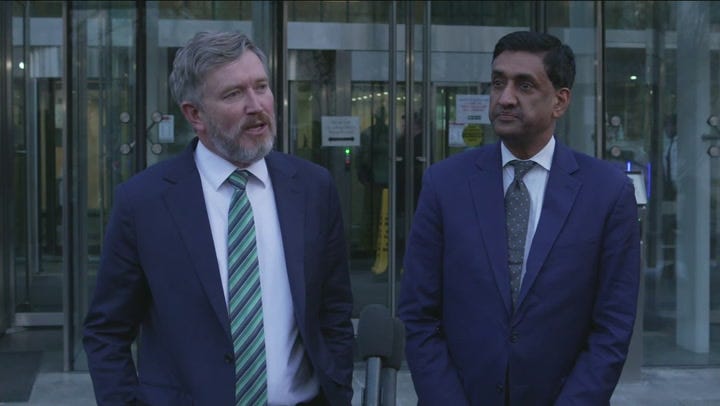
On Sunday, Reps. Thomas Massie (R-KY) and Ro Khanna (D-CA)—the bipartisan co-authors of the Epstein Files Transparency Act—spent two hours at the Department of Justice reviewing unredacted versions of the files. They emerged with a blunt assessment: at least six men whose names had been redacted are “likely incriminated” by what’s in those documents.
Massie wouldn’t name them publicly—yet—but described one as “pretty high up” in a foreign government. He’s given DOJ a window to unredact the names voluntarily, with the implicit threat that he could read them on the House floor, where congressional speech is protected from legal liability.
Then things moved fast.
Within hours of Massie’s public pressure on X, the DOJ began unredacting documents. An August 15, 2019 FBI Criminal Investigative Division memo now shows eight individuals listed as “co-conspirators” in Epstein’s sex trafficking operation—including billionaire Les Wexner, the former Victoria’s Secret CEO and longtime Epstein financial patron. The others named include Ghislaine Maxwell, Lesley Groff, and Jean-Luc Brunel.

Then things moved even faster.
On Tuesday, Rep. Ro Khanna took the next step and read the names of six men on the House floor whose identities had been redacted in the public release. Because statements made during congressional proceedings are protected by the Speech or Debate Clause, the move allowed the names to enter the public record without legal liability. Khanna argued the redactions went beyond protecting victims and instead shielded individuals whose names already appeared elsewhere in the files.

He did not clarify whether any of the six men had been identified by victims as abusers or accused of criminal conduct in sworn testimony. Khanna and Rep. Thomas Massie, along with Rep. Marjorie Taylor Greene before her resignation from the effort, had previously said they were willing to name individuals publicly under congressional privilege. Elon Musk also publicly offered to fund legal defense for victims who chose to identify alleged abusers themselves, but no names identified directly by victims have been read into the Congressional Record.
Massie pointed to the document as evidence that officials had misled Congress. He cited Kash Patel’s past congressional testimony claiming no evidence of other sex traffickers or co-conspirators had been identified, claiming his testimony now appears to contradict the FBI’s own internal memos.
But the Wexner situation—and the redaction mess generally—is more complicated than the “they lied” narrative suggests.

The co-conspirator label appears in documents from the early stages of the 2019 probe—immediately after Epstein’s arrest in July 2019 and around the time of his death in August. As investigative journalist Jason Leopold reported, federal agents served grand jury subpoenas on approximately 10 individuals designated as “co-conspirators” during the same week Epstein was indicted. But a follow-up email from August 2019 notes “limited evidence regarding his involvement” in the crimes.
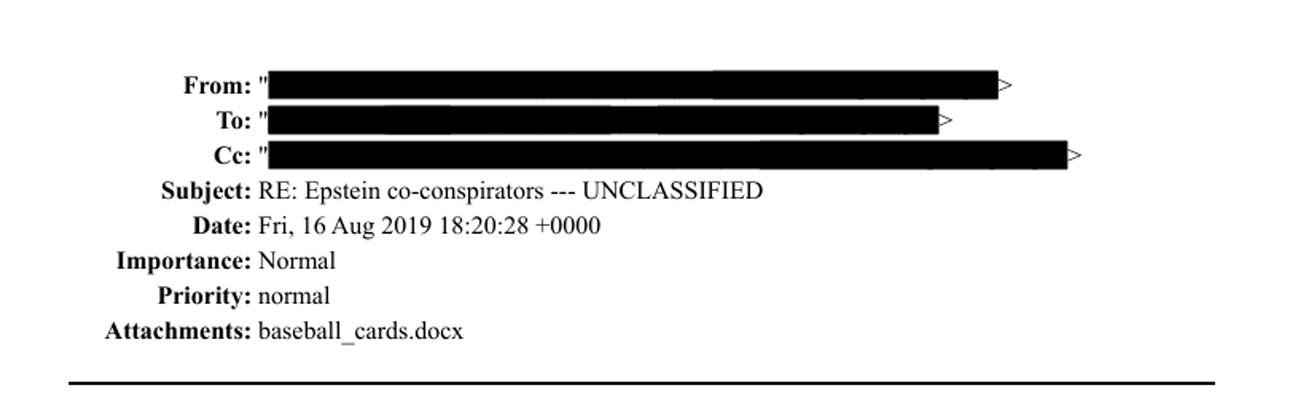

According to Wexner’s legal team, prosecutors—specifically the Assistant U.S. Attorney leading the case—later informed his counsel that Wexner was “neither a co-conspirator nor target in any respect” regarding the sex trafficking investigation. No charges have ever been filed against him.
Wexner cooperated with the 2019 FBI investigation, providing documents and background on his relationship with Epstein. He publicly stated in 2019 that he discovered Epstein had ”misappropriated vast sums of money” from him and his family, initially reported as $46 million, with later reports suggesting hundreds of millions. A private settlement in 2008 reportedly saw Epstein return about $100 million.
This is how federal investigations often work: preliminary co-conspirator designations are used to pursue subpoenas, interviews, and evidence. They can be upgraded or downgraded as the probe evolves. The question isn’t necessarily whether someone “lied”—it’s whether the investigative posture changed, and why.
The Algorithm Problem
Part of the confusion stems from how DOJ redacted these files. Rather than manually reviewing millions of pages, the department used an algorithm to automate redactions, which explains why certain names appear redacted in some documents but unredacted in others. Wexner’s name, for example, shows up “thousands of times” in the files according to Deputy AG Todd Blanche, yet was blacked out in the co-conspirator memo.
The algorithm also blanket-redacted all women’s names to protect victims. That sounds reasonable—until you realize it also shielded women who weren’t victims at all.

Case in point: an email referencing a “little girl” who “was a little naughty” had the sender’s name redacted. Many assumed the sender was a man. It wasn’t. Massie acknowledged that the algorithm automatically redacted all women’s names—but this particular woman appears to have been a facilitator of Epstein’s abuse, not a victim.

This connects directly to what Rep. Anna Paulina Luna observed: some of the most “horrifying emails” in the files come from women who were once victims themselves. Epstein, she noted, appears to have groomed some victims to become recruiters and traffickers. Once you turn 18, you’re no longer a minor victim—you’re a potential co-conspirator. The algorithm doesn’t distinguish between the two.
So the redaction pattern isn’t necessarily evidence of a cover-up. It may be evidence of a blunt instrument applied to a situation that required a scalpel. But that raises its own question: why wasn’t more care taken?
Massie also pushed on another document: a 2009 email to Epstein referencing a “torture video.”
The sender’s email address had been redacted. After Massie’s public pressure, DOJ unredacted it, and Massie confirmed the sender was Sultan Ahmed bin Sulayem, the Emirati billionaire who chairs DP World, one of the world’s largest port and logistics conglomerates. Blanche pushed back, saying the Sultan’s name is available elsewhere in the files. But the original redaction raises the same question: what principle was being applied?
The pattern Massie is highlighting is clear. He argues DOJ has been systematically over-redacting—not to protect victims, as the law requires, but to shield powerful people from scrutiny. Whether that shielding was intentional or the byproduct of a lazy algorithm, the effect is the same: the public didn’t get full transparency, and Congress had to fight for it.
New documents also raise fresh questions about what Trump knew—and when.
The Miami Herald reported Monday on a previously unreported 2019 FBI interview with Michael Reiter, the former Palm Beach police chief who led the original Epstein investigation. According to Reiter, Trump called him in July 2006—just as Epstein’s crimes became public—and said: “Thank goodness you’re stopping him. Everyone has known he’s been doing this.”
Trump allegedly told Reiter that Maxwell was Epstein’s “operative,” adding: “She is evil and to focus on her.” He also claimed he was “around EPSTEIN once when teenagers were present” and “got the hell out of there.” ABC News confirmed the document, though an FBI official denied Trump ever made the call. Reiter confirmed to the Herald that the conversation happened.
This is notable because Trump has repeatedly said he had “no idea” about Epstein’s crimes. The 2006 call—if accurate—suggests otherwise. It also tracks with a 2019 Epstein email in the files where he wrote: “Of course, he knew about the girls, as he asked Ghislaine to stop.”
None of this proves Trump did anything criminal. And it still aligns with his claims that he cut ties with Epstein early on. But it raises questions about the extent of what 'everyone' knew, and why more wasn't said or done sooner
And then there’s Maxwell’s offer.
Ghislaine Maxwell, serving 20 years for sex trafficking, appeared virtually before the House Oversight Committee on Monday and promptly invoked her Fifth Amendment right against self-incrimination. But her lawyer made her play explicit: if Trump grants her clemency, she’ll “speak fully and honestly,” and clear both Trump and Bill Clinton of any wrongdoing.

“Only she can provide the complete account,” attorney David Markus said. “Some may not like what they hear, but the truth matters.”
House Oversight Chairman James Comer said he was “disappointed but not surprised.” Democratic Rep. Suhas Subramanyam called it “all strategy for her to get a pardon.”
Trump has said he “has not thought about” pardoning Maxwell. But he’s also said he would “take a look at” her case. The Clintons are scheduled to testify before House Oversight later this month.
One more oddity:
US officials told BBC Verify that a draft press release announcing Epstein’s death was mistakenly dated the day before he died. They’re calling it a typo. Draw your own conclusions.
The Epstein Files Transparency Act was supposed to force full disclosure. What it’s actually revealed is a messy combination of algorithmic shortcuts, evolving investigations, and powerful names that—intentionally or not—got protected longer than they should have. Whether that protection was corrupt or merely incompetent remains the central question.
But there’s another challenge nobody talks about: what happens when you release millions of pages of raw investigative documents to a public that has no framework for understanding how federal investigations actually work. Most people don’t know that “co-conspirator” is often a preliminary designation, not a verdict. They don’t understand that investigations evolve, that someone can be subpoenaed in week one and cleared by week four. They’re encountering these files in fragments, filtered through social media accounts with their own biases and political motives, stripped of chronology and context.
Related

That doesn’t mean the public shouldn’t have access. It means the information environment we’ve built isn’t equipped to handle it responsibly. When a document from August 2019 lands on your timeline without the follow-up memo from September, you’re not getting transparency, you’re getting confusion dressed up as revelation. And in that confusion, everyone finds evidence for whatever they already believed.
Breaking News
School Shooting In Trumler Ridge, BC


Update On Kidnapping of Nancy Guthrie


ICE and CBP Chiefs Defend Their Tactics on the Hill
The heads of Immigration and Customs Enforcement and Customs and Border Protection faced Congress yesterday for the first time since two Americans were fatally shot by federal agents in Minneapolis, and the hearing was exactly as contentious as you’d expect. Maybe more.
Acting ICE Director Todd Lyons, CBP Commissioner Rodney Scott, and USCIS Director Joseph Edlow testified before the House Homeland Security Committee for roughly three and a half hours. Democrats accused the agencies of operating like a “violent secret police force.” Republicans defended the officers and warned that undermining enforcement would make the country less safe.
Lyons defended his officers’ tactics and said they “would not be intimidated” in carrying out the president’s mass deportation mandate. He touted the numbers: in the first year of Trump’s second term, ICE conducted nearly 379,000 arrests and more than 475,000 removals, including over 7,000 suspected gang members and 1,400 known or suspected terrorists.
Neither Lyons nor Scott would answer questions about the deaths of Alex Pretti or Renee Good, citing ongoing investigations. They also declined to say how many agents had been fired for misconduct. Both confirmed that “standard operating procedures” were being followed in the Minneapolis shooting investigations.
Then things got weird.
Ranking Member Bennie Thompson (D-MS) went after CBP official Greg Bovino, accusing him of dressing in “Nazi attire” and enjoying spraying people with tear gas. The “Nazi attire” in question? A coat that’s been standard issue to CBP agents since the Obama administration. Thompson then displayed what appeared to be an AI-enhanced image of Pretti being shot. Yes, really. In a congressional hearing. An AI picture.


Thompson wasn't done. He called DHS Secretary Kristi Noem a "liar" and said the department "has the blood of American citizens on its hands." He accused Noem of "gaslighting the public" with a "demonstrably false story" about Pretti's shooting, which is kind of fair.
But if Thompson took the low road, Rep. LaMonica McIver (D-NJ) found a tunnel underneath it. In a moment that drew audible groans from the chamber, she asked Acting ICE Director Lyons whether he thought he was “going to hell.”

That’s not oversight. That’s not accountability. That’s a TikTok clip in search of a platform. And it’s exactly the kind of performance that lets the actual policy questions—body cameras, warrant requirements, use-of-force standards—get buried under the theatrics.

The body camera question was central. Pressed by Thompson, Lyons said about 3,000 of ICE’s 13,000 field agents currently have body cameras, with 6,000 more being deployed. Scott said roughly 10,000 of CBP’s 67,000 agents are equipped—and that more funding is needed to expand the program.
Some Republicans sounded sympathetic to Democratic demands. Former Homeland Security Committee Chair Michael McCaul said he supports body cameras, judicial warrants before entering private property, and an end to roving patrols. But most GOP members defended the agencies and blamed protesters for escalating tensions.
The hearing comes as DHS funding is set to expire Friday. Democrats want major reforms codified into law—body cameras, warrant requirements, banning masks on officers—before they’ll agree to a full-year spending bill. Republicans say most demands are “non-starters.” The White House and congressional Democrats are trading proposals, but no deal is in sight.
If funding lapses, TSA, FEMA, the Coast Guard, and the Secret Service would be affected. ICE and CBP, however, would keep operating—they got a massive infusion of cash in last summer’s reconciliation bill.
What CBS Got Wrong About ICE—And What the Data Actually Shows
CBS News dropped an “exclusive” this weekend with internal DHS data showing that fewer than 14% of immigrants arrested by ICE in Trump’s first year back in office had violent criminal records. The framing was clear: the administration’s tough talk about targeting “the worst of the worst” is mostly theater.
Here’s what the story said: “Out of roughly 393,000 ICE arrests, only about 54,000 involved charges or convictions for violent crimes—homicide, robbery, sexual assault, kidnapping, arson. That’s 13.9%. Nearly 40% of those arrested had no criminal record at all, only civil immigration violations.”


ICE fired back on X within hours: nearly 70% of those detained had pending charges or prior convictions. And CBS’s definition of “non-violent” includes drug trafficking, distribution of child pornography, burglary, fraud, DUI, human smuggling, and solicitation of a minor.
CBS isn’t technically wrong about the 14% figure. But the story buries the fact that 60% of arrestees did have criminal records—and that “non-violent” is a legal classification, not a moral one. Whether the public considers child pornography distribution or human smuggling “non-violent” is a different question.
Polling on ICE is more complicated than the headlines suggest. Yes, 63% disapprove of the agency in the latest Quinnipiac, but those same Americans still support deportation and enforcement by margins of 56-66%. The gap isn't about whether to enforce immigration law; it's about how to do so. People want the policy but don't like the execution, a distinction that matters when you're trying to understand what's actually driving public opinion versus what's driving coverage.
The Jobs Report Is In—Let’s Talk About It
The delayed January jobs report finally landed this morning, and the headline number beat expectations: employers added 130,000 jobs last month—the strongest gain in over a year—and unemployment ticked down to 4.3%. Economists had been bracing for something closer to 65,000-70,000.
But the real story isn’t January. It’s what the annual benchmark revision just confirmed about 2025.
The economy added almost 900,000 fewer jobs in the 12 months through March 2025 than originally reported, the largest downward revision since 2009. Job gains averaged just 15,000 per month last year, down from the initially reported pace of 49,000. That’s not a rounding error. That’s a fundamentally different picture of the economy.
So what happened?
Some of it was likely baked into administration policy. The Trump administration’s aggressive immigration enforcement—including an estimated 2.2 million self-deportations and over 675,000 formal removals—reduced the foreign-born labor force by roughly 1.2-1.3 million workers. Immigrants accounted for 18-20% of the workforce in sectors such as construction, agriculture, and hospitality. Fewer workers means fewer jobs counted. White House officials have even pointed to these policies as a contributing factor to the softer employment numbers, though economists note the spillover effects: reduced consumer demand from smaller immigrant communities means fewer jobs for U.S.-born workers, too.
Then there’s DOGE. The Musk efficiency operation resulted in an estimated 270,000-320,000 federal job losses in 2025—a 9-13% reduction in the federal workforce through buyouts, reductions in force, and attrition. Federal payrolls have been declining steadily, and this morning’s report showed that trend continuing into January. (Whether the cuts actually reduced government spending as promised is a different question—early analyses suggest not as much as advertised.)
None of this is “cooking the books,” the benchmark revision process has worked the same way for 90 years. But it does mean the 2025 labor market was running on fumes, and the monthly data was giving us a rosier picture than warranted.
The silver lining?
January’s numbers could actually be a good sign for 2026. Health care led the way (as it did for most of 2025), but construction and professional services added jobs too. Manufacturing posted its first monthly gain in over a year. Economists at RBC and ING are calling it a “firm” start to the year, potentially signaling stabilization after 2025’s disruptions.
Of course, we’ve been here before. Monthly reports come in hot, everyone exhales, and then the revisions hit. Historical data shows these numbers can swing by hundreds of thousands once the BLS squares them with harder data. So take the optimism with a grain of salt—but don’t ignore it either.
Treasuries slumped on the news, and traders pushed back bets on the next Fed rate cut from June to July. The labor market may be stabilizing, but the Fed isn’t ready to declare victory.
The Quick Rundown
TPS for Haiti is still in effect—for now. A federal judge declared DHS’s termination order for ~350,000 Haitians “null and void,” citing procedural violations and potential bias. The administration appealed on Feb. 6. So Haitian TPS holders get to keep their work permits and deportation protections while the courts figure out whether the government followed its own rules.
TPS for Honduras, Nepal, and Nicaragua? Not so lucky. The 9th Circuit lifted a lower court’s block, allowing the administration to move forward with ending protections for ~89,000 immigrants from those countries. The panel found the government had “legitimate reasons”—like improved conditions back home—and hit pause on the procedural and racial animus concerns. Two TPS cases, two different outcomes. Welcome to federal court roulette.
California’s mask ban for federal officers got struck down. A federal judge ruled the state can’t ban ICE agents from wearing masks while exempting its own cops—Supremacy Clause, meet selective outrage. But she upheld the ID requirement, and the mask ruling is stayed until Feb. 19 for potential adjustments. Newsom called it “a clear win for the rule of law.” Bondi called it “ANOTHER key court victory.” They’re both technically right, which means nobody’s happy.
The 2026 Winter Olympics continue in Italy. If you need an escape from all of this, there’s always curling.
What Do You Think?
The Epstein files saga keeps chugging along, but at what point does over-redaction stop looking like privacy protection and start looking like institutional self-protection, and does intent matter if the result is the same?
If “everyone knew” about Epstein years before his arrest, what does that say about how power, access, and reputation influence who gets investigated — and who gets ignored?
Finally, on ICE: Do you buy the CBS framing, or is the distinction between “violent” and “non-violent” crime doing a lot of heavy lifting?
Drop a reply. I read them.

The Brief publishes Monday, Wednesday, and Friday. No corporate overlords—just independent journalism you can actually trust. Share it with someone who needs the real story.
Those non violent crimes are still heinous and if they are illegal then they need deported!