

The Brief | The Epstein Files Are Out—The Internet Just Made Them Useless
Epstein files drown in AI fakes, the media buries the lede on Tulsi, and Washington punts DHS funding to Valentine’s Day

It’s Wednesday!
We are halfway through the week, but I am ready for the weekend. Sorry, I have been a little MIA for the last few days. I’ve been battling a headache since Monday, but I am feeling much better today. Even made it to the gym this morning. Yay me!
In today’s Brief:
3.5 million pages of Epstein files drop—and within hours, AI slop floods the internet with fakes that make the real revelations harder to find
The Clintons finally blink: filmed depositions in three weeks after nine Democrats voted to hold Bill in contempt
Tyler Robinson’s defense wants the entire Utah County Attorney’s Office tossed from the Charlie Kirk murder case—because a prosecutor’s kid witnessed the shooting
WSJ runs “explosive” Tulsi whistleblower story, buries that the IG already found it “not credible”
Government reopens, but DHS is only funded through February 13—Happy Valentine’s Day
Savannah Guthrie's 84-year-old mother kidnapped from her Tucson home; police are now looking at her brother-in-law as a possible suspect
Let’s get into the news!
The Epstein Files: What’s Actually In Them
The Justice Department released 3.5 million pages of investigative materials related to Jeffrey Epstein last week, the largest single disclosure to date. The files include search warrants from Epstein’s Upper East Side mansion and his private Caribbean island, flight logs, emails, court documents, and photographs.
What the documents reveal is a sprawling network of powerful people who maintained relationships with Epstein, some of whom continued those relationships long after his 2008 conviction. Commerce Secretary Howard Lutnick was invited to Epstein’s island for lunch in 2012 with his wife and four children, despite Lutnick’s previous claims that he cut ties with Epstein in 2005. Elon Musk reached out to Epstein at least twice to plan visits to the island, asking in 2012 “what day/night will be the wildest party on our island?” Steve Bannon bantered with Epstein about politics and asked whether Epstein could provide his plane to pick him up in Rome.
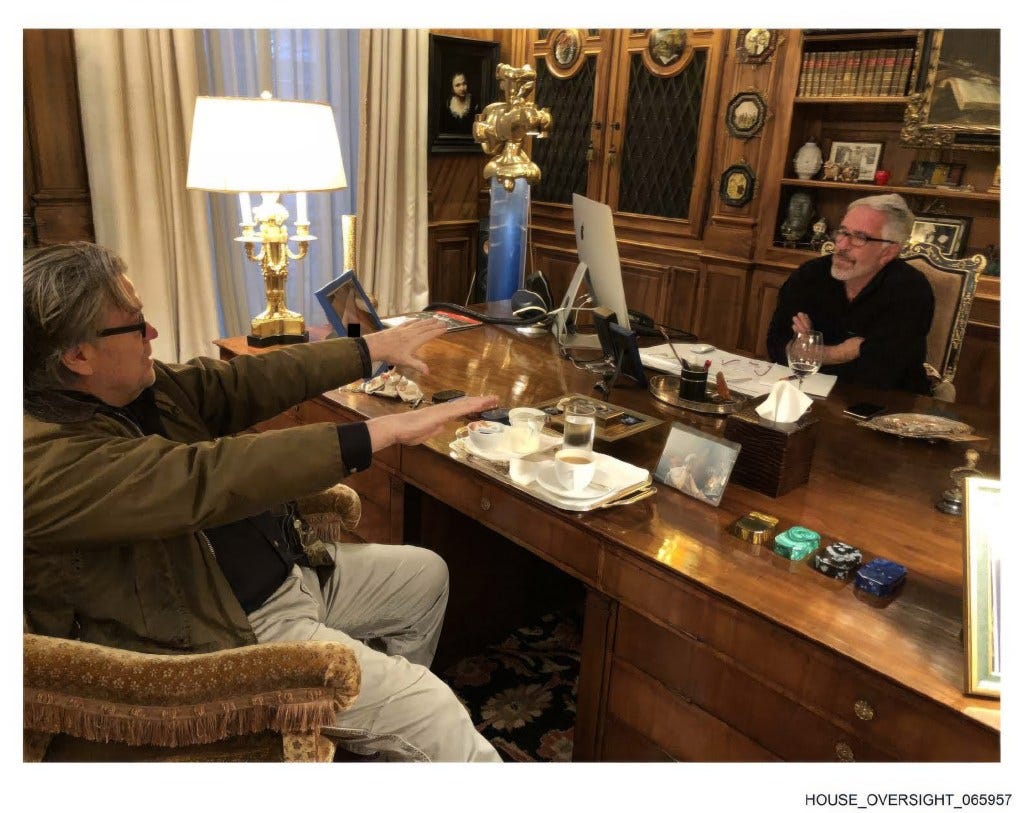
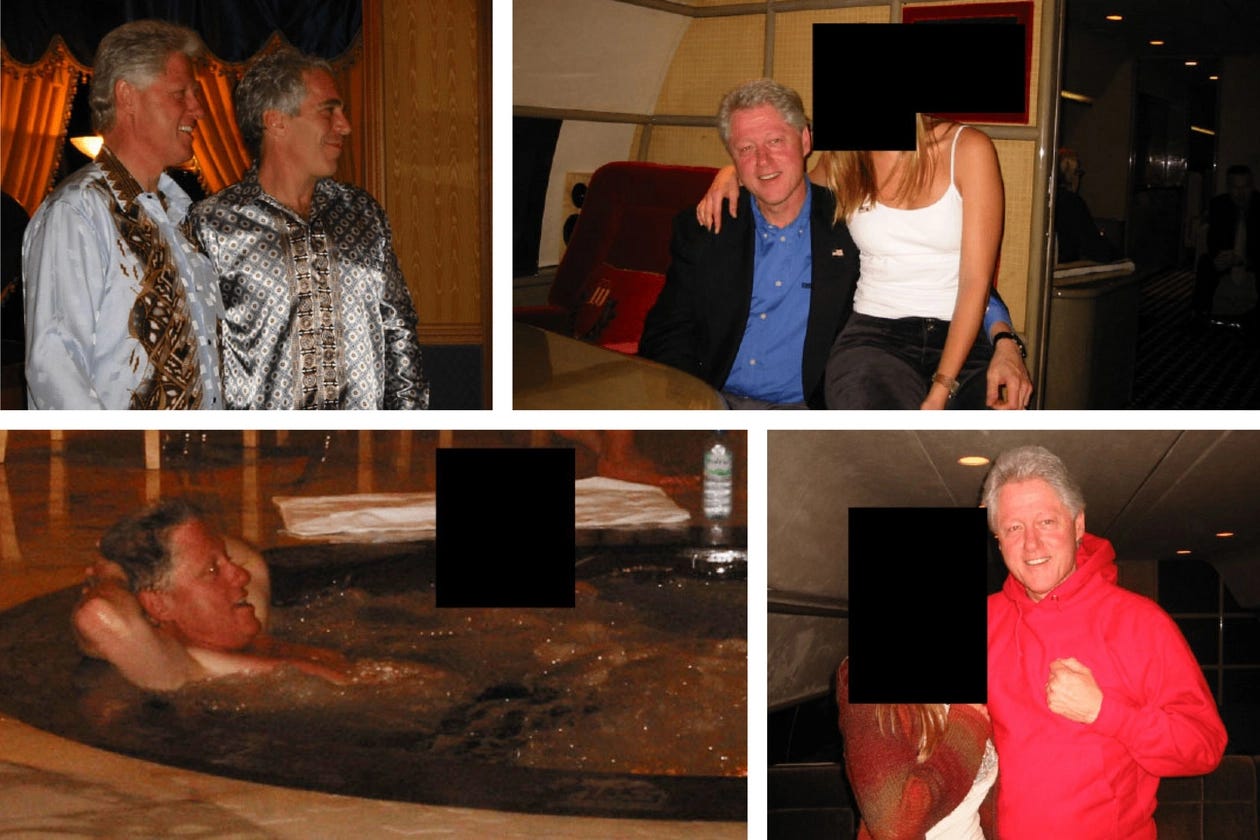
The files also contain correspondence with or about Prince Andrew (whose name appears hundreds of times), Tom Barrack, New York Giants co-owner Steve Tisch, and Obama White House counsel Kathy Ruemmler. Flight logs confirm Bill Clinton traveled on Epstein’s private jet multiple times in the 1990s. A photo of Clinton in a swimming pool at Epstein’s estate with Ghislaine Maxwell was previously released in December.
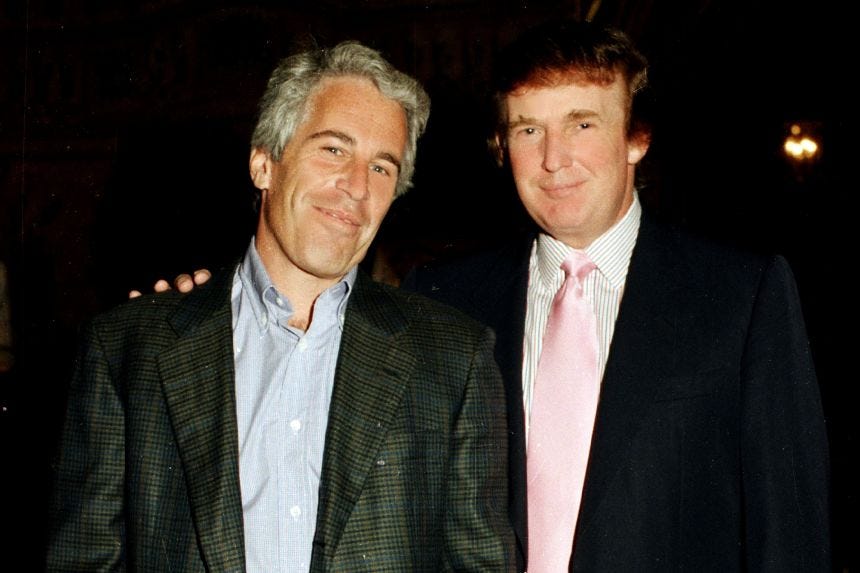
As for Trump: Despite the president’s name appearing thousands of times in the documents—mostly in news clippings and unsubstantiated tips to the FBI—Deputy Attorney General Todd Blanche told Fox News Digital that “in none of these communications, even when doing his best to disparage President Trump, did Epstein suggest President Trump had done anything criminal or had any inappropriate contact with any of his victims.”
In fact, the emails show Epstein mocking Trump extensively—calling him “dopey Donald” and “demented Donald,” criticizing his finances, and even coordinating with author Michael Wolff on an “immediate counter narrative” to a book about Epstein by suggesting Trump could be used as political cover. “Becoming anti-Trump gives you a certain political cover which you decidedly don’t have now,” Wolff wrote to Epstein in 2016.
Hardly the correspondence of co-conspirators.
The Redaction Chaos
The release has been plagued by sloppy redactions that exposed victim information. Lawyers for survivors told a federal judge that the lives of nearly 100 victims had been “turned upside down” by exposed names, nude photos showing victims’ faces, email addresses, and banking information. One victim received death threats after 51 entries included her private banking details.
The DOJ blamed “technical or human error” and has since withdrawn several thousand documents. But the damage was done—and it fueled legitimate anger that the government was somehow protecting perpetrators while exposing victims.
The Tip Sheet Problem
Buried in the release are summary documents of tips mentioning Trump that were sent to the FBI’s National Threat Operations Center, the public hotline. The New York Times reported on them. What the Times was more circumspect about: the tips are unverified, some have been marked as not credible, and many came flooding in around the 2016 and 2020 elections.
The Justice Department’s own statement acknowledged that the documents “may include fake or falsely submitted images, documents or videos” and that some contain “false claims against President Trump that were submitted to the F.B.I. before the 2020 election.”
The tip sheet summaries include no corroborating evidence. Notes on individual tips indicate some tipsters didn’t even provide contact information for follow-up. This is a collection of accusations phoned into a public hotline, not evidence of wrongdoing. But without that context, the mere existence of “FBI documents mentioning Trump and Epstein” becomes a weapon.
The AI Problem
The sheer volume of documents—released in dumps of millions of pages at a time—has made it nearly impossible to parse what’s real. And bad actors have filled the void with AI-generated fakes.
The most egregious example: New York City Mayor Zohran Mamdani was falsely accused of being Jeffrey Epstein’s biological son. AI-generated images showing him as an infant with Epstein, or as a child alongside Epstein, Bill Clinton, and Bill Gates, went viral. Alex Jones posted that a “major investigation” was underway. X’s AI chatbot Grok told users the photos were authentic.
They weren’t. The entire conspiracy was based on an email mentioning Mamdani’s mother, filmmaker Mira Nair, attending a promotional screening afterparty hosted at Ghislaine Maxwell’s home in 2009. Mamdani was born in 1991. The images were fabricated, and some even contained visible AI watermarks that people ignored.
Similar fakes have circulated showing Canadian Prime Minister Mark Carney with Maxwell on a beach, fake audio of Trump berating Marjorie Taylor Greene, and an AI-generated video of Trump and Clinton in compromising positions. None of it is real.
This matters because it creates cover. When every accusation might be fake, legitimate concerns get drowned out. When every photo might be AI-generated, real evidence gets dismissed. The chaos benefits anyone who wants the actual contents of these files buried under noise.


There’s also been widespread confusion about redacted photos, particularly those with faces blacked out. The DOJ stated they “redacted every woman depicted in any image or video, with the exception of Ms. Maxwell” to protect potential victims. But social media users saw redacted faces and assumed they were perpetrators being protected. In some cases, like photos of hedge fund manager Glenn Dubin—who Epstein victim Virginia Giuffre accused Maxwell of instructing her to give a “massage”—the redactions were of his children or other women present, not of Dubin himself. (Dubin has denied all allegations.)
The point isn’t to dismiss legitimate scrutiny of powerful people named in these files. The point is that the combination of sloppy government disclosure and viral AI slop is making it harder to conduct that scrutiny responsibly.
What’s Still Missing
According to Congressman Ro Khanna, one of the authors of the Epstein Files Transparency Act, approximately 2.5 million documents remain out of public view. The DOJ says it will provide Congress with a “more detailed look at government officials and ‘politically exposed’ persons” within 15 days, though there’s no definition of what “politically exposed” means.
The Epstein saga calls for a sober, independent investigation into how the criminal justice system failed over and over again to hold him accountable. That’s harder to do when the discourse is clogged with AI hallucinations and viral misidentifications.
BREAKING


WSJ Runs “Whistleblower” Story on Tulsi—Buries That It’s Not Credible
The Wall Street Journal published a breathless exclusive on Monday about a classified whistleblower complaint against Director of National Intelligence Tulsi Gabbard. The story made it sound explosive, cloak-and-dagger intrigue, documents locked in a safe, months of wrangling.
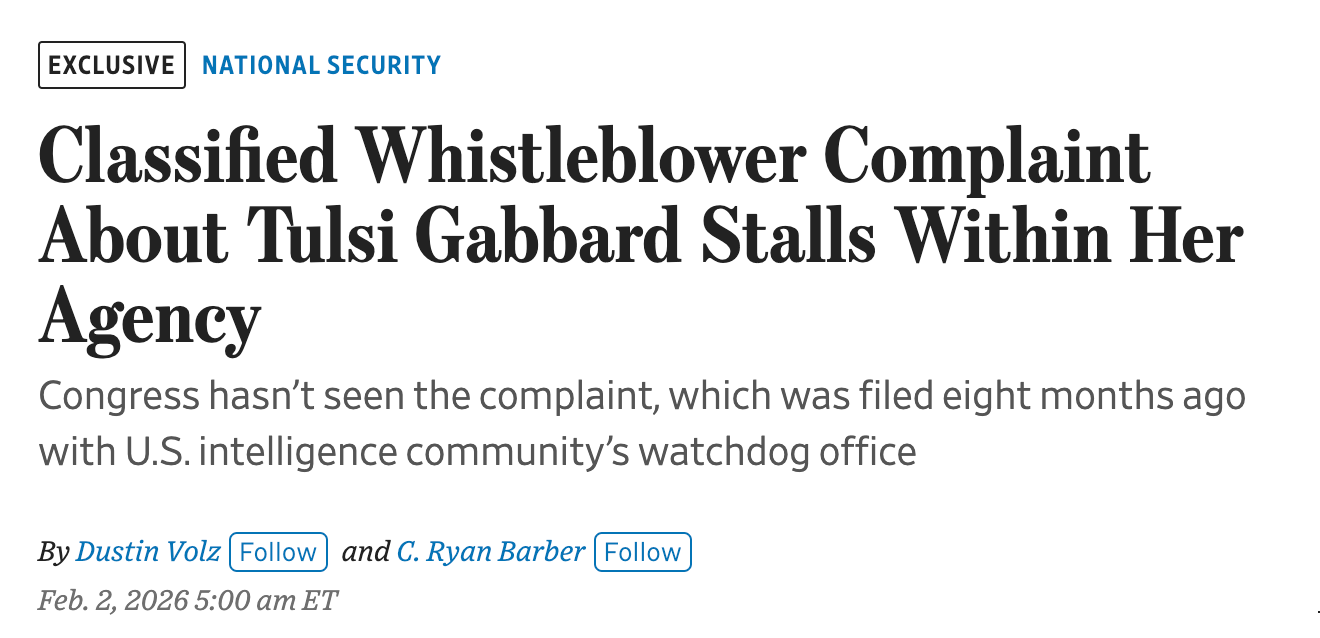
What the Journal buried deep in the piece? The acting Inspector General already determined the allegations “did not appear credible.”
Here’s what actually happened: A whistleblower filed a complaint in May 2025 alleging Gabbard restricted a “highly sensitive intelligence report for political reasons.” Acting IG Tamara Johnson initially flagged it as a matter of “urgent concern,” but after reviewing new evidence, she determined the claims didn’t hold up. The current Inspector General, Christopher Fox, confirmed this in a letter to Congress and noted he would have disagreed with the original “urgent concern” determination entirely.
The whistleblower’s lawyer, Andrew Bakaj, was previously counsel to the CIA officer whose 2019 complaint launched Trump’s first impeachment. That complaint also promised bombshells, until the actual transcript of the call was released, undermining the central claim.


Gabbard’s office called the complaint “baseless and politically motivated.” Her deputy chief of staff compared it to the playbook used to gin up Trump-Russia collusion allegations.
Sound familiar? It should. The Journal framed it as a developing scandal. Just the News actually read the IG’s letter. The difference is instructive.
Shutdown Over—For Now
The government is open again. President Trump signed a spending bill on Tuesday, ending a partial shutdown that began Saturday.
The House passed it 217-214—barely—after a procedural vote nearly collapsed when Republicans demanded action on the SAVE Act, a voter ID measure. Twenty-one Democrats ultimately voted for the final bill; twenty-one Republicans voted against.
Here’s the catch: The Department of Homeland Security is only funded through February 13. Democrats—still furious over ICE enforcement actions in Minneapolis that resulted in civilian deaths—are demanding body cameras, judicial warrants, and a code of conduct for immigration agents before agreeing to full-year funding.
Speaker Johnson has already rejected the warrant requirement. “If someone is going to be apprehended and they run behind a closed door and lock the door, what is ICE supposed to do at that point?” he said Tuesday.
Democrats insist this is about accountability. “ICE and the Department of Homeland Security need to dramatically change,” said Minority Leader Hakeem Jeffries.
Republicans see it differently. “They’re like a spoiled child that’s not getting what they want and throwing a temper tantrum in the middle of the grocery store,” said Rep. Lisa McClain. “You don’t reward them with giving them a candy bar.”
So: ten days to negotiate, or DHS shuts down on Valentine’s Day. Romantic.
Today, Anchor’s Mother Allegedly Kidnapped—Brother-in-Law Named as Possible Suspect
This story is bizarre and developing fast. Monday, anchor Savannah Guthrie’s 84-year-old mother, Nancy, was kidnapped from her Tucson-area home over the weekend. Police are now reportedly looking at a family member as the prime suspect.

According to journalist Ashleigh Banfield, citing law enforcement sources, Savannah’s brother-in-law Tommaso Cioni—married to her sister Annie—has been identified as a possible suspect. Annie was the last person to have dinner with Nancy on Saturday night. Investigators have since towed Annie’s car, which reportedly has “some connection” to Cioni. All the cameras at Nancy’s home were smashed.
UPDATE: 2.4.26 @ 10:07 A.M.


Blood was found at the scene matching Nancy. A ransom note demanding millions in Bitcoin was sent to TMZ, though the Pima County Sheriff’s Department and FBI are still investigating whether it’s authentic.
Nancy is in poor health, requires daily medication, and time is critical. Savannah has asked followers to “please pray.”
This is a developing story with many questions, including whether the suspect’s reported family connection checks out.
Charlie Kirk Murder Trial: Defense Seeks to Remove Prosecutors
Tyler Robinson, the 22-year-old accused of assassinating Turning Point USA founder Charlie Kirk at Utah Valley University last September, appeared in court Tuesday for what’s become a pivotal pre-trial hearing.
Robinson’s defense team is trying to disqualify the entire Utah County Attorney’s Office from the case after it was revealed that an adult child of a prosecutor in the office was present during the shooting. The defense argues this creates a conflict of interest that tainted the decision to seek the death penalty.
Tuesday’s hearing was a continuation of January proceedings and featured extensive testimony from Utah County Attorney Jeff Gray and lead investigator Dave Hall.
Defense attorney Richard Novak pressed Gray on the timing of his death penalty announcement, suggesting it was driven by political pressure rather than legal analysis. Novak pointed to three factors: Gray’s campaign promise to seek the death penalty in “appropriate” cases, the prosecutor’s family connection to the crime scene, and President Trump’s public statement that “I hope he gets the death penalty.”
Gray testified that while he was aware of Trump’s statement, it did not influence his decision. He said he announced the death penalty pursuit early—before arraignment, which is unusual—to “limit speculation” and reduce “unnecessary angst” for victims’ families, particularly Charlie’s widow Erika Kirk.
On the conflict question, Gray acknowledged he knew a prosecutor’s adult child witnessed the shooting but testified they had not discussed it, and it played no role in his decision-making. In a previous filing, Gray argued the child “returned to classes after the shooting” and had not experienced lasting trauma beyond being scared in the moment.
The court also heard from Agent Dave Hall, who testified about the investigation’s focus on identifying the shooter through video, forensic, and digital evidence. Graphic cellphone footage of Kirk being shot was shown in court. Hall testified that DNA found on the firearm recovered near campus was consistent with Robinson’s DNA, and investigators found social media messages containing admissions.
Robinson watched the proceedings, shackled at the waist, his parents present in the courtroom. When videos of Kirk before and during the event were played, Robinson accepted a tissue from his attorney and wiped his face. As he exited, he gave his family a small grin.
Judge Tony Graf has scheduled a February 24 hearing at which he will issue an oral ruling on whether to disqualify the prosecutors. Legal experts say removing an entire prosecutor’s office is rare and difficult.
“I think to remove an entire office can be very difficult,” Salt Lake City defense attorney Skye Lazaro told Fox News. “What this is ultimately going to turn on is whether or not that played any role in their decision to charge this case, and I don’t think that it really did.”
But she added: “This isn’t going to keep Tyler Robinson from being prosecuted. It just means either a different county attorney’s office would handle it, or a special prosecutor would be appointed. And whoever prosecutes the case is the one who decides whether to seek the death penalty, a decision that can change.”
Robinson faces seven charges, including aggravated murder. He has not entered a plea.
Quick Rundown
Clintons finally agree to testify. After months of stalling, Bill and Hillary Clinton caved hours before a contempt vote and will appear for filmed depositions before the House Oversight Committee—Hillary on February 26, Bill on February 27. Nine Democrats voted to advance the contempt measures. The depositions will be transcribed, despite previous Clinton demands to the contrary.
F-35 shoots down Iranian drone near USS Abraham Lincoln. An Iranian Shahed-139 drone “aggressively approached” the aircraft carrier in the Arabian Sea with “unclear intent.” The F-35C pilot shot it down in self-defense. Hours later, Iranian boats threatened to board a U.S. merchant vessel in the Strait of Hormuz before the USS McFaul intervened.
Detransitioner wins $2 million in landmark verdict. A New York jury found psychologist Kenneth Einhorn and surgeon Simon Chin liable for rushing Fox Varian into a double mastectomy at 16. It’s the first detransitioner malpractice case to go to trial. Varian’s mother testified the psychologist “browbeat” her into consenting by warning her daughter would commit suicide otherwise.
Ryan Routh faces sentencing today. The man who attempted to assassinate Trump at a Florida golf course is facing a potential life sentence. He left behind a letter offering $150,000 to “whoever can complete the job.”
Peter Mandelson resigns from Labour. The British Lord stepped down after DOJ Epstein files revealed £55,000 in payments from Epstein between 2003-2004.
Iran’s supreme leader warns of “regional war.” Ayatollah Khamenei issued his most direct threat yet as the USS Abraham Lincoln sits in the Arabian Sea.
Let’s Discuss
The Epstein files contain real revelations—but they’re getting buried under AI fakes and viral misidentifications. Is this the new normal for major document releases? And will the Clinton depositions produce actual answers, or just hours of “I don’t recall”?
Drop your thoughts in the comments.

The Brief publishes Monday, Wednesday, and Friday. No corporate overlords—just independent journalism you can actually trust. Share it with someone who needs the real story.
We already know the truth. We don’t need to read the files to know we are slaves to a very sick system.
Maybe we’re about to find out we are no different than the Soviet or the Nazi’s.
All this psyops propaganda has Americans very apathetic to everything going on. Maybe this is by design. Flood the zone, and do what the globalist want.
We were warned in 2020, there was a book wrote about and everything.
We were told that when the transformation happens… that it will happen so fast that we won’t know what hit us.
Trump is bringing us closer to this reality.