

The DSA Just Passed Eugene Debs. Ask What Happened Next.
On the Fourth of July, the Democratic Socialists of America surpassed Eugene Debs's Socialist Party. Take the comparison seriously and it stops being a victory lap.

On July 4, 2026, the Democratic Socialists of America handed out a number and a name.


“On July 4, 2026, Democratic Socialists of America passed 120,000 members, making us the largest socialist organization in United States history and surpassing the Socialist Party of America under Eugene Debs, which reached its peak dues-paying membership in 1912.”
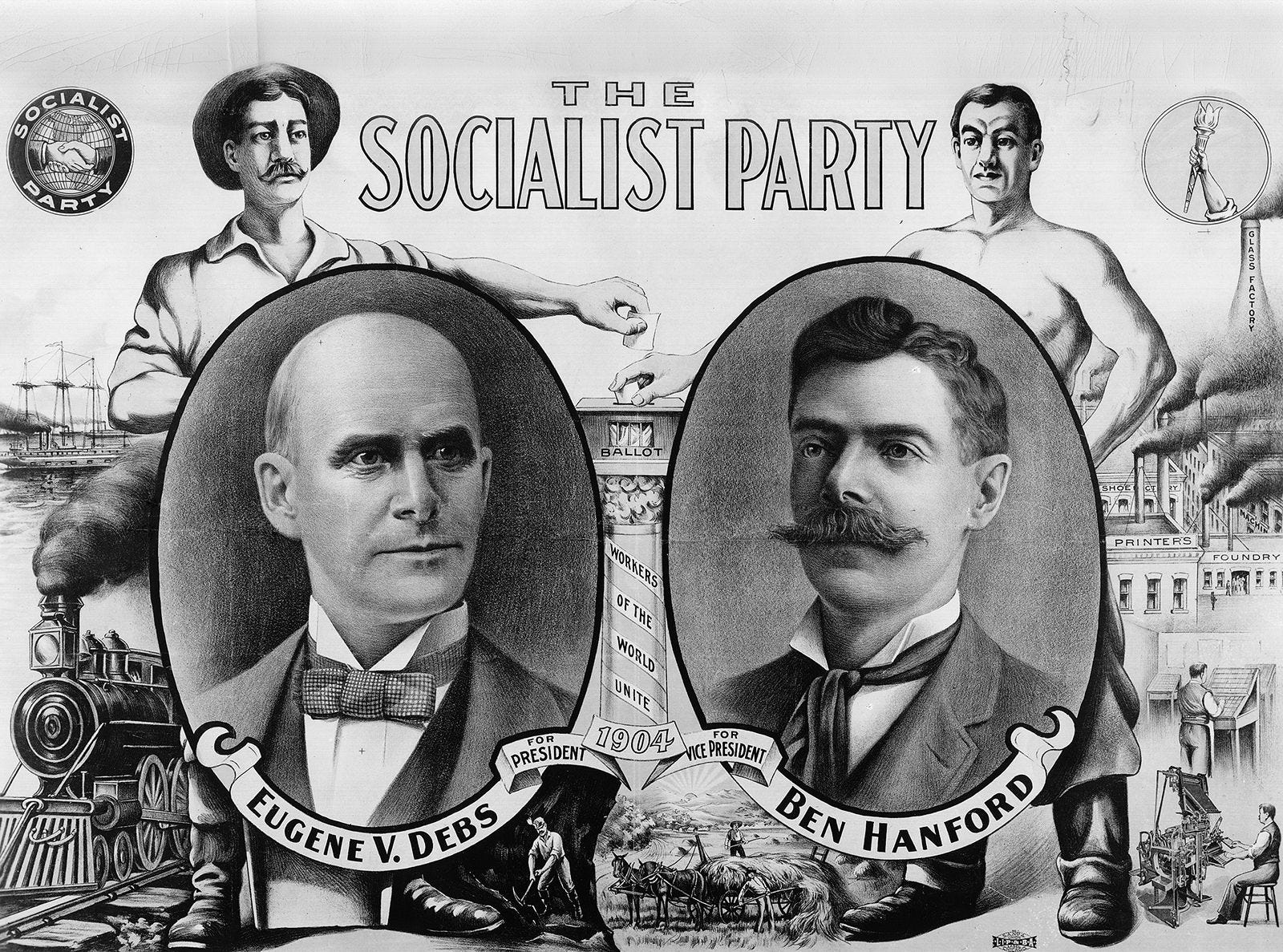
Take note that this announcement was not made on some random Tuesday. Nope. They saved it for the country’s 250th birthday. And not a vague benchmark, either. They picked Eugene Debs, the patron saint of American socialism, as the ruler they wanted to be measured against. The announcement went out on their own account. A week earlier, their tally stood at “over 95,000,” per the Washington Examiner; they credit the jump to a run of primary wins.
Fine. No surprise they featured their growth along with Debs' image. But who is Debs?
Who Debs actually was
Start with how alive he still is for these people. On the night he won City Hall, Zohran Mamdani closed his victory speech not with his own words, but with Debs’s.

Here’s the part the confetti left off. Debs said, “I can see the dawn of a better day for humanity,” in 1918, standing in a federal courtroom, right before a judge sent him away for 10 years under the Espionage Act for a single speech against the First World War. Mamdani’s victory line was a condemned man’s line.
And here's a wrinkle the modern left never brings up: the man who kept Debs behind bars was the Democrat, Woodrow Wilson, who called him a traitor and refused him a pardon to the last. The one who finally set him free, over that same speech conviction, was a Republican, Warren Harding.
So who earns that kind of reverence? Debs was a railroad worker out of Terre Haute, Indiana. He built the American Railway Union and led the great Pullman Strike of 1894, and he did six months in jail for it, where he read Marx and came out a socialist. He co-founded the Socialist Party of America and helped launch the radical Industrial Workers of the World. He ran for president five times. And here’s the part that gets quietly sanded off. Debs didn’t want to regulate capitalism. He wanted to end it. “The Socialist Party is not a reform party,” he told a crowd of miners in 1902; its aim was “to abolish the capitalist system” and “transfer from private hands all the means of production and distribution” to “the people in their collective capacity.” Not tax the railroads. Own them. Not cushion the wage system. Abolish it — he called wage labor “wage-slavery” and the American worker a “twentieth century slave.” He backed the eight-hour day and the end of child labor and votes for women too, but those were down payments, not the purchase. The purchase was the whole economy. He put it plainest running for president in 1904:
“The overthrow of capitalism is the object of the Socialist party. It will not fuse with any other party and it would rather die than compromise.”
And he meant it down to the ground. His most quoted words come from that same 1918 courtroom:
“while there is a lower class, I am in it; while there is a criminal element, I am of it; while there is a soul in prison, I am not free.”
Say what you want about where the politics lead. The man was no fraud. He believed every syllable, and he went to prison rather than swallow it.
That’s who they picked. Not a mascot. A revolutionary who wanted the whole thing torn down and paid for saying so.
They wanted Debs. So let’s use all of Debs.
So let’s stay with the record they’re waving. Of his five runs, 1912 was the peak: about 6% of the national vote, roughly 901,000 ballots, and the Socialist Party at its high-water mark of around 118,000 members. The DSA’s own announcement puts Debs’s peak at 113,000 “dues-paying.” Small gap, and it doesn’t matter which figure you use, because the story ends the same place.
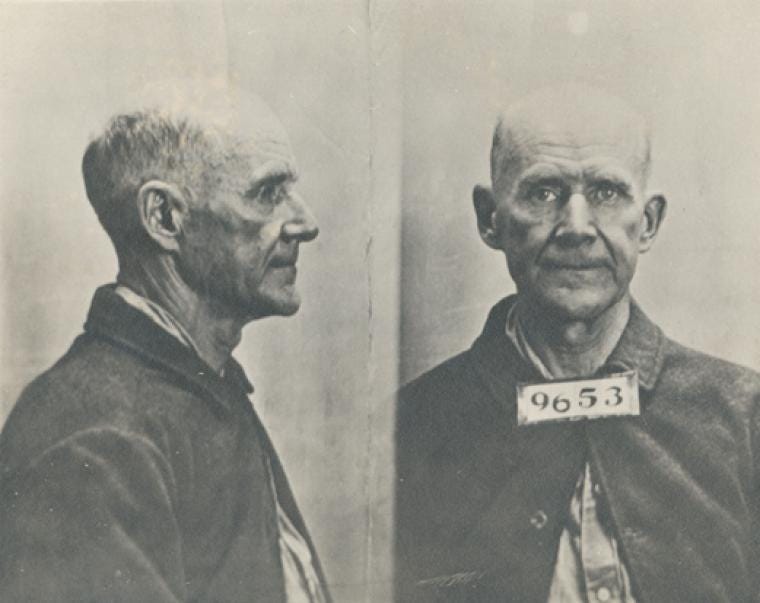
Take note that 1912 wasn't the launch. It was the ceiling. Debs's biggest year was, more or less, his last good one. Look at his 1920 run, waged from that prison cell eight years later. He pulled about 914,000 votes, a hair more than the 901,000 he got in 1912. Sounds like he held steady. He didn't. The country had grown, and women had won the vote, so that same raw number was now 3.4% of the electorate instead of 6%. Flat vote, half the share. No new ground, the same true believers he already had. And weigh what he pulled that number under. By 1920 he was a jailed martyr, handed the kind of story that's built to make a country rally. Nearly a million people voted for him from outside a federal prison, and it moved nothing. The sympathy was real, but the conversion never came. That's what a hard ceiling looks like.
I read what the DSA actually says and hand you the receipts, three times a week. Subscribe free so the next one finds you.
What the banner leaves off
The announcement stops the clock at the peak. Keep reading and the rest of the decade shows up fast.
World War I split the party over whether to back the war. Then the government came down hard, the Red Scare hit, and in 1919 the party fractured, spinning the Communist parties off from the socialist trunk. By 1919 the Socialist Party reported 77,647 members, down from that 118,000 peak, and the slide kept going. Debs was in prison. Within a few years the Communist Party had passed the party he built, and American socialism spent the next half-century out at the margins of national politics.
And notice what actually broke it. Debs’s Socialist Party was never one thing. It was a coalition, reformers who wanted to win elections sharing a roof with revolutionaries who wanted the whole system gone, and when the Bolshevik question forced everyone to choose, it split right along that seam. The DSA is built the same way. It’s not a monolith; it’s a truce between tendencies: reformist caucuses content to work inside the Democratic Party sitting alongside openly Marxist-Leninist ones like Red Star and the Marxist Unity Group, whose stated endpoint is communism, full stop. Last year’s convention even repealed the party’s old ban on “democratic centralism,” the Leninist model for running an organization. That’s a lot of conviction under one banner, and conviction like that doesn’t share power quietly. People who agree on tearing a system down rarely agree on what replaces it, and the faction that wins that argument is usually the one least willing to compromise. Winning is what keeps the peace. Victories paper over the doctrine. So watch what happens if these candidates keep running up the score in safe blue primaries but can’t break through at the federal level, because nothing sharpens the knives inside a movement like the sense that it has stalled.
This is history, not a prophecy, and I’m not going to pretend it’s one. I’m not saying the DSA is booked for the same collapse. I’m saying the comparison they reached for carries its own warning, and they cut it off right before the warning starts. “Surpassing Debs” sounds like a finish line. Debs’s own movement tells you it can just as easily be a peak.

Related
The DCCC Chair Has Laid the Welcome Mat to a Socialist Takeover

Meet Rep. Suzan DelBene, the woman in charge of electing House Democrats, on tape, ceding the Democrat party to the socialists winning its primaries:
The one thing that actually changed: the ballot line
Let’s evaluate this claim that “socialism is suddenly popular.” The real difference between the DSA and Debs isn’t the head count, and it isn’t the ideas. It’s the line on the ballot.
Debs ran as a Socialist. He built his own party, stood outside the two-party system, and stayed outside it, and the party he built broke apart. The DSA runs its people as Democrats. They win Democratic primaries, take the party’s ballot line, and inherit safe blue seats that were never in doubt in November. That’s why 120,000 members in 2026 buys something 113,000 in 1912 never could: actual offices, with actual gavels.

Look at Colorado. Melat Kiros, a 29-year-old democratic socialist, just ended Diana DeGette’s 30-year career in the state’s first district, running on the Democratic line, and said the quiet part into the microphone on primary night: “We are taking back our party and our country.” Not joining. Taking. And this isn’t one lucky race. The Intercept, no one’s idea of a right-wing outlet, counts 305 DSA-backed lawmakers elected since 2018, with chapters spread across a majority of states.
Debs built a party, and it broke. The DSA borrowed one that already works. That’s a significant difference, and it’s why the “big tent” talk you hear from Democratic leadership misses the point completely. A tent assumes everyone inside is pitching the same tent. Debs pitched his own, on his own lot, in the open. The DSA moved into somebody else’s, like a parasite. And in its own documents, it’s honest about its intent to keep the lot.
The number that should worry you isn’t 120,000. It’s 58 percent.
Let me not hand myself a cheap win. A membership record is not proof that socialism went mainstream. 120,000 people in a country of 340 million is a rounding error, and anyone waving the raw count as evidence of a national tide is doing the same lazy thing I keep calling out in the press.
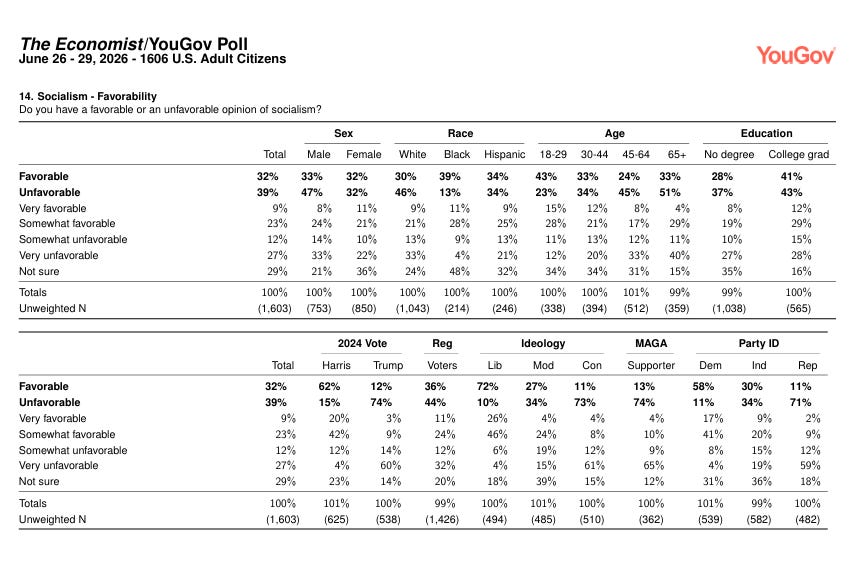
The softening is real, though, and it doesn’t show up in the member rolls. It shows up in the polling. An Economist/YouGov survey from late June found 58% of Democrats hold a favorable view of socialism. Other national polls land lower, so don’t build a cathedral on that one figure. But the direction is concerning. And “socialism” here isn’t my label pinned on them from the outside. It’s theirs. Their 2025 platform, “Workers Deserve More!,” calls for collective ownership of “the key economic drivers” and to “abolish the carceral forces of the capitalist state.” Sounds a lot like “abolish the police.” The 120,000 is a headline. The 58% is the water table underneath it.
The bigger mistake runs the other way
I’m not going to pretend Trump picked the wrong word. RedState’s headline, “the DSA just proved him right,” is closer to the mark than the people sneering at it want to admit. I don’t need Trump to be a prophet, though. I have something better. History has run this experiment before, and it keeps ending up in the same place.
Here’s who actually needs to hear that, and it isn’t the people already paying attention. It’s the normie Democrat who reads the Times and MSNow, trusts them, and is being told, gently, that this is just a healthcare plan with a bolder name. They’re the whole ballgame. And right now the outlets they trust are selling them the friendly version.
Socialism has a history, and it’s not the one being handed to young Democrats right now. Every time it’s been tried at scale, the pitch was gentle, and the ending wasn’t. The romanticizing always comes first and the downplaying second. The shortages and the secret police come after. The people who warned early got called hysterics, right up until they got called correct. I’m not saying the DSA is the Soviet Union. I’m saying it is openly working to remake one of the two parties that run this country; it is honest in its own platform about wanting to end the system that built the richest economy on earth, and the only thing standing between “fringe curiosity” and “governing faction” is whether anyone says so plainly while it’s still small enough to matter.
So I’m not going to soften it to sound measured. The measured-sounding version is the trap.
They picked the ruler
They wanted to be measured against Debs. Good. Measure away. But understand what that choice gives away. You don’t reach for Eugene Debs if you’re a party of tinkerers. You reach for the man who ran five times to pull the system out by the roots. They told you what they are by whose name they put on the banner — and they told you how it usually ends, because Debs ran on his own line and lost, and the party he built cracked apart and drifted to the margins.
The catch is that I can’t promise the ending repeats, because the game is different now. Debs built his own party, out in the open, and it withered on the fringe where it couldn’t take anyone with it. The DSA isn’t building a party. It’s moving into one that already exists, and the Democrats are holding the door.
So here’s the only comfort I’ve got, and it might be naive. Every movement that set out to replace the system instead of fix it has failed in the end. Every one. The DSA will too. The banner says they passed Eugene Debs; it doesn’t say what passed him next. The only question left is whether they fail early, out on the fringe the way Debs did, or late, from the inside, after the rest of us have gone down with them.
Here’s the deal. Nobody in your feed is going to sit down with the DSA’s own platform and their caucus letterhead and tell you straight what’s in them. The Times won’t. MSNow won’t. I do, three times a week, with the receipts.
If that’s worth something to you, back it. Paid subscribers fund the digging and get what won’t fit in a Friday send: the deeper investigations, plus the DSA candidate tracker I keep current as the races move.
You made it to the bottom. You’re already one of us. Make it official.
Thank you for these great articles Messidy! I’ve really been enjoying them and am praying people’s eyes start to open prior to midterms - especially with New York showing just how…. Ick it is.