


Meet Rep. Suzan DelBene, the woman in charge of electing House Democrats, on tape, ceding the Democrat party to the socialists winning its primaries:

“…those are part of folks who are being elected, and they’re going to come and join the caucus…. my job, our job, is to make sure we have those gavels so we can do the work of the American people.”
This is significant because DelBene is chair of the DCCC, and during her interview on Chuck Todd's "Sunday Night with Chuck Todd" on June 28, her primary concern was counting gavels. Not the platform. Not what these socialists ran on. Not one word about the thing they're promising to do once they get inside. To her, success is simply about the majority. Whether that majority is worth handing the party to people who mean to replace it, she never says. The silence is the answer.
Who she is, and why that quote is different
If you’ve never heard of DelBene, here’s why she matters. The DCCC is the money. It recruits House Democrats, funds them, and plugs them into the national fundraising machine. Without it, a campaign is virtually unwinnable, especially in a competitive race. It’s like bringing a garden hose to a wildfire. She holds the purse strings for the entire House Democratic operation.
A Fox host warning about a socialist takeover is one thing. It can be dismissed as overreacting. But the DCCC chair describing those winners as folks who’ll “come and join the caucus” is another, because she signs the checks and controls the coffers. She isn’t guessing at the trend from the outside. She’s the one holding the door open.

Same week, different vantage point
Now listen to one of the people she’s welcoming. Melat Kiros, the 29-year-old democratic socialist who just ended Diana DeGette’s 30-year career in Colorado, gave her victory speech on June 30. Here’s how she framed the night:

“We are taking back our party and our country.”
Taking back. Not joining. Not adding a chair to the big tent. Taking. And she was specific about the agenda she’s taking it toward:

“We will not wait to abolish ICE and pass Medicare for All… We will not wait to reject corporate PACs and AIPAC. And no, we will not wait to end the genocide in Palestine.”
These two are not speaking the same language. DelBene sounds like a host describing a guest. DelBene is saying “you can sit with us.” Meanwhile, Kiros sounds like she wants to flip the table. Same event, two accounts of who’s really in charge. Only one of them is being straight with you about where this ends.
“Big tent” is a category error
DelBene’s defense, echoed by Pramila Jayapal, is that Democrats are a “big tent.” Her own words gave away what the tent is for: “We’re a big tent. I want to make sure that our big tent is a tent that is in the majority and that we have the gavels.” The point of the tent is the majority, not the principles.

Jayapal told CNN the welcome has to run both ways: “If we are a big tent party, we have to have both sides of the big tent included.” And she framed the double standard like this:
“Every time a moderate wins an election, people are like, ‘That’s the new blueprint for the Democratic party.’ But if a progressive or a Democratic Socialist wins, ‘Oh, the whole party’s falling to hell in a handbasket.’”
She wants that treated as ordinary factional sorting, the kind of thing that resolves itself once everybody calms down.
Here’s why the big-tent argument with socialists falls apart, and is a very bad idea. A real big tent works when people share the fundamentals and fight over the approach. Republicans agree on limited government, capitalism, and constitutional liberty. We brawl over how to protect them, not whether to. It’s an argument among family.
Democrats versus the DSA isn’t a family argument. It’s a fight over the foundation itself: capitalism or socialism. And the DSA doesn’t hide where the road ends. Their own caucuses put it on letterhead. Red Star’s stated goal is “to abolish capitalism and, ultimately, to achieve communism.” The Marxist Unity Group describes a world “free of the market, borders, classes… in a word, communism.” You can’t big-tent a faction whose stated plan is to replace the ground the tent is pitched on.

And the "democratic" in democratic socialism doesn't soften the landing. Socialism achieved through a democratic process instead of a revolutionary one ends the same way.
Venezuela is the case study the socialists downplay. Hugo Chávez won an election in 1998 on promises that should ring a bell: end corruption, lift the poor, redistribute the wealth, break the grip of the oligarchy, and — his signature pledge — convene an assembly to rewrite the constitution.
In office, he rolled out the feel-good programs to match: free neighborhood health clinics, state-run groceries selling food far below cost, a national literacy drive.
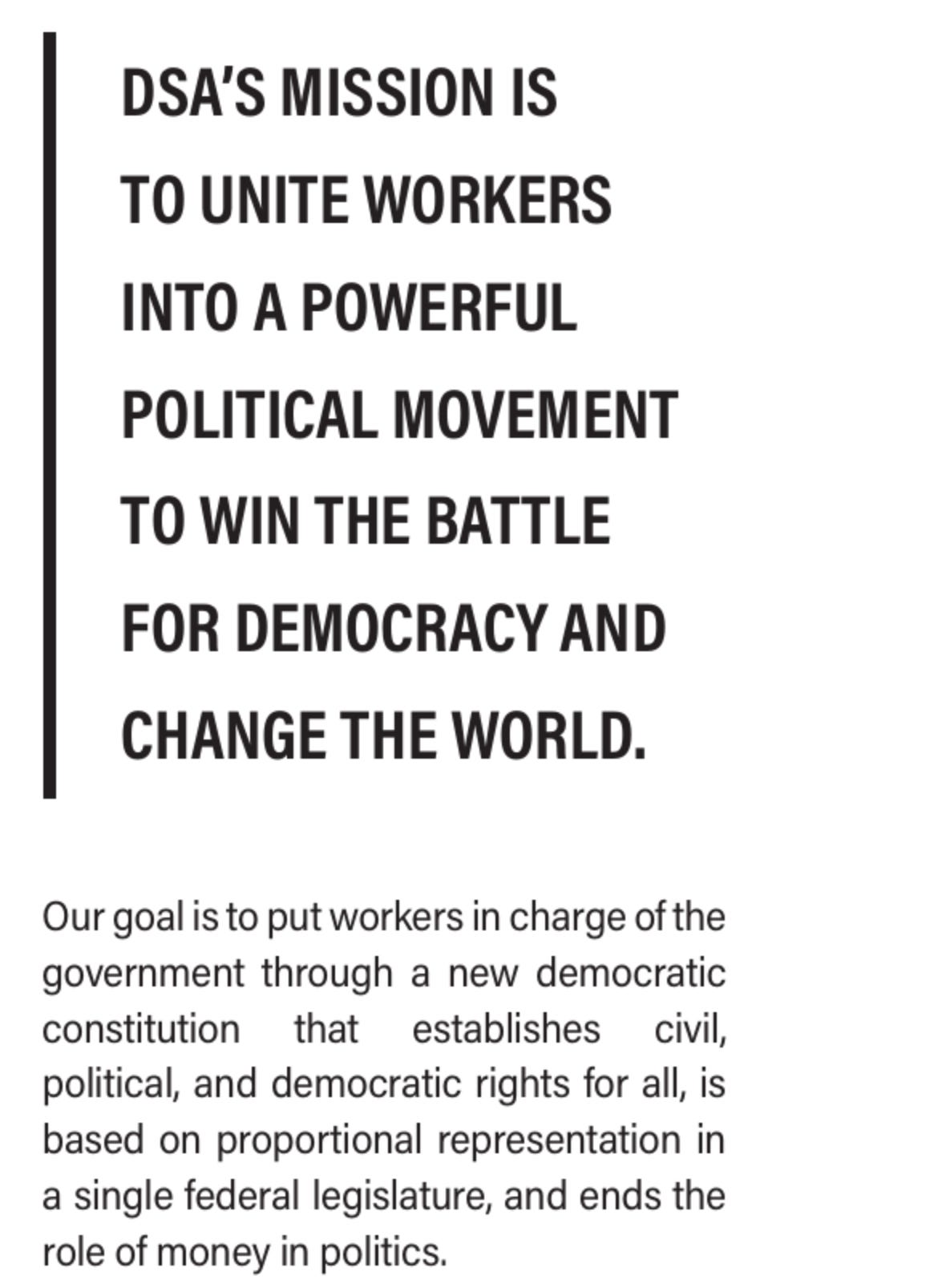
Sound familiar? Medicare for All, "get big money out of politics," a fight Gustavo Gordillo, NYC-DSA co-chair, frames as "the billionaire class" against "the working class," and a DSA platform — "Workers Deserve More!" — that puts it in writing: its goal is to put workers in charge of government "through a new democratic constitution" and to "build a socialist society" where "the largest corporations are put under public ownership." Chávez's exact opening move, a generation later.
Then came the gradual part, the socialist part: control the economy, control the food, choke the opposition, and one free election at a time the country stopped having them. More than 7 million people have since fled, the largest displacement in the history of the Western Hemisphere. Call it a scare story if you want. It's really just the record of where "we'll do it through the ballot" goes once one faction owns the machinery.
The one time someone pressed, she looked away
A welcome this eager doesn’t stop to ask who’s walking in. Todd tried to make her ask, pressing DelBene, more than once, on Jewish Democrats’ concerns about the incoming bloc. She kept moving the subject. She pointed to Texas, where the party worked to defeat an openly antisemitic candidate, as proof Democrats take this seriously.


Then Todd asked about Darializa Avila Chevalier, the DSA candidate who just unseated Rep. Adriano Espaillat in New York — someone who went to an anti-Israel rally the day after the October 7 massacre, shared a post rejecting Israel’s right to exist, and co-founded Columbia University Apartheid Divest (CUAD), the campus group that posted it was fighting for “the total eradication of Western civilization.” DelBene’s reply: “that’s not representative of where other candidates land.”

One candidate, don’t read too much into her. Except it isn’t one candidate. Melat Kiros called October 7 “the inevitable consequence of apartheid,” wrote in a 2023 letter about Israel’s “weaponization of anti-Semitism,” and wouldn’t call the Boulder firebombing that killed Karen Diamond, a Holocaust survivor, an antisemitic act: “I don’t know what was in the heart of the perpetrator.” The Democrat who did call it antisemitic was Phil Weiser, the party’s Jewish nominee for Colorado governor: “Karen Diamond’s life mattered. You don’t put a comma, an ‘and’ or a ‘but.’ Period.” When the plainest rebuke of a DSA nominee’s antisemitism comes from inside your own party, “that’s not representative” stops being an answer.
Why won’t DelBene look? She already told you. She wants the votes, and some of those voters hold exactly the positions a real denouncement would cost her. That’s the price of this tent.
The DSA takeover, in their own words
Strategist Matt Klink told the Washington Examiner the DSA is "no longer a fringe annoyance… It is becoming an open revolt within the party." The scale backs him up: 305 DSA-backed candidates have won office since 2018.

And here’s the part that should end the debate about who’s using whom. Gustavo Gordillo, co-chair of NYC-DSA, said it flat out to Spectrum News:
“We’re on the Democratic Party ballot line. We contest the primaries… but we don’t agree with the way the Democratic Party establishment organizes or runs its party apparatus.”
And notice the word people like Kiros still reach for: our party. She’s DSA. Gordillo just admitted they don’t share the Democrats’ aims. So “our” is the tell — the softener that lets a socialist pass for a Democrat who wants a few more social programs, right up until you read the platform. The possessive is doing PR the policy can’t.
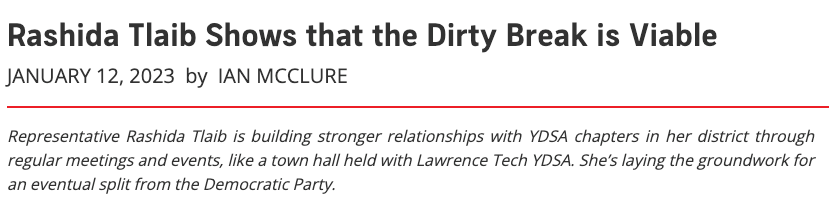
The strategy even has a name in their own literature — the “dirty break” — run on the Democratic line, use their infrastructure to build their own, to eventually walk away with the base. They’re not hiding it. People simply do not inform themselves.
So you’ve got two people describing the same door. DelBene, from the inside, calls it a welcome. Gordillo and Kiros, from the other side, call it a vehicle. When the host describes the guest and the guest describes a takeover, believe the guest.
The Senate is the next rung
Treat this as a House problem, and you’ve already missed it. The DSA didn’t start in Congress, and it has no plans to stop there. This is all about a climb to power: city councils and school boards, then state legislatures, then the House. Each rung sets up the next, and the Senate is simply the one they haven’t reached yet. They’re already spending to get there. In Michigan, the DSA has poured organizers, volunteers, and money into Abdul El-Sayed’s Senate primary, boosting the Sanders- and AOC-backed challenger against the establishment’s Haley Stevens.

And the person running Senate Democrats’ campaign arm is making DelBene’s case for her. Kirsten Gillibrand chairs the DSCC, the Senate version of DelBene’s committee, and when she looked at the socialist primary wave she called it “a very good trend for nationwide elections.” Same welcome, one chamber up. Two of the people whose entire job is building Democratic majorities have looked at a movement that means to replace their party and pronounced it good news.
The voters didn’t order socialism
Here’s the part that complicates the story instead of simplifying it: most of the people casting these votes aren’t socialists. They’re furious. Matt McDermott, a Democratic pollster, said the strongest signal from Democratic voters right now “isn’t ideological, it’s entirely performance-based.” They want a fighter, someone who’ll do something about rent and groceries and a system that feels rigged. DSA candidates read that mood and sold themselves as the fighters. The socialism came stapled to the back.
The numbers say the same thing. A New York Times–Siena poll found just 25% of Democratic voters want the party to move further left. Fifty-two percent said they don’t. That isn’t an electorate demanding a democratic socialist republic. It’s an electorate demanding results, handed a movement that wants something else entirely.
Related
There's Probably a DSA Member on Your City Council. Here's What You Weren't Told.

As of August 2025, more than 250 members of the Democratic Socialists of America held elected public office in the United States. Roughly ninety percent of them were elected after 2019. The list includes 96 city councilors and county commissioners, eight mayors or county executives, and significant blocs on major city councils. Seven of fifty seats in C…
Let me be honest about my own side here. The economy is bad, and a bad economy lands on whoever holds power, which right now is Republicans. Plenty of these same voters have spent a decade being told the GOP wants to “destroy democracy,” that “cruelty is the point,” that every policy difference is really hate or racism dressed up. Tell people the other side is evil long enough and some of them start to believe only something radical can save them. That’s emotion, not analysis. Most of what actually separates the parties is economics and how you run a police department, not good against evil. But emotion is the soil socialism has always grown in. It sprouts in hard times, when the old establishment looks broken, and a charismatic outsider promises to tear the whole thing down and start over. Chávez ran that exact play. So have plenty of others, and the con almost always ends the same way, with foundational damage that takes a generation to undo.
So no, this isn’t the lazy game of calling Democrats socialists because they want a bigger safety net. Expanding Medicare is not the same as printing “abolish capitalism” on your caucus letterhead. The DSA draws that line itself: these candidates are the real thing — Mamdani, Chevalier, Kiros — part of a movement with communism named as the endpoint in its own documents. The voters didn’t order that. They’re being served it anyway by candidates who won’t say it out loud and by a leadership that counts gavels instead of taking a stand and exposing what these people believe.
DelBene’s whole job was to win House majorities. She just told you how she plans to do it and what she’s willing not to look at to get there. Kiros already told you where it goes.
While DelBene wants a big tent, the DSA is running a hostile takeover — and only one of them is saying so out loud.
The DSA isn't slowing down. Neither am I. Paid subscribers get every DSA piece — the quotes, the primary sources, the parts the legacy press files under "nothing to see here." If you want to actually watch this movement, not just read the cleaned-up version later, subscribe.
I always learn something when I read your work, Meseidy!
This is scary, but not at all surprising. The worst part to me is how the Dems in positions of power have no meaningful values, aside from attempting to keep said power. And when you openly state that as your goal, you will certainly be manipulated and lose it.
I wish everyone in the country would read Rand Paul’s book The Case Against Socialism, it was recommended to me by my oldest daughter (31). If young people had to read it high school or college it would change the way they look at the world.
My two younger daughters (23,26) refuse to talk about this book let alone glance at it and I’m sure will vote for any DSA type candidate when they can, they love Bernie Sanders still ugh and I can’t seem to influence they way they see things at all