


In 1923, Le Corbusier published Vers une architecture (Towards a New Architecture). Inside were retouched photographs of American grain silos. The photos had circulated for a decade—first published by Walter Gropius, who would later found the Bauhaus. Concrete cylinders thrown up by men who needed to store their grain. These men had never read architectural theory or intended to create art. When Le Corbusier saw them, he saw the future and called them the first fruits of the new age.
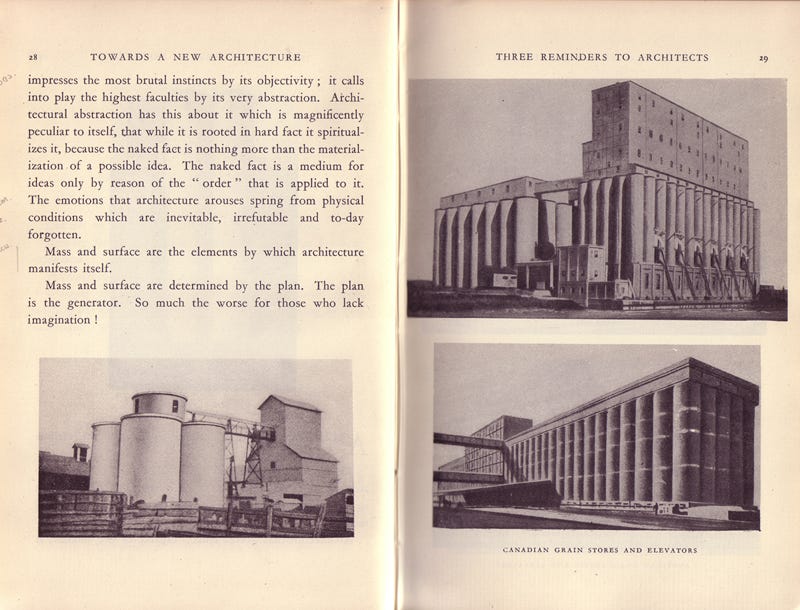
Then in 1924, Erich Mendelsohn, a German-Jewish architect enamored of the American grain silo, got on a boat to see them himself in Buffalo. Mendelsohn viewed architecture through an organic and rhythmic lens, inspired by his love of classical music. He marveled at structurally unified buildings that captured movement, machine-age progress, and modern industrial life. He wrote home to his wife about the size of the silos and the loud working mess of the place. He called them his silo dreams.
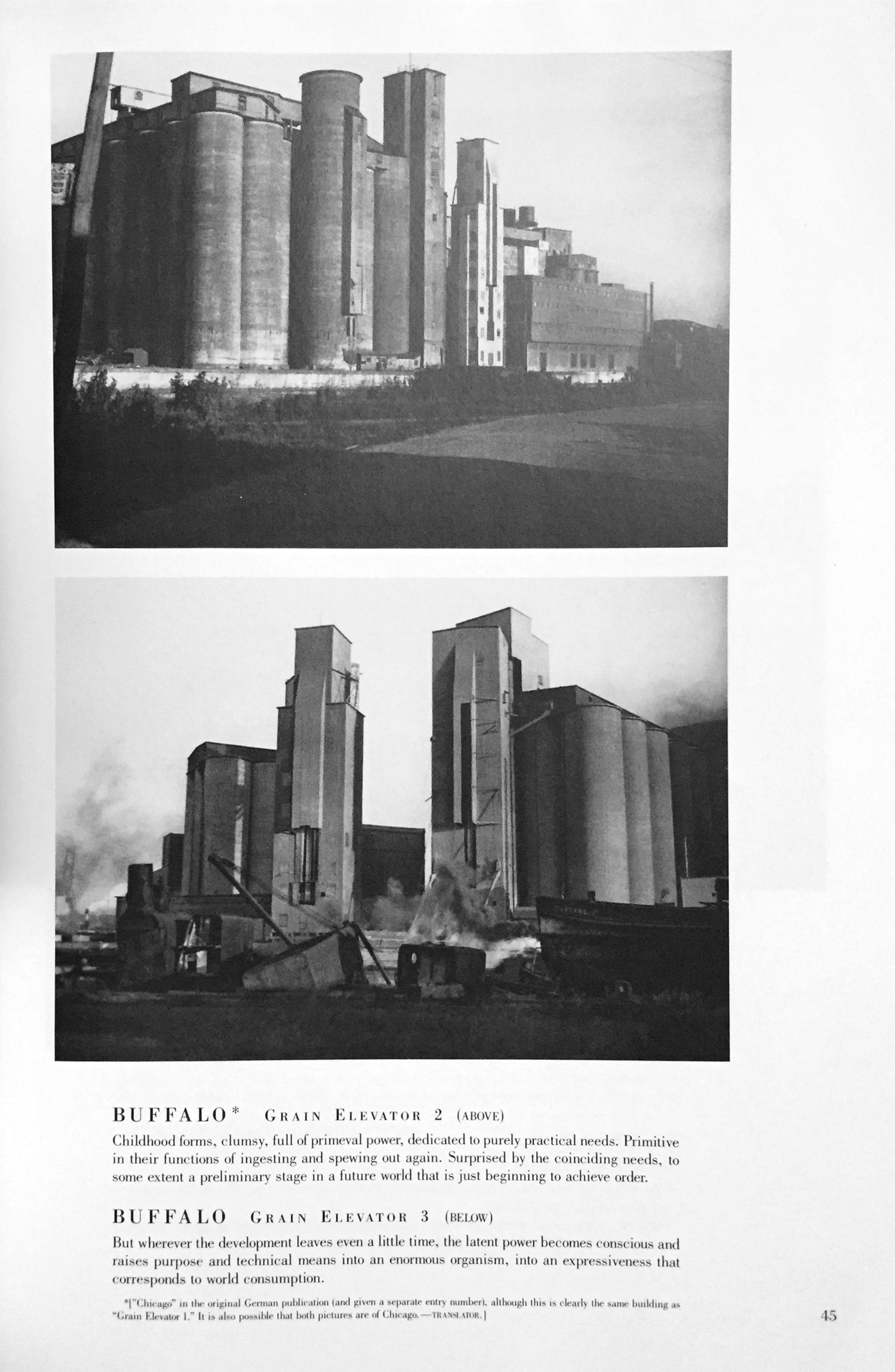
Mountainous silos, incredibly space-conscious, but creating space. A random confusion amidst the chaos of loading and unloading corn ships, of railways and bridges, crane monsters with live gestures, hordes of silo cells in concrete, stone and glazed brick. Then suddenly a silo with administrative buildings, closed horizontal fronts against the stupendous verticals of fifty to a hundred cylinders, and all this in the sharp evening light.
I took photographs like mad. Everything else so far now seemed to have been shaped interim to my silo dreams.
Mendelsohn sounds as if he is describing a lunar base, but he is standing in the mud admiring a grain elevator filling the silos with corn. Nobody sat down to design the silhouette or thought of them as fruits of the new age. The shape came out of necessity. The client was the farmer’s needs. Yet architects in Europe crossed the Atlantic to awe at our farm equipment as symbols of the future.
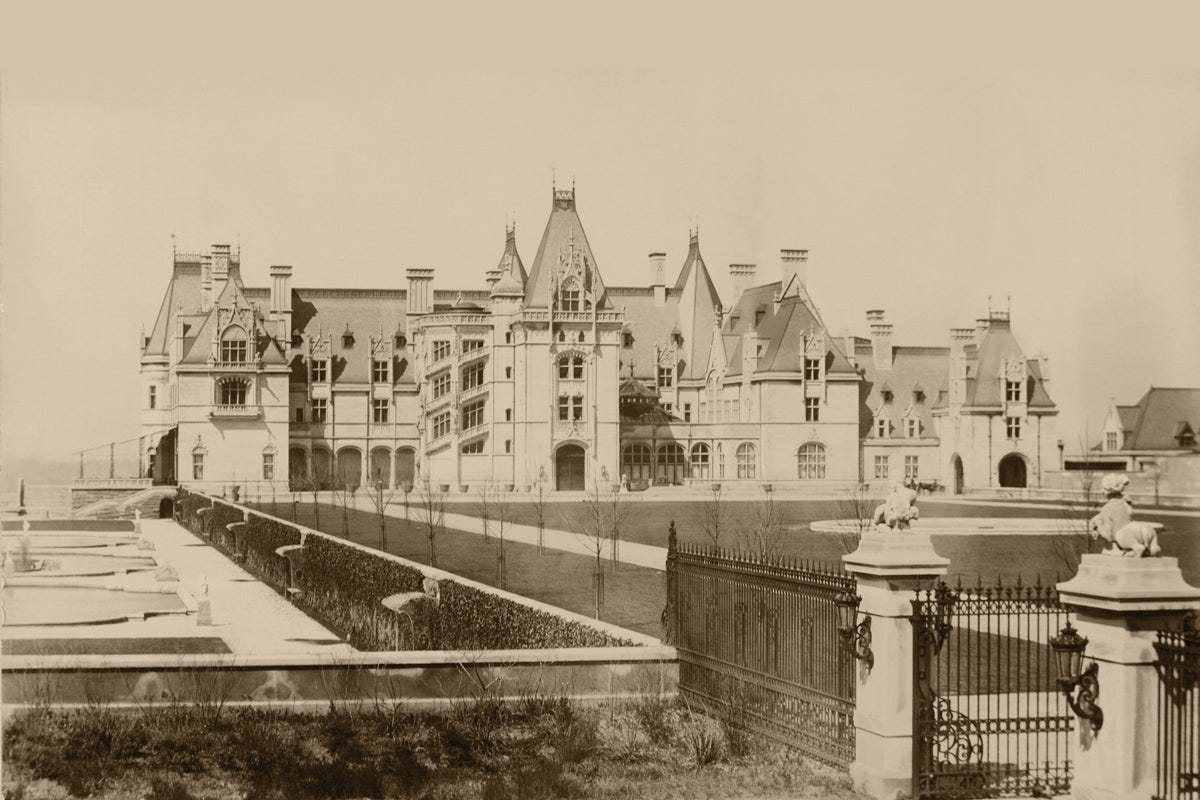
The men who built America were sailing the other way. Vanderbilts. Carnegie. They paid exorbitant amounts of money to drop French chateaus onto Newport lawns and the hills of North Carolina. For Hearst, it wasn’t enough to simply build in the style of the Old World. He had a twelfth-century Spanish monastery taken apart stone by stone, packed into thousands of crates, and shipped and railed all the way to California.
Two crossings of the same pond, at the same time. Europe came here looking for the future. Americans went shopping for the past.
Two kinds of beauty
Western Civilization has produced two kinds of beauty, but the current discussion mainly focuses on one.
It is the beauty of arrival. The cathedral, the estate, the dome. It is worth defending and admiring. The times I have stood in front of one, it took my breath away.
But there is another kind. What rises out of necessity. It gets torn down or built over as soon as its job is done.
The log cabin candidate
In the 1840 campaign, William Henry Harrison built his candidacy around the log cabin. Floats carried cabins with live raccoons and barrels of hard cider; crowds sang “Tippecanoe and Tyler Too.” The image began as an insult—a Democratic paper sneered that Harrison would gladly sit out his days in a cabin with a barrel of cider. The Whigs flipped it, casting Harrison as the rugged American and Van Buren as the gold-spoon snob. In truth, Harrison had been born on a Virginia plantation and lived in a sixteen-room mansion; Van Buren grew up in a working-class Dutch family and learned politics in his father’s tavern. Harrison won, delivered the longest inaugural address in the cold, and was dead within a month.
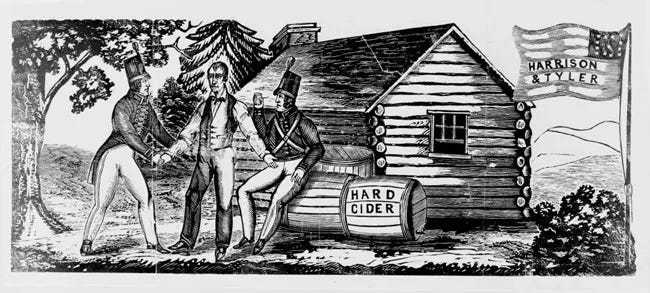
For him, the cabin was a prop. It has been a prop, in some form, for 186 years. Tucker Carlson broadcasts from one while declaring feudalism is "so much better than what we have now," because the lord is invested in the prosperity of the people he rules.

The log cabin
A lone cabin in the woods, or out on open prairie, has long been the symbol of American grit.
Four walls cut from trees that stood on your land, notched and stacked without nails, packed with a mixture of straw, pebbles, and mud so the cold couldn’t reach your family. Its purpose was to protect life so dreams could grow.
The floor was dirt. One window, two if you were lucky, for daylight. At night the glow and heat of the fireplace gave you comfort and hot meals. The cabin rose log by log in a race against the clock, against the weather, against whatever else was already living on that land.
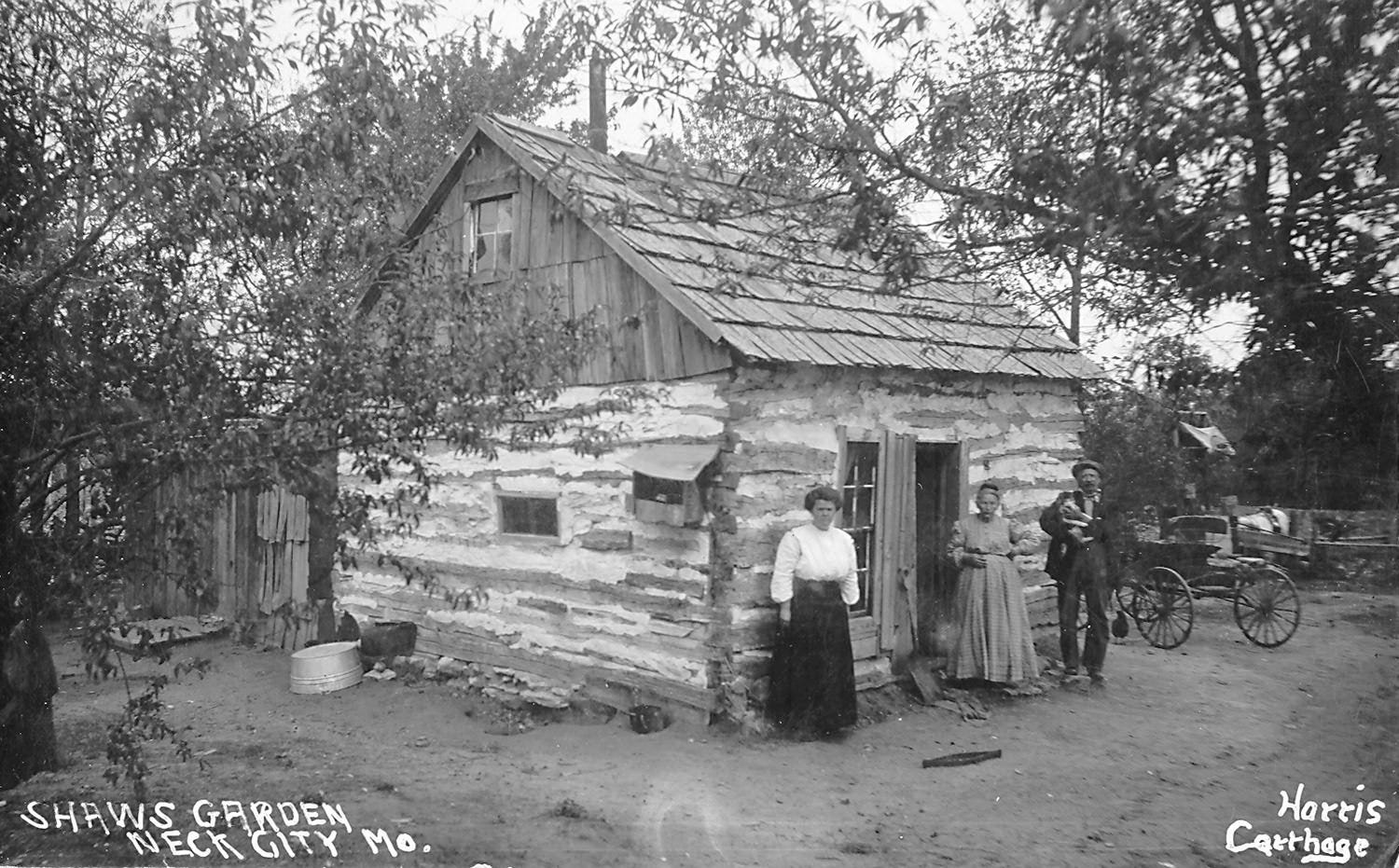
This American symbol of determination wasn’t even English. It was the Swedes and Finns, accustomed to surviving through brutal winters, who brought the cabin to the Delaware Valley around 1638. Peasant technology, focused entirely on survival. Germans in Pennsylvania picked it up before it went down the Great Wagon Road, through the Cumberland Gap, and spread into the frontier west.
No lineage. No pedigree. No Lord to grant it to you.
In their world, land was inherited or granted as a favor, decided by someone above. In America, a man walked into standing timber and carved out his destiny.
Today we romanticize the cabin as a warm, secluded place of comfort, somewhere to step away from the noise of modern life. To vacation and sip cocoa by the fire with a book. It’s become an aesthetic on social media, a symbol of status for some, a backdrop for monetization.
The cabin of our American ancestors was dark and dirty, built with blood and sweat in every notch and joint, because nails cost too much money and too much weight. Everyone lived and died in one room.
The cabin changed with the family through its life. It was never meant to stand for hundreds of years, much less a decade. It was humble beginnings, the first step, in time to be left behind or built over to grow a dream.
European beauty marks its arrival.
The cabin is the beauty of what is to come.
The price of arrival
A cathedral requires a bishop. An estate requires a Lord, and the Lord requires a King who granted it to him. Every stone at Chartres and Versailles exists because a strongman permitted it and somebody else’s back carried it—then went home to the hovel or damp cottage just beyond the walls.
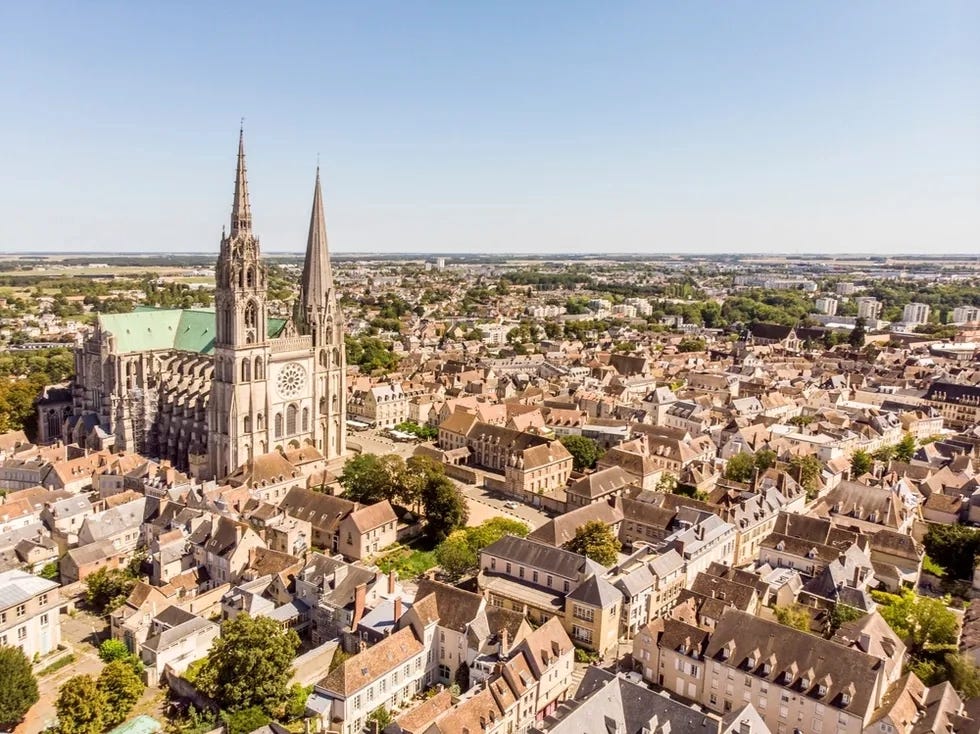
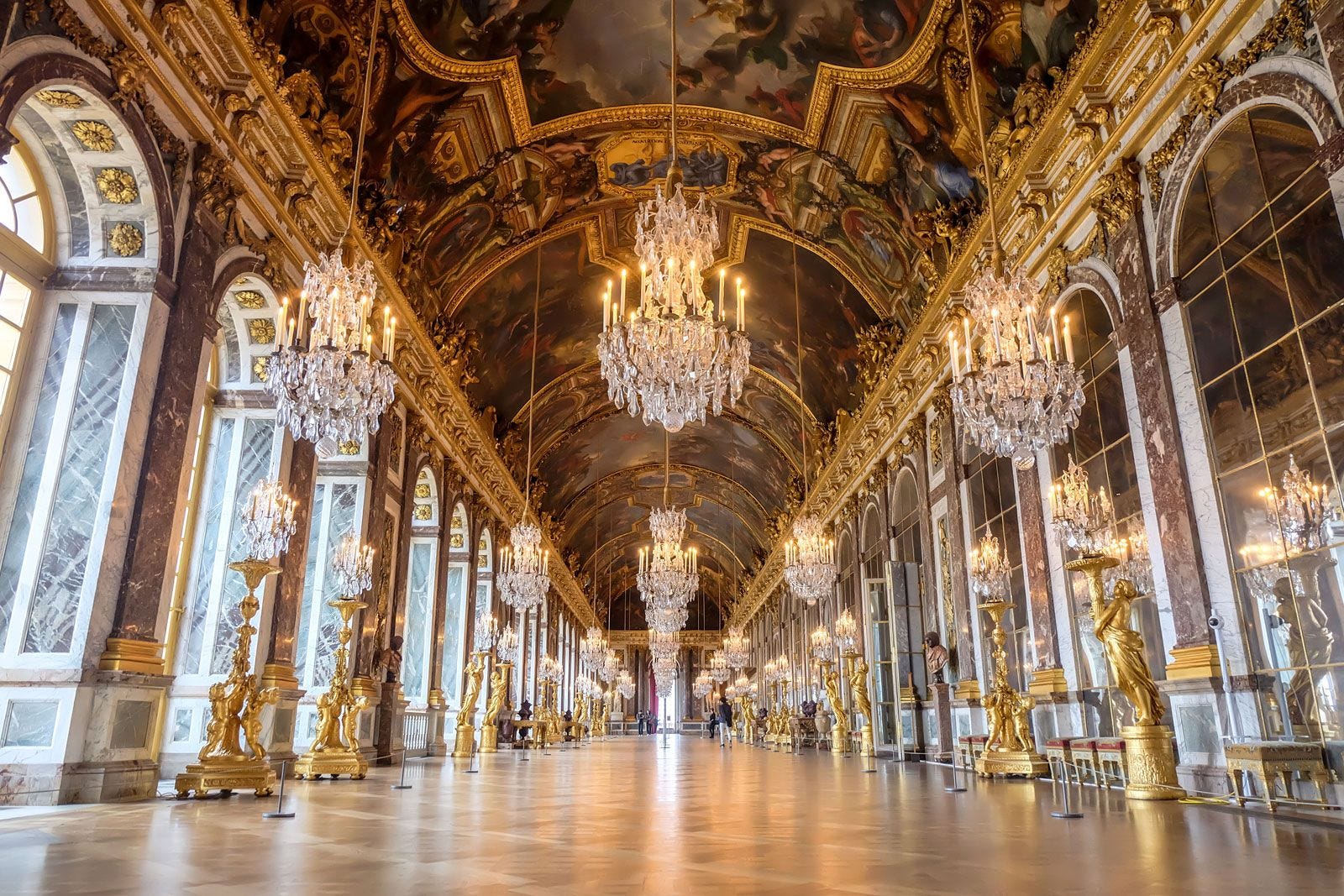
The beauty of those structures represents a fixed order. You inherited your place. Your rank decided how far into the building you were allowed to walk.
The cabin required a man, an axe, and hope.
Chartres is clearly beautiful. What I want to explore is what it cost.
When someone says we have stopped building beautiful things and points across the Atlantic, the real request is often not the cornice. It is the authority that could compel it—the willingness to trade the open field of necessity for the closed order of hierarchy. The cabin never required that bargain.
From the notch to the moon
The beauty of America is rooted in necessity that did not stop at the treeline. As the frontier cabins crumbled, America advanced.
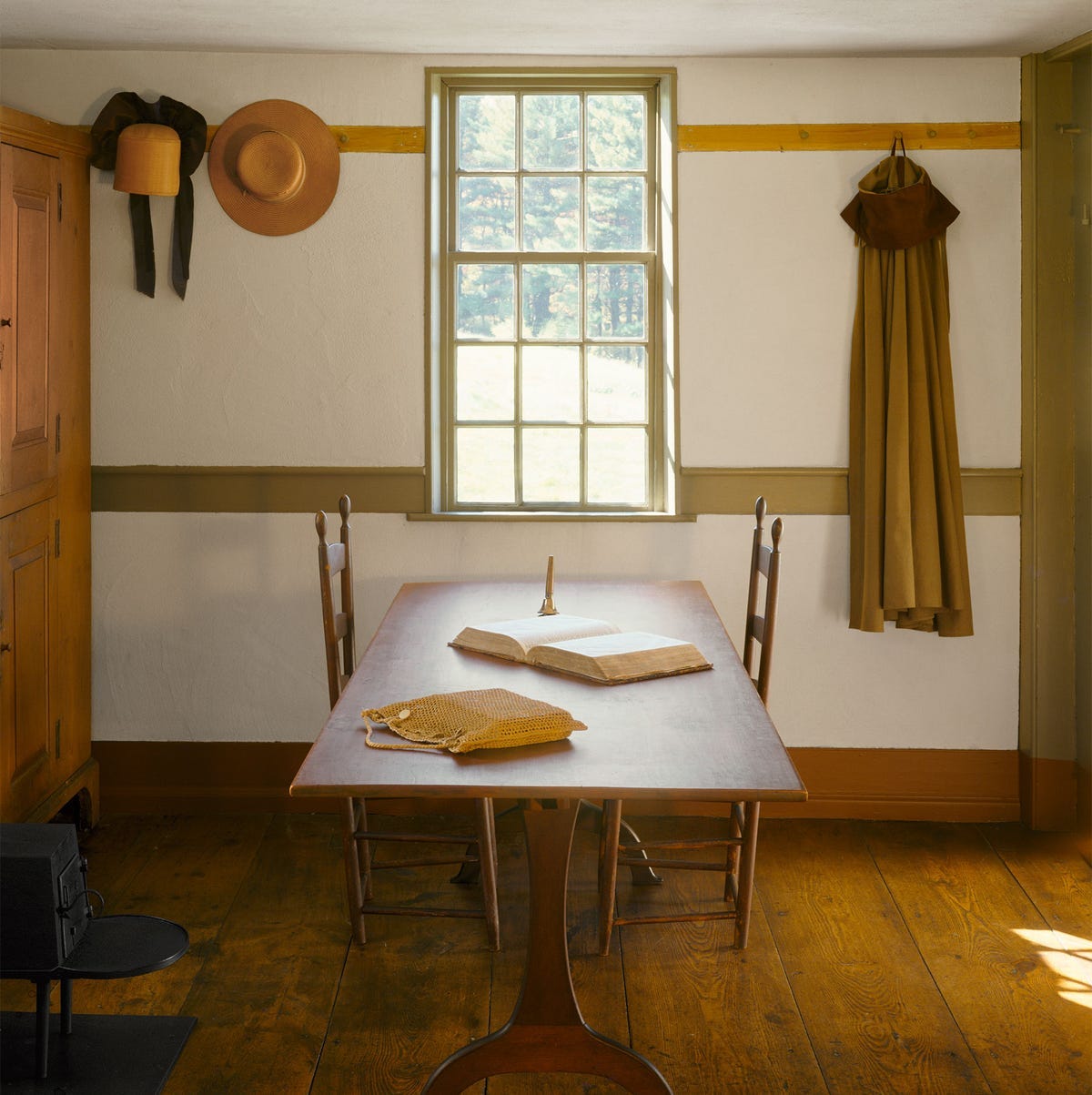
The Shakers lived by the philosophy, "Don't make something unless it is both necessary and useful; but if it is both necessary and useful, don't hesitate to make it beautiful." A peg rail ran the length of every wall so the chairs could be hung up and the floor swept clean underneath. Nothing was carved, upholstered, or added for effect. It was simple, useful, and still beautiful. Much of it is now in museums and in our homes today.
I am not claiming that everything America builds today is beautiful just because it is needed. The McMansion and the strip mall are not descendants of the cabin or the Shaker workshop. They are what happens when the old discipline of necessity disappears—one side produced quickly and cheaply with little care, the other built mainly to impress. The Shakers understood the difference. They made what was necessary and useful, and then they made it as beautiful as the work required. That discipline is the part of the American inheritance worth recovering.
The grain elevator and the barn were vital to feed a growing America. The silos were towers of industry. The barns that dotted the open plains were made from timber cut off the same land, hewn square by hand, joined with mortise and tenon and pegged. Their shape stored hay and moved the air so the crop didn’t rot before spring. Neighbors raised them in a day because one man couldn’t. They brought communities together in preparation for the harvest.
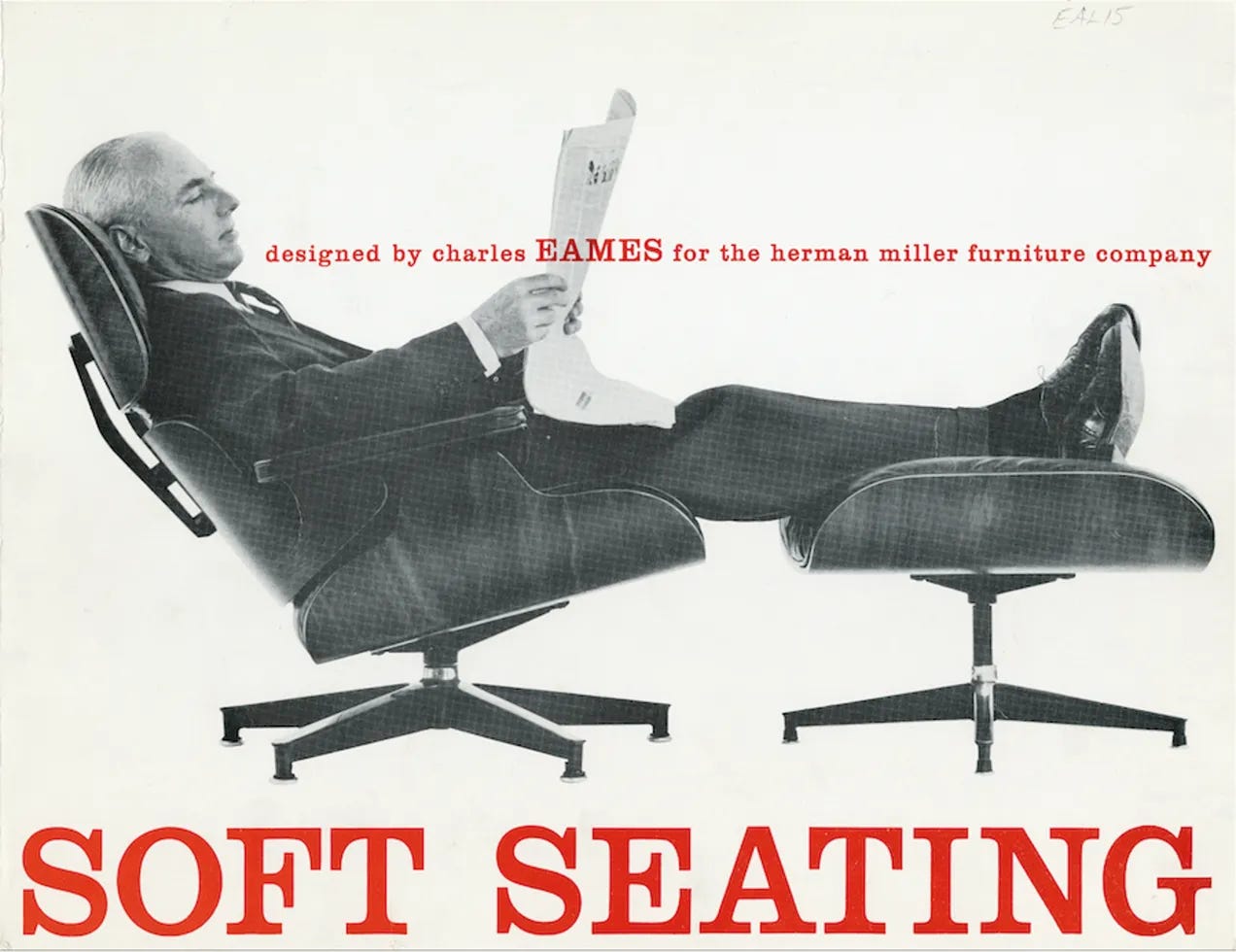
One of my personal favorites: the Eames chair, which came from plywood leg splints molded for wounded servicemen in WWII. Later, the technology was repurposed for affordable commercial furniture.

Vesta Stoudt inspected ammunition boxes at the Green River Ordnance Plant outside Amboy, Illinois. She had two sons in the Navy. The boxes she packaged were sealed with paper tape and dipped in wax to create a waterproof seal. The little pull tab tore off in hurried fingers, leaving a man picking at a box of cartridges under fire, losing a minute he does not have.
February 1943, Vesta went around every man above her with an idea—a strong, waterproof, cloth-backed adhesive tape—and wrote to President Roosevelt. She included diagrams. “We can’t let them down by giving them a box of cartridges that takes a minute or more to open.” Roosevelt sent it to the War Production Board. They approved it in weeks and put Johnson & Johnson on it. The soldiers called it the hundred-mile-an-hour tape, because it fixed everything.
It has held together race cars, film sets, hurricane shutters, and even a prom dress or two ever since. Then it went to the moon.
Apollo 13 was two hundred thousand miles from Earth when the carbon dioxide started to climb. They literally needed to fit a square peg into a round hole. With help from engineers in Houston, the crew took a plastic stowage bag, cardboard torn from the flight plan, a hose from a moon suit, and duct tape, and built a converter that scrubbed the air and saved three men.
That science project is not in a museum. It is a bag and some tape. But I am sure the astronauts thought it was the most beautiful object they had ever seen.
These are not feudal arrangements. None of this took a lord. Not the silo, not the peg rail, not Vesta’s tape, not the science project that saved three astronauts two hundred thousand miles from home. Each of them started with somebody looking hard at a problem, with nothing in their hands but what was available.
That is the American difference. What some might think looks like hierarchy in these cases was temporary coordination. It existed to solve the problem, not a permanent structure of anyone’s destiny. The origin remains individuality and freedom—someone looking hard at a problem with what is available—scaled through systems that answer to necessity, not blood. This is what is needed to revive American beauty: the ingenuity that builds what is needed and will not stop at mere usefulness.
The frontier
I do not fault anyone who stands before Chartres and asks why we no longer build like this. The longing is real. But while some keep looking to the estates and cathedrals of Europe, I want to focus on our part in the story. America is not a failed version of that beauty. It is its latest frontier. America is not about the beauty of arrival. It is the beauty of what is still becoming.
A frontier is not a rejection of the country behind it. It is the edge of it. The place where the thing keeps going because there is still somewhere to go. Everything the old world knew came over on the boats with the English, Swedes, the Finns, and the Germans, and then it hit standing timber and no lord, and it had to become something else.
I do not only admire the beauty of the buildings, the cathedrals, the estates. Those mark a civilization that has arrived.
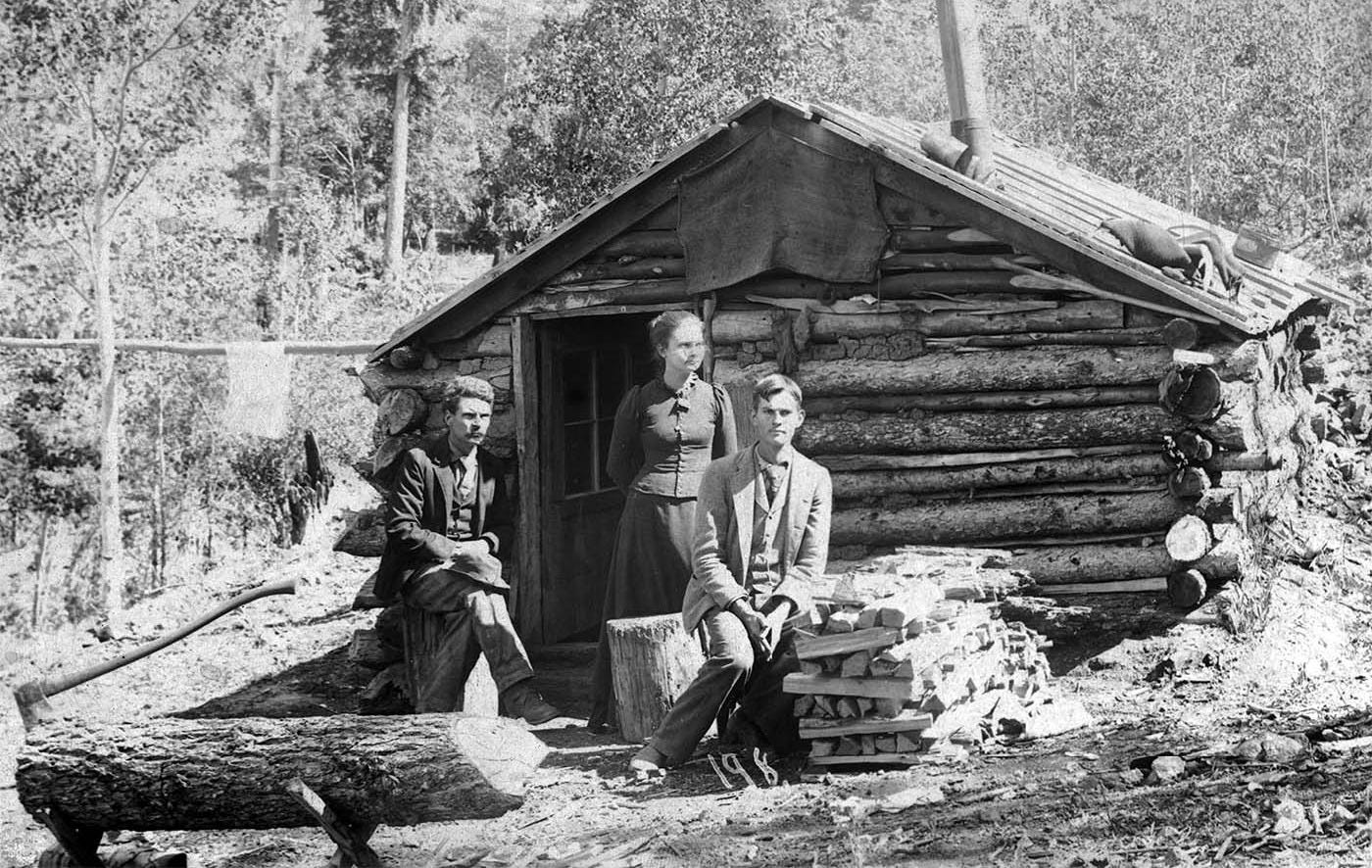
The cabin is the beauty of becoming.
If beauty can only be found in the grand buildings of the old world, it will take a “King” for their return.
I see the beauty in whatever let that man put an axe to the first pine—the one that would have to be enough to start a life.