

Tucker Carlson: Order Over Liberty - Part 1
The Pitch — how Tucker Carlson sells you a strong hand

On August 1st, Marjorie Taylor Greene posted a photo to X: a rustic dining table inside a Maine cabin — Tucker Carlson’s cabin, part of what I can only assume is a multimillion-dollar compound, all of it currently thanks to our system of capitalism. At the head of the table, with wild eyes and a thinly lined smile, sat Carlson. Around him were Thomas Massie and Joe Kent, and everyone’s spouse — except Tucker’s. The caption did the rest: “We said no more foreign wars and we meant it and supported Donald Trump because he made that promise. But he’s betrayed us all… The movement has begun.”


The internet blew up. Within hours, the photo spurred speculation of a coming third party announcement, and Greene was telling anyone who’d listen that Tucker “would beat Trump” in 2028. Everyone waited to see what he’d say next.


On Wednesday evening, he made his big announcement. Except it wasn’t a campaign. It wasn’t a party. It was a ninety-minute video — what I can only describe as a grievance manifesto — laying out his vision for 10 things America should be. It reads like a manifestation wish list. I’ll admit I agree with some of it. But the most reasonable-sounding points are there to run cover, so he can turn to you and ask, “Am I crazy for wanting a safe America?” — and then, sounding like the most reasonable man alive: “We don’t have to have a lot of rapes or murders or armed robberies or car thefts or carjackings” (47:18). It’s the same move a DSA candidate makes when she says, “I just want everyone to have healthcare.” So pay attention to what else he’s saying. Tucker is a narrative crafter, working through emotive language, strategically placed questions, and innuendo. He positions himself as a truth-teller. He is not.

To understand his wish list, you have to understand how he thinks about power. So set the manifesto aside for a moment and rewind about a year, to a much quieter conversation. Interviewing Auron MacIntyre on his podcast, Carlson said: “feudalism is so much better than what we have now… the leader is vested in the prosperity of the people he rules… if all your serfs die, you starve.”
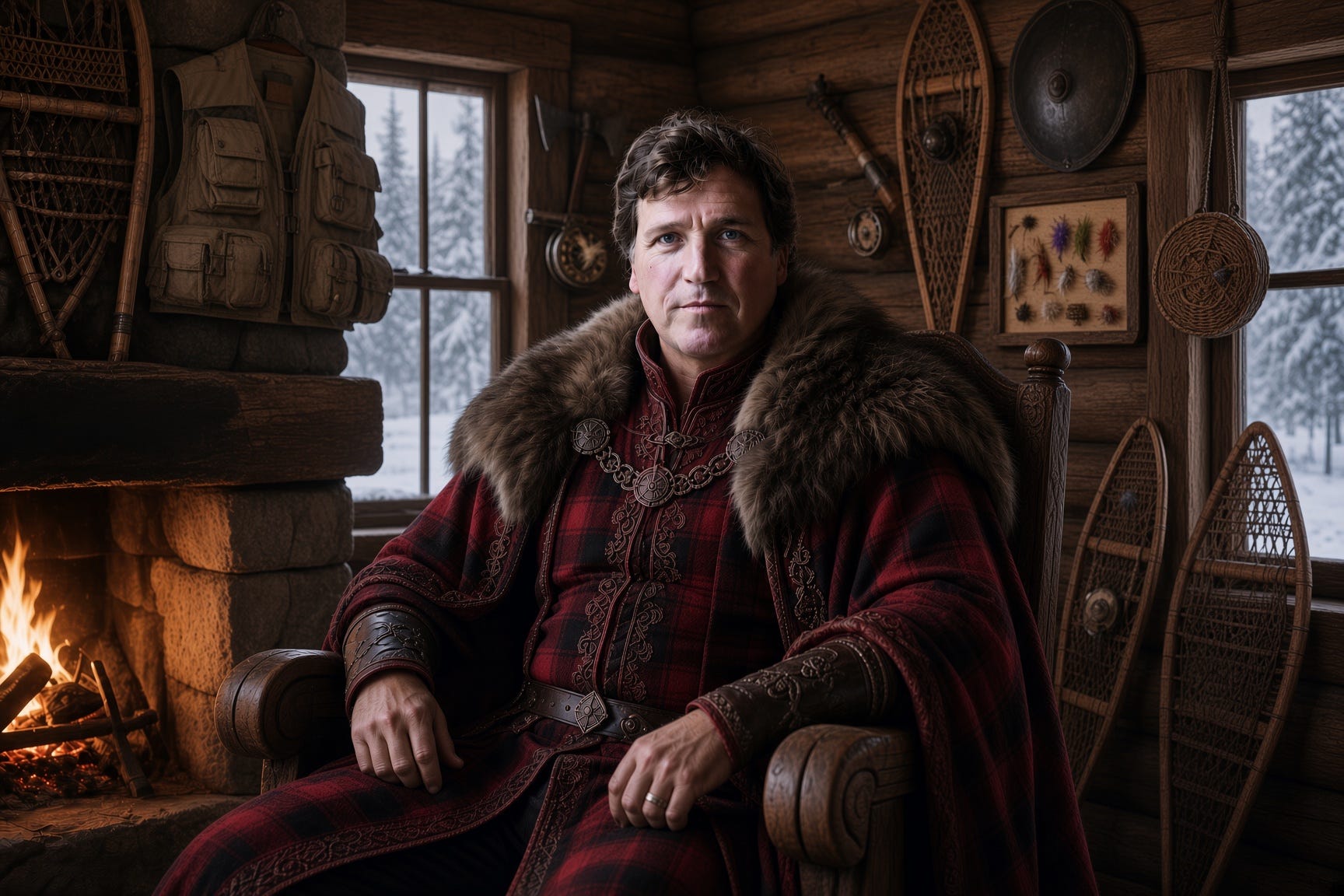
For anyone unfamiliar with feudalism: it was a medieval system where power and livelihood came from land grants, not citizenship or private property. The king handed land to his nobles for their loyalty; they carved off parts for lesser lords; and at the bottom, serfs worked land they'd never own, owed their lord labor and a cut of everything, and couldn't leave. It’s the very system our founding fathers dismantled with the founding of America. The Declaration of Independence, along with the Constitution, specifically targeted feudalism by stripping its legal underpinnings in the new states and designing a republic to prevent its return. But Carlson thinks feudalism is “much better than what we have now.”
This is a window into what Carlson values. Not how well a system protects liberty and lets most people thrive on their own — but what it produces: order, hierarchy, and a leader 'vested' in his people.
Tucker Carlson spent decades crafting a reputation in conservative media, and that reputation lets casual followers hand him the benefit of the doubt. It’s a kind of pre-vetting that works in his favor. I watched it happen at dinner not long ago. A friend brought up how much she’d always liked Tucker. Then, half a beat later, she admitted she hadn’t really watched him since Fox cut him loose. But even before he left Fox, I watched him set liberty aside for order. In 2019 he spent a segment praising Elizabeth Warren’s economic plan — yes, Elizabeth Warren. Not her politics; her economics: a new federal Department of Economic Development, two trillion dollars in government-directed industrial spending.
In a 2018 interview with Ben Shapiro, he said that as president he’d order a full stop on driverless trucks (great explainer why this is wrong) — “in a second” — to protect trucking jobs, in an industry that was already short on drivers and struggling to fill the seats it had.
Ben Shapiro: The fact that there are going to be automated cars on the road. So, would you, Tucker Carlson ,be in favor of restrictions on the ability of trucking companies to use this sort of technology, specifically, to you know, sort of artificially maintain the number of jobs that are available in the trucking industry?
Tucker Carlson: In a second. In a second. In other words, if I were president would I say to DOT, the Department of Transportation: “We’re not letting driverless trucks on the road, period.” Why? Really simple. Driving for a living is the single most common job for high school educated men in this country, in all 50 states. By the way, that’s the same group whose wages have gone down by 11% over the past 30 years. The social cost of eliminating their jobs in a 10-year span, 5-year span, 30-year span, is so high that it’s not sustainable. So the greater good is protecting your citizens…
These are not conservative musings. Now that he is off leash, he no longer hedges his positions — and as a conservative myself, I’m telling you: this man is not conservative.
Let’s check Tucker’s list against his record.
10 Words Nobody’s Against
So what should America be? Tucker shared his list with his audience: fair, sovereign, productive, beautiful, healthy, honest, optimistic, wise, decent, united.
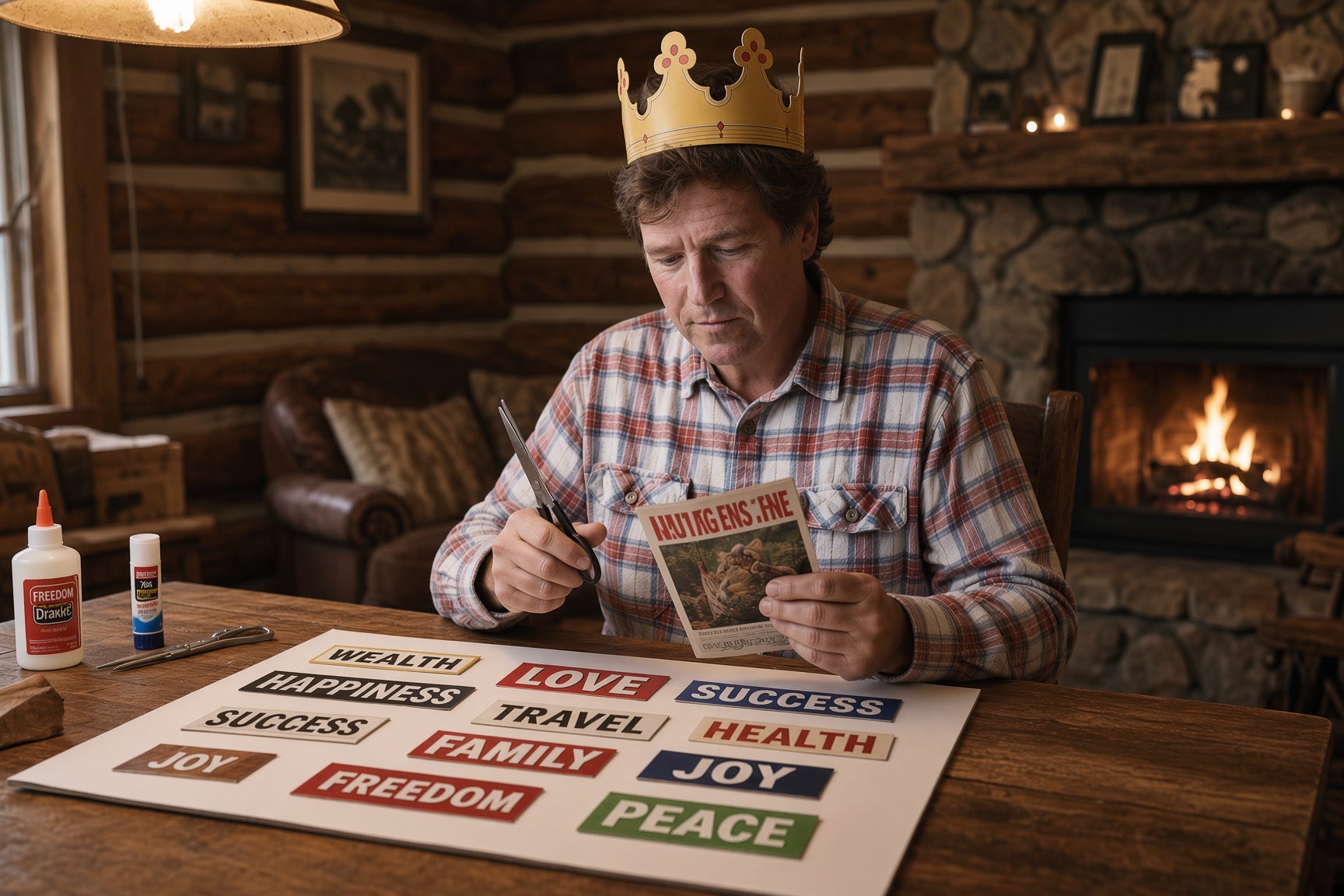
I’m sorry, but I picture him at a poster board, cutting out magazine clippings — images and these 10 words — prepping his monologue to manifest his America. Craft night at the Carlsons’. I mean, who’s against any of that? Sounds kind of awesome, right? That’s the point. They’re simple, easy to understand — what reasonable person wouldn’t want these things? How can you argue with “beautiful”? But listen closely, and there’s nothing to grab onto. No solutions. That’s exactly why the list works: it’s a vision board in podcast form. 10 words nobody could stand up and oppose. 10 words that commit him to nothing.
Fair is the first word on the board. How does America become “fair”? By what mechanism? Who decides what is fair, and with what limit on their power? He never says. And he doesn’t have to, because he’s already told you he doesn’t believe in mechanisms. Not even fifteen minutes into the monologue, he blackpills. “There are no political solutions to anything, really, in any system,” he says (11:41). Trying to fix the country with “technocratic solutions is by definition doomed to fail” (13:33). And even a third party — the thing everyone keeps asking him about — isn’t the answer: “Will that be enough is the question. And the answer, the hard answer is no” (11:25).
So what are we doing? His plan is words and incantations. Tell the truth out loud, and — ta-da! — the country heals. That’s it. That is all he’s got. No, seriously, that is the big plan.
It is very easy to describe a beautiful, honest, united America from a million-dollar cabin in Maine. It does not cost him anything, and he makes no commitments. The 10 words are niceties. But his true views come out in what’s between his words.
The Order He’s Selling
What about “beautiful”? Surely we all want our cities and lands to be beautiful. Nobody thinks graffiti and needles on the sidewalk are good. Clean beats filthy. A pretty building beats a concrete bunker. Okay. But watch where Tucker takes it.
He describes the American surveillance state in full — the cameras, the biometrics, “a totally comprehensive surveillance state” where “there’s nothing you do that the authorities can’t find out about” (46:01) — and he isn’t alarmed by it. He’s annoyed it isn’t doing more. “As long as you’re gonna live in a much more efficient East Germany,” he asks, “why wouldn’t you get rid of crime?” (46:40) Crime is “all optional.” You could “fix that in a day” (46:57).
Yes, he’s complaining about the surveillance state, and I’m no fan of it either. But we haven’t come close to the U.K., China, or the UAE, and here, at least, there’s still real opposition to expanding it. So pay attention to what he’s really mad about.

Because the places Tucker holds up as clean, safe, and beautiful are the ones with the most eyes on them. He toured the Moscow subway on camera and marveled that it was “perfectly clean and orderly — how do you explain that?” That subway runs one of the most aggressive facial-recognition systems on earth — the same one Russia uses to track down protesters and men dodging the draft. The Gulf states he praises for their order and low crime, the UAE among them, are wall-to-wall cameras and biometrics. Those clean streets are because of the surveillance state.
So what’s actually bugging Tucker about “East Germany”? It's not the spying — it’s the lack of benefits from the spy. The lack of clean streets and good behavior. If he was in charge of the cameras, the files, the whole machine, he would be good with it if he gets his desired order.
He knows how that sounds, so he beats you to it: “Why is it bad to demand order — not fascism, the opposite of fascism?” (47:56) But he doesn’t say what the opposite of fascism is. So, like Russia?
“United” is where he gets specific, and here I’ll surprise you: I agree with a lot of it. He wants to sharply curb immigration. Agreed, it is important for protecting our economy, our resources, and our national security. A country that won’t control its border isn’t serious about any of them. He wants English as the national language, with ballots and federal documents in English only. Agreed, a country with no shared language is destined to divide.
But then he says something that stops me cold. Where a shared national identity doesn’t already exist, he says, “one will have to be created” (1:29:16).
Created? Create what, exactly? We are not a blank country waiting to be handed a personality. America has a lot of personality; it’s one of the reasons the Euros kind of hate us. We have a Constitution. We have founding principles. We have generations of tradition and culture that already spell out what it means to be an American. That is the thing every immigrant should have to respect — and more than respect, be willing to live by. We don’t need to invent an identity. We need to preserve the one we have. You know, conserve it.
And here’s the thing: he never actually says what needs to be created. Asked to name it, he punts — “somebody needs to begin work immediately on one question… ‘What unites all of us?’” (1:36:39) — and ends the whole manifesto on a promise instead of an answer: “What does it mean to be an American?… we will be trying, and we’ll tell you as we continue to do that” (1:38:09). Read that back. He wants a national identity created to hold the country together. Create what? He doesn’t know either. He only knows it should be built — and that he’ll be the one to tell you later what it is.
So why does he reach for “create”? If he wanted to conserve America, he would start by naming what’s already here and worth keeping. Tucker skips all of it and grabs his scissors and vision board.
Creating where something already exists requires dismantling what is already there.
The Blackpill
Here’s the thing about selling people order: first you have to convince them the alternative is death.
That’s what the opening stretch of the manifesto is for. Before Tucker ever begins to list his 10 words, he spends a long time proving America is finished. Not struggling. Not fading. Finished. We’re staring down “the two greatest threats, arguably in all recorded history” (2:15) — nuclear war and AI — and a government too “paralyzed” to manage either. The whole system is “bound for probably pretty imminent destruction” (6:22). “Any system that elects 80-year-olds to run the place… is not long for this world” (6:28).
Some of that lands. It gives you those feels in your gut — especially the AI part — and I’m not going to stand here and tell you your worry is silly. I know you are worried. But I don’t share the doom. Yes, we need to be responsible with this technology. No, I don’t believe it’s the end of the world. We’ve been here before. Every generation or so, America gets handed some invention that’s supposedly going to end us — electricity, the automobile, the atomic bomb, the computer, the internet — every time, we figure out how to live with it and come out better off. I will take that bet.

And nuclear war, what is he talking about? When Tucker warns that a president is “openly threatening” to eliminate a civilization, he means Trump (3:47). Obviously, this isn’t new. In June 2025, as Trump moved on Iran’s nuclear program, Tucker was out front insisting it would trigger World War III — and he has since escalated to calling the president flatly “homicidal” or even the “anti-Christ.” The vibe is apocalyptic. But the world war he promised us then never came. If anything, the president has demonstrated the opposite, literally. There isn’t one. What Tucker has displayed is an emotive freak-out dressed up as prophecy, built to tear the president down and sell you the downfall, to justify his claim that something new can be “created” in the wreckage.
And the eighty-year-olds? Sure, it’s a real problem that our government has been run by the very old. But — not to be heartless — that problem is kind of solving itself. Look at the names lining up for 2028 on both sides. The geriatrics are out. He’s describing a problem with a built-in expiration date as if it were terminal.
Follow the guided tour. By the time he starts describing the America he wants, he has already spent an hour convincing you that the America you have is collapsing, and not worth saving or conserving.
It is all to prime people for the next step. A person consumed by hopelessness will sign off on things he’d never touch. Break the glass, suspend the rules, hand the keys to whoever has the best pitch. Feudalism is not a solution if you believe the republic is healthy — but if someone’s spent ninety minutes convincing you it’s already a corpse, you would consider it.
That's the setup: the despair that makes a person reach for a strong hand. Next, the villain he needs you to fear, the economics hiding under the flannel, and the name for what he's actually selling.
Part 2 — The Payload — will be out Thursday for paid subscribers. If you want the rest, upgrade below.
Share your thoughts in the comments! I am sure you have some. 😉


