

The Billionaire Baby Factories and the Law Trying to Stop Them
Xu Bo has over 100 U.S.-born children via American surrogates. He's not the problem. He's the product.

I came across a Wall Street Journal investigation from last December, and we must discuss it. It opened in a Los Angeles family court in the summer of 2023, where a clerk was working through routine surrogacy petitions, the kind of paperwork that normally gets a quick stamp and moves on, designed to unite a newborn with its intended parent as quickly as possible. Then the clerk noticed something. The same name. Again and again, on filing after filing.
She brought it to Judge Amy Pellman. The judge thought it was worth a closer look.

Pellman issued a summons. On the day of the hearing, the intended parent appeared on video. Not because he was stuck in LA traffic, but because he was on the other side of the world in China, speaking through an interpreter. He was seeking parental rights to at least four unborn children at the time. Further court research revealed he had already fathered, or was in the process of fathering, at least eight more, all via surrogates, all in the United States.
He told Judge Pellman he hoped to have approximately 20 U.S.-born children via surrogacy — boys specifically, because, in his words, they are “superior to girls” — to one day take over his business. Several of his children were already in Irvine, California, being raised by nannies while their paperwork to travel to China was processed. He hadn’t met them. His excuse? Work had been busy.
Judge Pellman denied the parentage petition. Experts described it as a rare rebuke; such petitions are almost always approved quickly and without question. The denial left the children in legal limbo: already born, already paid for, without a legal parent on American soil.

The man is Xu Bo. He makes fantasy video games. He calls himself “China’s first father” and is a vocal critic of feminism. His company’s Weibo account confirmed that through surrogacy in the United States, “after many years of effort,” Xu Bo has “only a little over 100” children. His ex-girlfriend, Tang Jing, put the figure at more than 300, living across numerous properties in multiple countries. Xu Bo’s company disputes this. Xu has previously accused Tang of theft, and the two are involved in ongoing lawsuits. In a 2023 Weibo post, he fantasized about obtaining “50 high-quality sons.”
This case had never been publicly reported before the Wall Street Journal investigation. That’s not an accident. U.S. court proceedings for surrogacies are typically sealed, often without even a mention on the public docket. The intent is to protect privacy. The effect is to limit oversight.
So who is Xu Bo, and how did he manage it?
The Numbers First
Between 2014 and 2019, international parents’ use of U.S. surrogacy quadrupled. By 2019, IVF clinics were starting 3,240 cycles for surrogate carriers working with international parents, nearly 40% of the U.S. total, according to researchers at Emory University. Of those international parents between 2014 and 2020, 41% were from China. Over 12,900 cycles during that period involved non-U.S. intended parents, most of whom were raising children abroad. 75% of those cycles happened in California.
Not dozens of cases. Not a fringe phenomenon. Thousands of cycles, year over year, operating in plain sight.
Now consider what it actually took to make each one happen, and who built the infrastructure to do it.
The System That Made Him Possible
If you are a foreign national who wants a U.S.-born child and never wants to set foot in America, you don’t have to. The system was built for you.
Surrogacy agencies. Fertility law firms. IVF clinics. Escrow services. Nanny networks. Hospital pickup services for newborns. End to end, the logistics of commissioning a child from abroad have been industrialized: genetic material shipped from overseas, an embryo transferred in California, a surrogate contracted and managed through a full pregnancy, a newborn handed to a nanny, U.S. citizenship documents filed, baby flown home.
Some surrogates report never meeting the intended parent at all — the baby collected from the hospital by a stranger carrying a power of attorney document, working on behalf of a father in China.
Cost: up to $200,000 per child. Agencies typically collect $40,000–$50,000 per surrogacy, separately from whatever is paid to the surrogate herself.
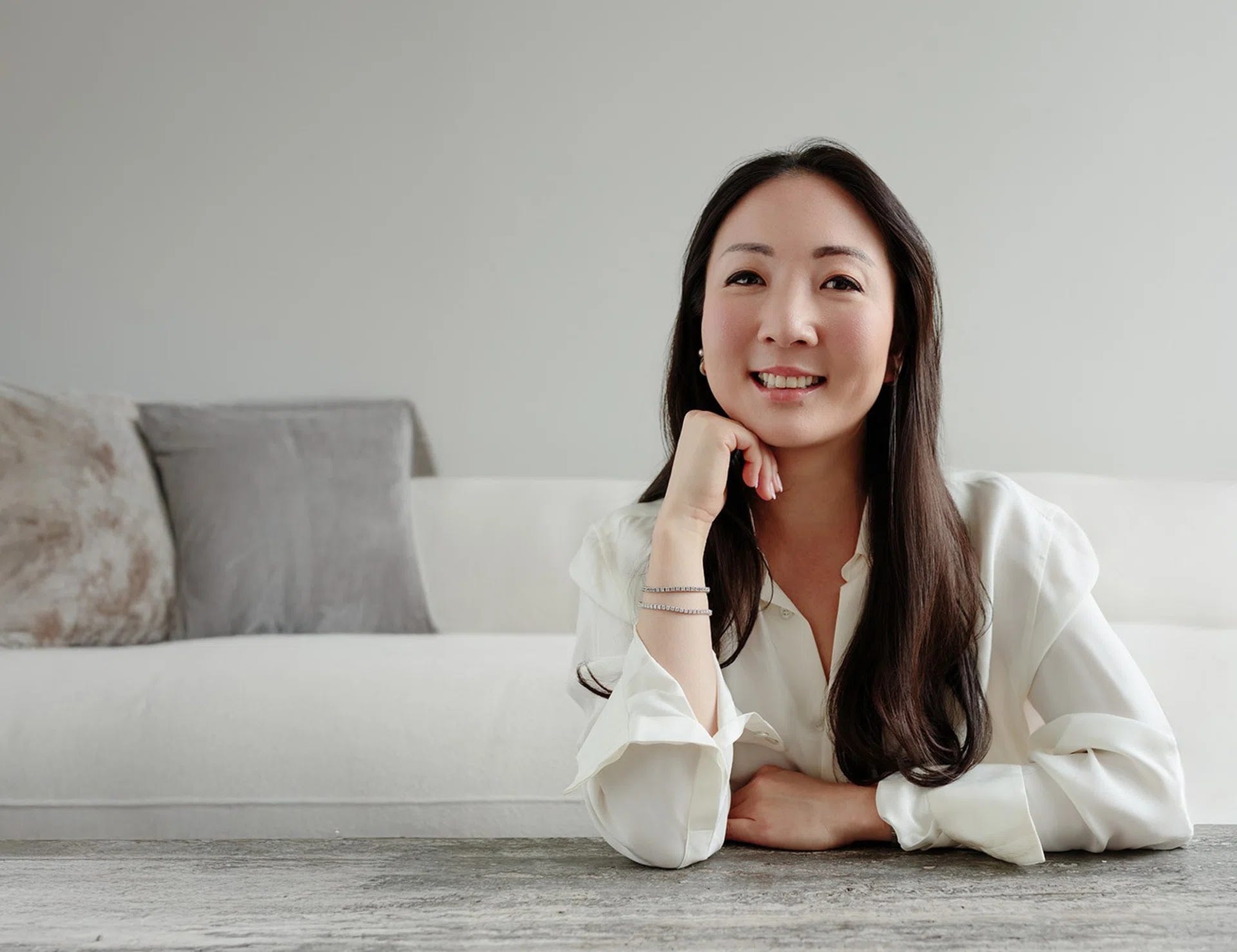
The industry’s own executives describe what they’re selling without much embarrassment. Take Margaret Wang, CEO of Rhea Fertility, backed by Peter Thiel’s family office to the tune of $10 million. Before Rhea, Wang ran Bridgewater Associates’ Singapore hub, the firm’s first international outpost. So this is not someone stumbling into the fertility industry from the sidelines. This is someone who built her career moving capital and infrastructure across borders, and who is now applying that exact same logic to reproductive medicine.
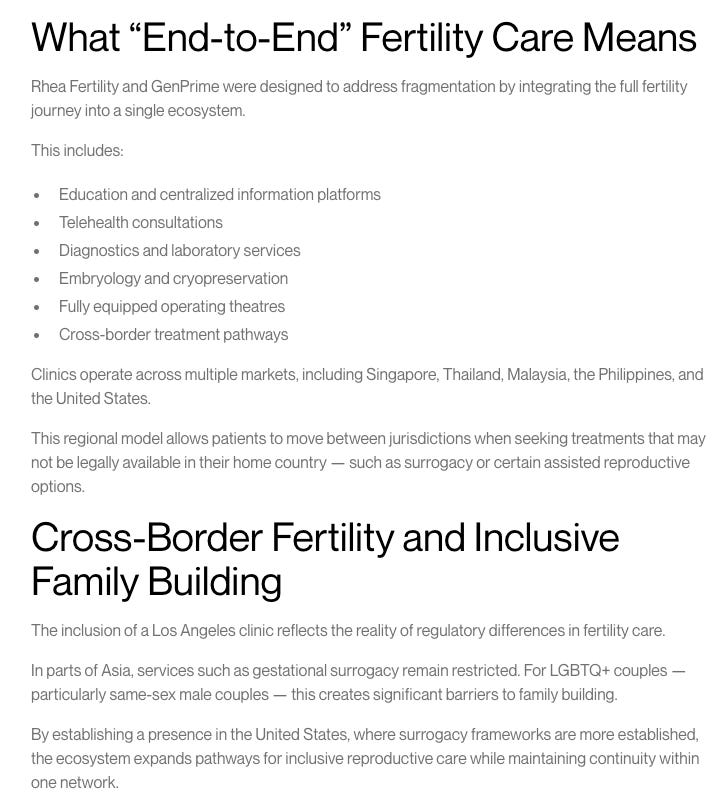
Wang has described the United States explicitly as the destination for clients pursuing “regulatory arbitrage” — her words — meaning: use American law to access services that are illegal where you actually live. And Rhea is built to operationalize exactly that. The company’s 2024 expansion is explicitly structured around connecting Southeast Asian clients to more established legal frameworks in the U.S., with Rhea’s GenPrime clinic network functioning as what the company itself describes as a “one-stop shop” — handling the emotional and logistical complexity of moving a pregnancy across regulatory environments. Headquartered in both Singapore and New York, Rhea doesn’t just broker the introduction. It manages the whole pipeline.
So when Wang says “the U.S. remains the destination for people who have the resources and need to go down that path,” she’s not editorializing. She’s describing her business model.
Nathan Zhang, CEO of IVF USA, which caters to wealthy Chinese clients out of California, has said his original clientele were “largely parents trying to bypass China’s one-child policy. Babies brought back to China, as U.S. citizens instead of Chinese citizens, fell outside the country’s penalty system.” In other words: have your child in America, ship it home, sidestep the government entirely.
Zhang also said this, about where his client base is heading now: “Elon Musk is becoming a role model.” He described an increasing number of wealthy clients commissioning dozens — or even hundreds — of U.S.-born children with the goal of “forging an unstoppable family dynasty.”
The regulatory environment is what made all of this possible. There is no federal surrogacy law. None. Gestational surrogacy contracts are enforceable in 31 states, void or unenforceable in one, and unregulated in 17 others. California, Connecticut, Delaware, Washington D.C., Illinois, Nevada, Oregon, and Washington are the most permissive: enforceable contracts, pre-birth parentage orders, and explicit openness to international clients. Cross multiple agencies, different counties, different states, and nobody is talking to each other. There is no registry, no cap, no alarm.
“Oversight of the industry is so scant,” the WSJ reported, “that it’s almost impossible to figure out whether parents are working with multiple surrogates, across different agencies and law firms.”
Joy Millan, a California surrogacy agency owner, put it plainly when asked about industry self-regulation: “The suggestion lacks teeth.”
The One Party Nobody Asked
The WSJ investigation named the billionaires. It quoted the fertility CEOs. It described the agencies by name. It did not quote a single surrogate.
The women who carried Xu Bo’s children — American women, most likely from working-class or middle-class backgrounds — are absent from the story the industry tells about itself. We don’t know how they navigated the contracts. We don’t know what NDAs they signed, or whether they were told who the intended parent was, or how many other pregnancies he was running simultaneously. We don’t know if they would have agreed had they known.
What we do know comes largely from a separate WSJ investigation into what happens when the transaction goes wrong. Nia Trent-Wilson, a Texas surrogate, lost her uterus carrying someone else’s child. She went home with $182,000 in medical debt. The parents went home with the baby. In court, a judge described her agency’s arrangement as the “contractual use of a woman’s body” for a “profit venturing business,” an honest assessment and rebuke of the industry. Surrogate compensation typically runs $40,000–$80,000 per pregnancy. The agency collects $40,000–$50,000 per surrogacy for significantly less physical risk. The intended parent, at up to $200,000 per child, is buying something. The surrogate is renting her body — for nine months, under legally binding terms she didn’t negotiate, in a transaction she didn’t design.
The Holy See put it without diplomatic softening in a March 2026 statement to the UN Commission on the Status of Women: “Many women who become surrogates cite economic need as their primary reason for doing so. It is not happenstance that stories of the rich and famous commissioning surrogates are common, whereas stories of wealthy women serving as surrogates are rare.”
The class architecture here is not incidental. It is the point. We’ll come back to it.
Part 2
Rent a Womb, Buy a Child: The Money of Surrogacy

PART 2 | In 2023, 11,000 American women were paid to carry babies for those who could buy a child and rent a womb. This is part two of my series The Surrogacy Racket. Part one was about the foreign billionaires purchasing American babies. In part two, I examine the money that funds this racket.
