

Rent a Womb, Buy a Child: The Money of Surrogacy
$22 billion a year in the belief that biological parenthood is a right — and that someone else's body is a barrier to remove.

In 2023, 11,000 American women were paid to carry babies for those who could buy a child and rent a womb. This is part two of my series The Surrogacy Racket. Part one was about the foreign billionaires purchasing American babies. In part two, I examine the money that funds this racket.

The Number That Should Make You Uncomfortable
There are many hands in the pot of the global commercial surrogacy industry, and it’s a big one. Three separate market research firms estimate 2024 revenue at roughly $22 billion, with projections approaching $200 billion by 2034. A compound annual growth rate (CAGR) of about 24.5%. That figure is the one worth dwelling on. Most established medical services that simply meet existing health needs grow far more modestly, typically in the single digits (for context, the more common assisted reproductive technology and IVF services market is commonly projected at only 7–9% CAGR over similar periods). Growth at this scale is more characteristic of industries that are actively scaling and expanding their customer base than of markets simply responding to a health crisis or need. Behind that growth is a cultural conviction that biological parenthood is a right — and that whatever stands between a person and that right, whether medical infertility, age, a same-sex partnership, or the choice to parent alone, is a barrier the market should resolve.
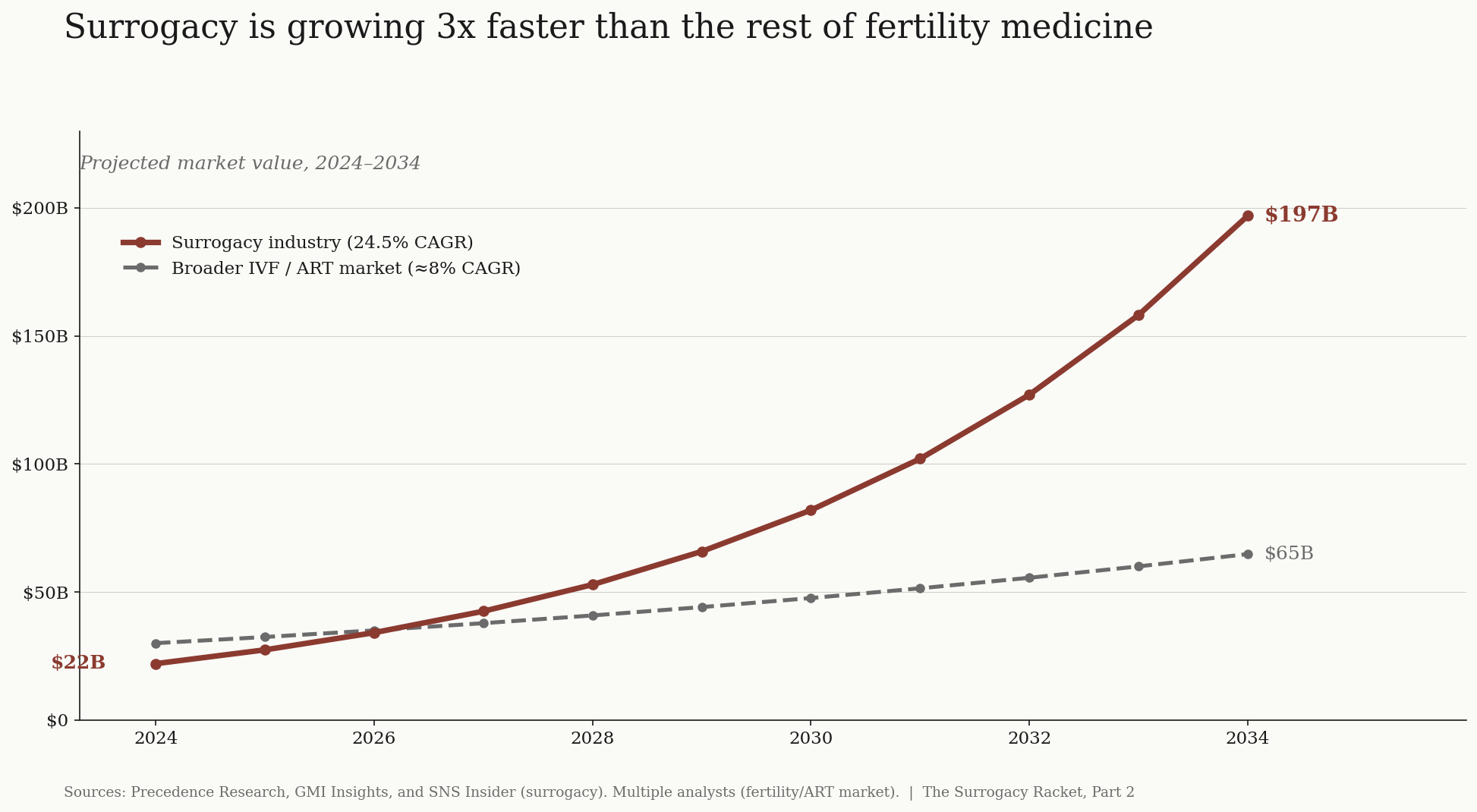
This solution comes at a cost. It’s always a woman who takes on the physical risks of carrying someone else’s pregnancy, usually for a set payment she has little say in. Her ability to have children is valued by the week and paid out when a healthy baby is delivered. By design, the child is separated at birth from at least one, and often both, biological parents. The money goes to agency fees, IVF procedures, egg donor payments, legal and escrow services, insurance, and finally the surrogate’s pay. Even though surrogate pay is the largest single expense, it’s still less than half of the total cost.
How Many For How Much
About 11,000 US surrogate embryo transfers happened in 2023, per industry data cited by WSJ, more than double the 2014 number. Average full arrangement now runs $200,000, up from $120,000 a decade ago, per surrogacy agency owner Yifat Shaltiel, quoted by WSJ.
But these are just estimates, because there’s no federal regulation of surrogacy agencies — and most states don’t regulate them either. No one knows exactly how many agencies there are in the U.S. One industry association has 155 member agencies on its rolls, while Alcea Surrogacy founder Angela Richardson-Mook’s own market research puts the total closer to 1,100, meaning the industry’s membership organization has access to roughly 14% of the agencies operating in the country. Leaving a big blind spot.
With each arrangement averaging $200,000 and 11,000 happening each year, where does all that money end up?
