

Zohran Mamdani Is Laundering the Word "Socialism"
A one-week media tour turned democratic socialism into a story about free libraries. The platform behind it says something very different.

When I run errands, I catch up on podcasts. Pull up next to me on a random afternoon and you might catch me yelling at one in my car.
On Friday, somewhere between the potholes and the Knicks jokes, Zohran Mamdani told Jon Stewart that if the two of them tried to invent the public library today, people would call it socialism. A free building full of books, slandered as a Bolshevik plot. Can you imagine?

It’s a good line. So good he ran a version of it three times in less than a week.
The mayor of NYC has been a busy boy. Between July 18 and July 22, he sat for the New York Times, Rolling Stone, and Stewart’s Weekly Show. Three friendly rooms, back to back, one week before the Democratic Socialists of America gather in Chicago for their national summit. This follows increasing scrutiny on the DSA and a rise of DSA candidates winning Democratic primaries. Smells like a public relations press tour to me. Not for Mamdani. For “socialism,” in an effort to file down the sharp edges until a narrative is laundered and packaged for primetime viewing.
This guy is scary skilled at his craft. Want to see?
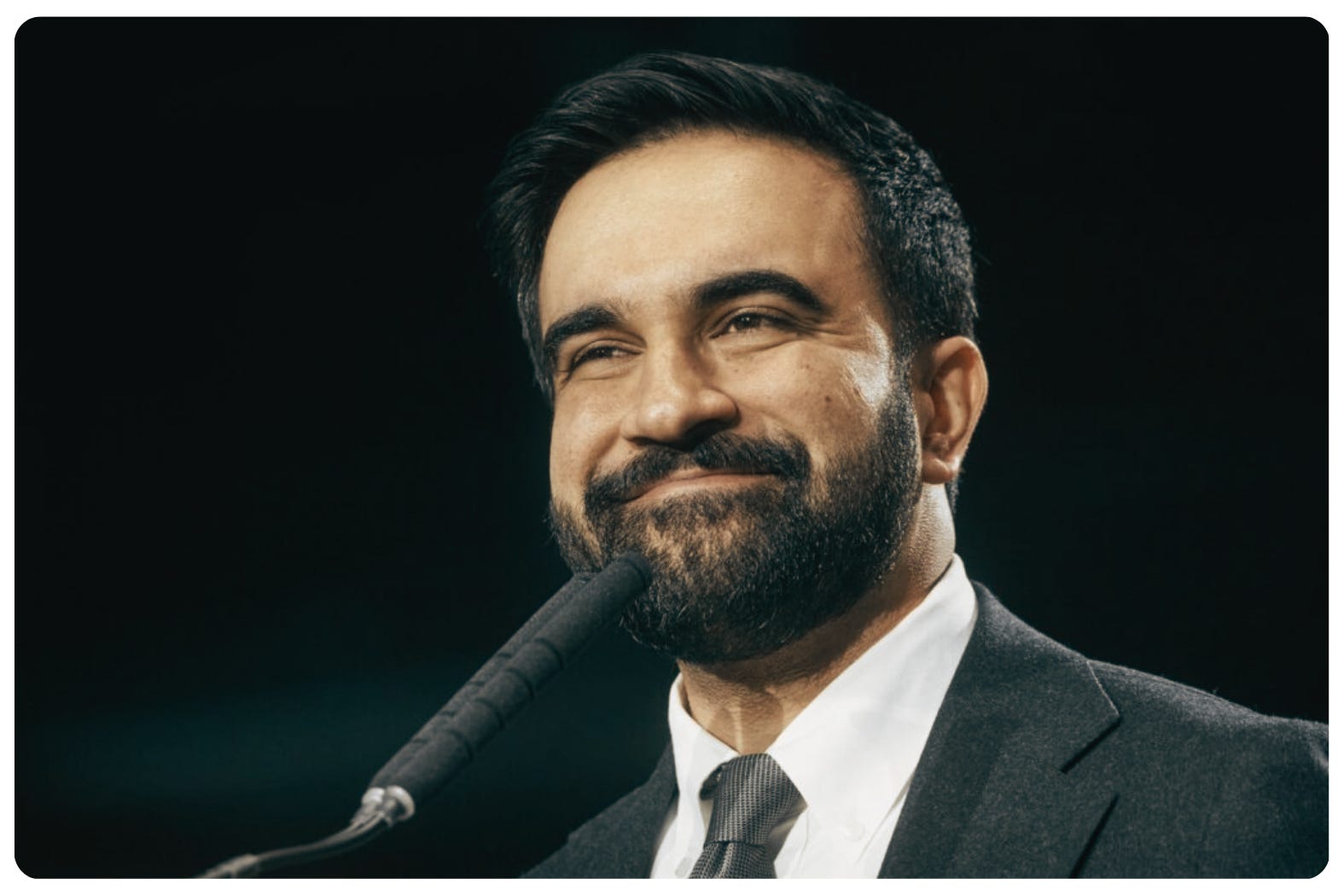
What he says socialism is
Ask Mamdani what democratic socialism means, and he turns on a smile before delivering a warm little bundle of things nobody finds scary. The library. The fire department. Public schools. Social Security. Medicare. On Stewart, he reached all the way back to FDR and Fiorello LaGuardia and said, if you go look, “you will see a lot of Democratic Socialist principles in their vision.” Social Security, he noted, was once smeared as “the Sovietization of America,” and now, although on the verge of collapse, he is quick to point out that it’s as American as anything. The implication: relax, this is just the New Deal for the modern age.
Except the library isn't socialism. Neither is the fire department. They're public goods, and they exist in every capitalist country on the planet, including ones with no organized left to speak of. Finland has libraries. So does Singapore. Capitalism is necessary for these programs to exist and be effective.
Social Security and Medicare aren't democratic socialism either. They're social insurance programs built by New Deal and Great Society liberals, who stated at the time that they were meant not to end capitalism, but to rescue it. Roosevelt signed Social Security in 1935 with Huey Long's "Share Our Wealth" (Pg. 6 - 7) campaign breathing down his neck, and the verdict that the New Deal held off a real revolt has been claimed by both the Hoover Institution on the right and the Socialist Party on the left.
While you can think those programs aged badly, that they built dependencies and ceilings of their own, the point still stands: they were designed to preserve the profit system, not abolish it. Stewart actually handed Mamdani that exact framing, telling him “what you’re doing is actually a reform movement for capitalism.” Mamdani took the compliment and moved on. He did not correct it, because correcting it would have provided another clip for what he actually believes.

He does it again with the groceries. Announcing his city-owned grocery stores on July 27, Mamdani reached back for Fiorello LaGuardia, who “spearheaded the creation of municipally owned markets” for the immigrant mothers priced out of food. Except again, he misleads and conflates. LaGuardia’s markets, Essex Street and Arthur Avenue and La Marqueta, were city-owned buildings that leased stalls to hundreds of private merchants, the same pushcart peddlers he was clearing off the streets. Those vendors set their own prices, ran their own businesses, and competed with each other. The city was the landlord, nothing more.

Mamdani’s version inverts it. Yes, a private operator will run the store, but only as the city’s instrument. The city sets “the mission, the standards and the store design,” mandates a 30 percent discount across all produce, meat, and staples, locks those prices in monthly, and writes the labor terms into the contract. LaGuardia’s grocers competed on price. Mamdani’s operator is handed a price by the city and told to beat every grocer around it. That isn’t a market. It’s a public utility in a market’s clothes, pointed straight at the private stores LaGuardia’s vendors actually were.
His flagship site is La Marqueta, one of LaGuardia’s own markets, the one that was built for 450 independent vendors, now the showroom for a model built to undercut shops like theirs. Same beloved name, same building, opposite idea. He isn’t only lying about LaGuardia. He’s laundering an ideology through him, too.
What his own organization says it is
Both the DSA National co-chair and the NY-DSA co-chair have appeared publicly to state the goals of the DSA. To use the Democratic party to gain power and to abolish key constitutional structures.

In case anyone wants to argue that these clips are out of context, the DSA wrote it down. Their binding national program is called Workers Deserve More!, and it’s posted on their own website for anyone to read.
Their goal is a “classless society” where people “labor for our common good instead of private profit.” It goes on to say, “complete victory will require building a new society from the ground up.”
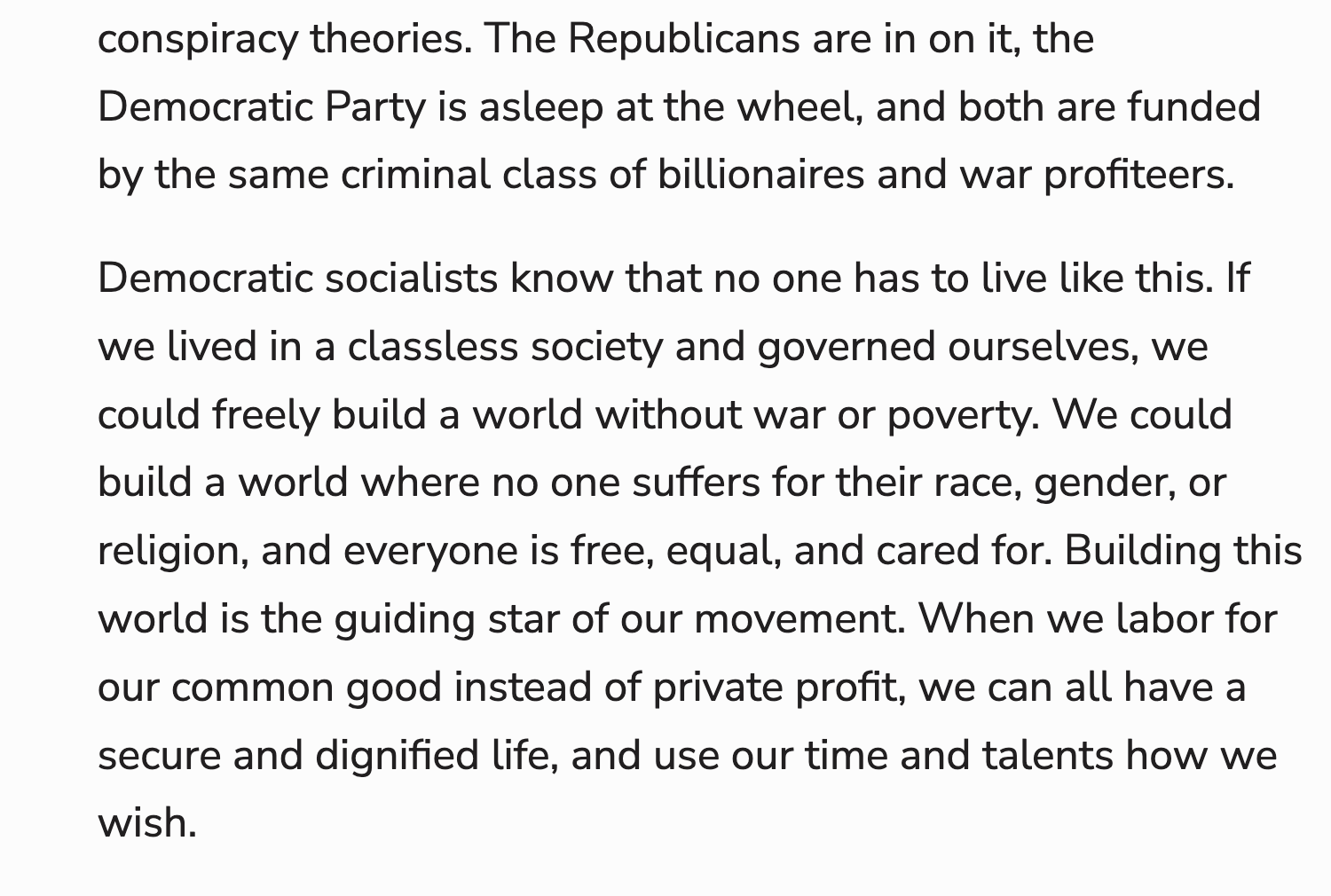
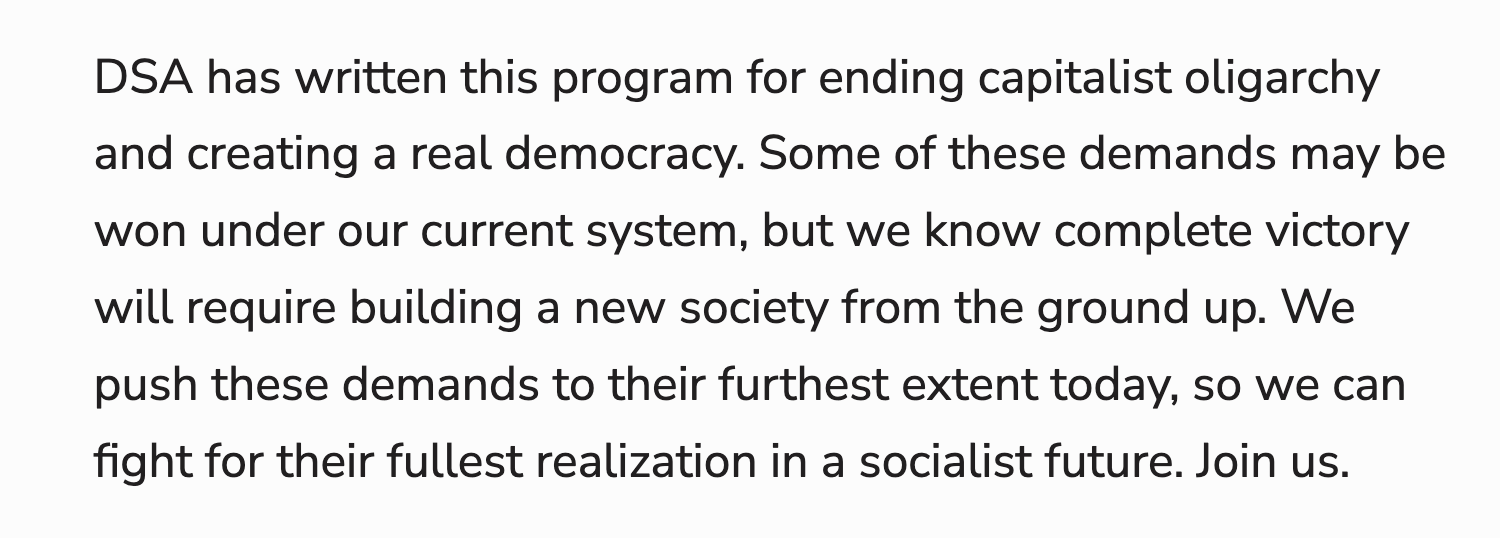
The sixteen demands include abolishing the police and the prison system, abolishing ICE with “amnesty for all immigrants regardless of status,” ending “all military and economic aid to Israel,” and replacing “the two-party system with a multi-party democracy.” It describes the Democratic Party as “asleep at the wheel” and funded by “the same criminal class of billionaires” as the Republicans.
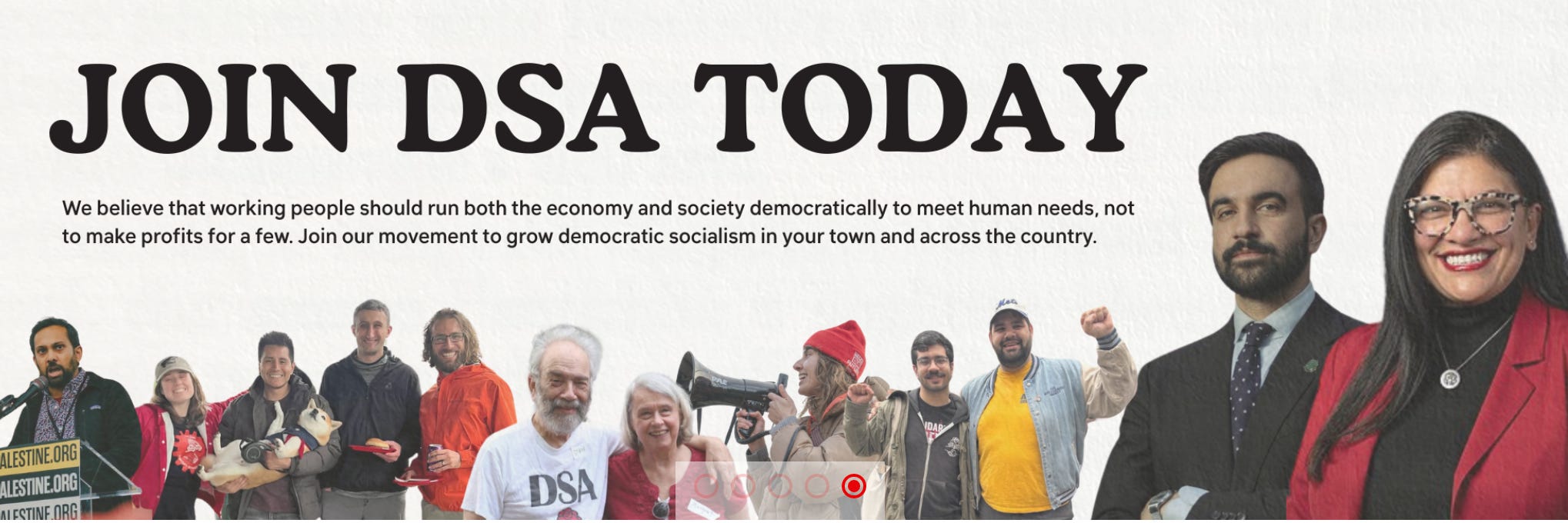
Mamdani is currently the star of the DSA; he is on their header. He knows what he is doing by putting the DSA platform behind the library speech, and because you read this Substack, you now do too. He borrows the popularity of the least controversial public goods in American life, which exist because of capitalism, then staples the socialist label onto them, and lets the actual platform stay off-camera. When Stewart practically begged him to admit it was all about the labels, Mamdani gave the tell of the whole tour: “words have lost their meaning over time.” Which has been part of the strategy the entire time. We are living through a hostile effort to make words lose their meaning. Why? Because a word drained of meaning becomes subjective and makes it possible to launder the truth and to make it more tolerable for the masses. It’s not that he lies about the library. It’s that he is laundering an ideology through it.

Currently the most immediate threat is not Mamdani; it’s the useful idiots like Stewart who platform him with no pushback. Every program Mamdani name-checks—the library, Social Security, the fire department—runs on the tax base of a functioning capitalist economy. They are capitalism’s dividends, not its replacement. So what he should have asked is, how does a man who told a socialist youth conference in 2021 that the “end goal” is “seizing the means of production” plan to fund the fire department once he’s done seizing the means of production? Instead, Stewart nods in agreement, reframes for his audience, and distributes socialism for the masses.
The receipts, and the retouching
People will often say, “just do something.” Mamdani sells himself as the guy who does that. Potholes filled, rents frozen, childcare delivered. Mamdani is doing something, but the question remains: will these things deliver?
Mamdani was very excited about potholes, so let’s start there. “More than 170,000 potholes,” he told the Times, “50,000 more than the prior administration by this point.”
The city documented its 100,000th within his first hundred days, a real and rapid pace. Which made me wonder what that number is actually counting. DOT doesn't publish a size threshold, or a severity one, or any real definition of what makes a pothole a pothole. A "fill" just means a closed work order. Patch five holes on one block, log five fills. When the Comptroller audited the program, the finding was that repair orders got "closed numerous times, possibly overstating productivity," and DOT was told — in writing — to stop counting temporary patches as finished repairs. So the city is counting effort. Whether the streets are any better, I guess we’ll have to wait till after Christmas.
Winter was brutal this year, opening holes faster than crews could close them; complaints tripled past 30,000, and the backlog kept climbing. The one thing that actually keeps potholes from forming is full repaving, and repaving has been flat or worse. The City Council's own budget analysis has resurfacing sliding from about 1,200 lane miles in 2023 to 1,168 in 2025, still dropping into 2026, hundreds of DOT jobs sitting empty the whole time. Mamdani inherited this problem, then built a “blitz” campaign around patching instead of repaving. A cold-patch fill lasts about a year. A repaved street lasts ten. Guess which one provides the fastest photo-op. As one Staten Island councilman put it, taking credit for filling potholes "is like taking credit for changing a lightbulb. It's what you're supposed to do."

If there is one thing a socialist loves, it’s saving money, or at least claiming they are saving money. He told Stewart his Chief Savings Officers "found about $1.7 billion in savings." They didn't. The $1.7 billion is a target, and nobody has “found” it yet. His own April update put the amount actually identified at around $200 million — twelve cents on every dollar he promised — and part of that was canceling a Slack subscription.
Same move on crime. All three interviewers hear that he delivered "the lowest recorded number of murders and shootings in New York City's history," except the NYPD's own release says the record is for only the first half of the year. He drops the "first half.” Will we be hearing about the second half?
The story where the policy should be
When the numbers aren’t in his favor, he deflects with a story, deploying his smile and empathy. And he has a rotating cast. The man walking out of a bodega with two packs of Huggies. The Harlem barbershop where everyone has papers, and everyone’s still scared. The tenant with twenty years of rust falling off her pipes. These are vivid human stories, and they arrive at the exact moment he doesn’t have a straight answer.
That’s the function. The story does the emotional work, providing an opportunity for the policy never to face a challenge. Take the rusted pipes. An image of real suffering, but ask why the pipes rotted for twenty years. Could it be an evil landlord? Sure. But statistically the truth is somewhere Mamdani would rather not go: a rent-stabilized building where the rent doesn’t cover the repair, wrapped in a permitting and violation regime that makes fixing the thing slower and costlier than letting it rot. His solution? To freeze the rent further and threaten to seize the building.

The same goes for the barbershop. What’s the truth? The men in that shop have status. They're documented. They are not who ICE is looking for, and yet they're terrified; why? Because every news report and their mayor tells them to be. And the solution avoids the question an actual mayor has to answer. New York refuses to cooperate with federal immigration enforcement, and Mamdani's own standard for when it will is the giveaway: the city works with the feds, he told the Times, only "on more than 170 serious crimes if someone has been convicted of them."
Short of that conviction, someone here illegally who then gets arrested is not handed over. He sells that as protecting the innocent. It also happens to coincide with the DSA's ultimate goal of abolishing ICE and eliminating borders. He frames it all as compassion and empathy but never asks what the ultimate outcome is.
The soft rooms
He needs friendly venues, because the whole strategy depends on nobody making him define his terms.
Stewart’s “interview” was an infomercial with a laugh track. He built the “caricature versus the grounded reality” frame and handed it to Mamdani, fed him the FDR parallel, called him “the fiscal conservative” — I know, hence the yelling at the podcast — and when he raised the one genuinely hard thing, the movement’s appetite for abolishing prisons and borders, Mamdani waved it off with a joke: "if you have more than one socialist in a room and there isn't disagreement, then you don't have more than one socialist in a room." He never said whether he holds the position himself, and Stewart laughed and never circled back.

He didn’t have to. A month earlier, he’d endorsed Darializa Avila Chevalier for Congress, who in her own since-deleted posts called to abolish the police, prisons, and borders, and she won her primary. After the mayor left, Stewart’s own producers narrated the magic trick out loud: “I don’t know how much I would be aware of that has changed in the past six months if it wasn’t for such an effective media strategy.”
Rolling Stone ran his campaign slogan as the headline. “If You Aren’t Willing to Fight You Will Never Win.” Jack Crosbie told him, on the record, “You’re good at this. Everyone who has seen you, met you, interviewed you says the same thing,” then spent the back half of the interview on Arsenal and Tower Records and Kacey Musgraves. It was like watching two girls skimming the pages of Tiger Beat.
Finally, Lulu Garcia-Navarro at the Times. Most times the paper is trash, but she’s a real interviewer and the value of that show is that people from every corner of the spectrum will actually sit down with her. She pressed and called Mamdani out on his dodge to his face: “I’ve noticed that when I’m trying to get specifics, you deflect to talking about what New Yorkers do and don’t want.”
She went four rounds on whether an asylum seeker can claim asylum at the border and never got an answer. She flagged the weak job numbers. But she’s no bulldog either. She opened by letting him run the highlight reel (the potholes, the “lowest crime in history,” the childcare math) without touching a number, and she tossed her share of softballs, from the magic-wand question to whether he’d landed a Taylor Swift wedding invite.
But each played their part. Stewart the useful idiot. Rolling Stone the cool bud. And Garcia-Navarro, who ran the toughest room of the three, still let plenty slide.
The press hands him the detergent
But this clean-up job doesn’t work without some help from a silent partner: a legacy press that runs its corrections in one direction only.

Exhibit A aired on CNN on June 27, a month before the tour even started. Kaitlan Collins, pushing back on Trump for calling democratic socialists communists, told her audience that “socialism, much less democratic socialism, is not communism.”
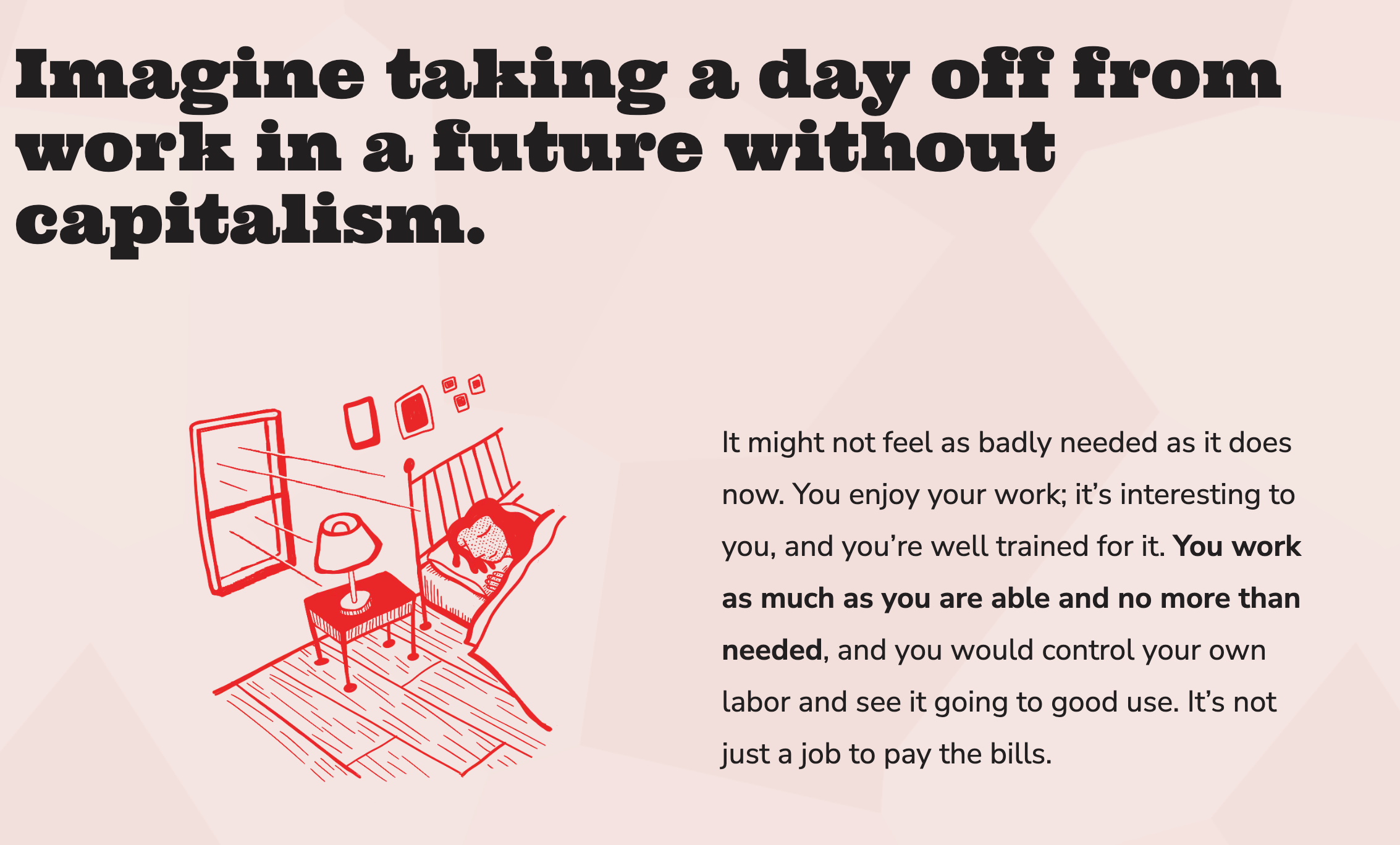
Sure, not yet. Collins's segment corrects the president’s comments and stops there, and never does a Google search to confirm what is on the DSA’s own website, the platform that wants to build “a new society from the ground up” and seeks to “imagine a future without capitalism.” Which is literally communism.
And it isn’t one clip; it’s the house style. Trump calls them communists, and we get full fact-checking segments everywhere, a hundred chyrons by dinner. The DSA sells itself as a modest little movement for healthcare and a living wage, while the actual platform just sits there on the website, ignored, week after week. Of course an overstatement from the president gets policed immediately. A disregard from the left sails through untouched. The media does the assist while Mamdani launders the word.
Who the softening is actually for
Now the part that makes the whole thing click, and it starts with a definition he won’t give.

Garcia-Navarro tried, repeatedly, to get Mamdani to say what “working class” means, since it is who he claims to be fighting for and the basis of his entire platform. Is a person making $250,000 working class? “I mean, I haven’t sat at home and asked myself where it starts and stops.” Nice dodge, Zohran. There’s only one majority in the country, he said, and it’s the working class. She wasn’t buying it: “That just doesn’t ring true to me.” She’s right, and pay attention to what he is doing.
Remember what he said on Stewart? He jokes that words have lost their meaning, and then he spends the Times interview refusing to let “working class” mean anything specific, because a term that includes almost everyone can be pointed at anyone. And the people it gets pointed at are whoever he and the DSA decided are not “working class.”
His actual tax line sits at a million dollars a year. Let’s look at the numbers. Fewer than 34,000 New York City filers report a million dollars or more, well under one percent of everyone who files, and that sliver already pays close to half the city’s income tax. They are also the most mobile. What will happen if even 10 percent of that group decides to leave the city? Will the bus driver and the doctor still be considered “working class” or will the doctor have to start paying a “fair share”?


So who’s actually in this expanded definition of working class? Nate Silver ran the numbers this month in a piece titled, with no varnish, “The DSA sweet spot: highly educated, downwardly mobile.” Of DSA members over 25, about 80 percent hold a bachelor’s degree, roughly 45 percent report household income under $60,000, and 85 percent are white. The base skews toward teachers, nonprofit staff, social workers, and city employees. Credentialed and underpaid, and — Silver’s word, not mine — aggrieved. Who it isn’t is the guy who fixes your boiler or bolts your car together. They have expanded the definition because it benefits them. The working class they claim to be fighting for is really just their own membership rolls. None of this is new. Lenin said it out loud in 1902: workers, left alone, would only ever push for better pay and shorter hours, so the revolution had to be carried to them by educated men who'd walked away from their own class. The vanguard was never the workers. It was the credentialed who followed Marx.
Mamdani is their poster child, literally. His father is Mahmood Mamdani, an endowed-chair professor at Columbia; his mother is Mira Nair, the filmmaker. He has the credentials and cultural capital, but no payroll in sight. He has lived his adult life educated and downwardly mobile — until now — as an artist and activist. So the guy telling you the working class is basically everyone grew up never working with his hands or building anything tangible. Conveniently, his definition bends toward the world he came out of — the credentialed, the artistic, the people already in the room — and it hardens the moment it points anywhere near the million-dollar line. He draws the line, making sure he remains on the right side.
Everything works in the honeymoon
Right now, Mamdani is doing PR, and everyone is helping him tout his successes, even though the receipts are still coming in. What happens once the spending is locked in and the narrow base that pays for it starts to thin out? And you don’t have to imagine how that goes. There’s a version running at full scale right now.
California is the preview. In 2022, the state was bragging about a record $97 billion surplus. Three budgets later, it faces structural deficits headed toward $35 billion a year, because nearly half its income tax comes from the top one percent and that money rides the stock market up and down. Chevron moved its headquarters to Houston in 2024, and the state booked its first population losses since it became a state. California has shown that if you tax the thin slice hard enough, long enough, it eventually moves.
You don't have to cross the country for the lesson, though. New York is living it. Between 2019 and 2022, the state's share of the country's millionaires fell from 12.7 percent to 8.7 percent, and the Citizen Budget Commission calculated that if New York had just held its share, it would have collected roughly $10.7 billion more in income tax in 2022 alone. And here the math turns worse than Newsom's, because in New York a millionaire doesn't even have to leave the state. The tax Mamdani wants is a city tax, stacked on top of the state's, and it only bites people who live in the five boroughs. Move your legal residence up to Westchester or out to Long Island, and it's gone. If you’re loaded, why not go the whole way — Greenwich is a forty-minute train ride, Palm Beach a nonstop flight.
And the person who has to approve that city tax already told you she won't. When confronted this summer with the millionaire numbers, Kathy Hochul — Democrat, the governor whose signature Mamdani needs — didn't dodge: "I am doing what I can to stop that because I believe that we should not be raising taxes on high-net-worth individuals." She is basically begging the millionaires to stay put. In the spring she'd tried flattery, telling a Politico crowd "there are some patriotic millionaires who stepped up. OK, cut me the checks," then nudging them to go down to Palm Beach and bring a few of the departed back home. When the Democratic governor is reduced to calling the rich patriotic for staying put, the exodus isn't a Republican talking point anymore. It's a problem for New York.
The other model his side loves to invoke is Scandinavia, held up as proof of the benefits of “Democratic Socialism.” Except the Nordic countries aren’t socialist; they’re market economies, as Denmark’s own prime minister told a Harvard audience in those words. And the one time Sweden actually reached for socialism, with union funds built to buy up private companies over time and a marginal tax rate that hit 102 percent, it turned tail, scrapping the funds in 1991 and cutting the taxes. The country held up as proof that socialism works is a market economy that backed away the moment it tried the real thing.
That’s what Mamdani’s “it’s working” tour keeps off-screen. Six months of potholes and photo ops is a honeymoon, one only given to politicians of the left. He has yet to show sustained results.
The long game
The facts. Mamdani said “seize the means of production” was the “end goal” in 2021. He mused about “the abolition of private property” as a frame for housing in 2020. He said on Meet the Press in June 2025, flatly, “I don’t think that we should have billionaires.” In 2020 he tweeted that the NYPD was “wicked & corrupt” and wrote “Defund it. Dismantle it.” By June 2025 that had become “I will not defund the police.” As mayor he kept a billionaire police commissioner and even added officers, drawing a public rebuke from his own NYC-DSA chapter. He just installed Lina Khan, Biden’s antitrust enforcer, atop the city’s economic development shop. And he is, right now, pushing to have the city seize buildings from landlords and “transfer ownership to responsible stewards,” his words, through a bill reviving a dormant program to do exactly that. The soft image and the hard program are both on the record, running at the same time.
A person's core convictions don't flip in eighteen months. What flipped was the packaging. The 2020 man who wanted to dismantle the NYPD and the 2026 man who defends his police commissioner are the same man, now sitting in Gracie Mansion. And the play? It’s to make democratic socialism unthreatening enough to get more democratic socialists elected. That's not a conspiracy theory. It's roughly what the DSA argues about itself in the open, in its own strategy debates about using the Democratic ballot line now and building independent power later.
Mamdani is the most gifted communicator the DSA has ever produced, a real political athlete, and he understands something his critics keep missing. You don't win the argument about socialism. You retire the argument by making the word mean the library, and then you use the goodwill to move the actual furniture. The rent freeze, the building seizures, the millionaire tax, the antitrust crusader at the economic-development table. Stewart called it reforming capitalism. I will tell you what is actually happening while everyone's charmed. Mamdani isn't the harvest here; he's the plow, breaking the soil and smoothing it back over so the DSA can plant behind him. He's preparing the ground for socialism to take root, and whatever grows will take time to break the surface — which is exactly why he can do it in plain sight.
This post has bonus content for paid subscribers. Upgrade to get full access.
The Receipts is the full ledger from Mamdani’s five days — every claim I didn’t have room for up top, graded by how much it should bother you and sourced to the primary document: the $12 billion “deficit” that’s really two years stitched together, the bus-route number he invented, the jobs figures that don’t survive a metro-vs-city check, the pothole count that came out three different ways on three different shows, the fact-checks that fall apart, and the promise a mayor has no power to keep. Plus the quote bank with timestamps.
Free tells you what happened. Paid provides The Receipts.
A heads up. On August 3, the annual rate goes from $65 to $75 (monthly from $7 to $8). Subscribe before then and you lock in $65 for as long as you stay. You were going to want The Receipts anyway — this is the cheapest it’ll ever be.