

Sunday Desk | Who Shows Up
A ballpark, a pew, a payphone, and one man who forgot how to be wanted

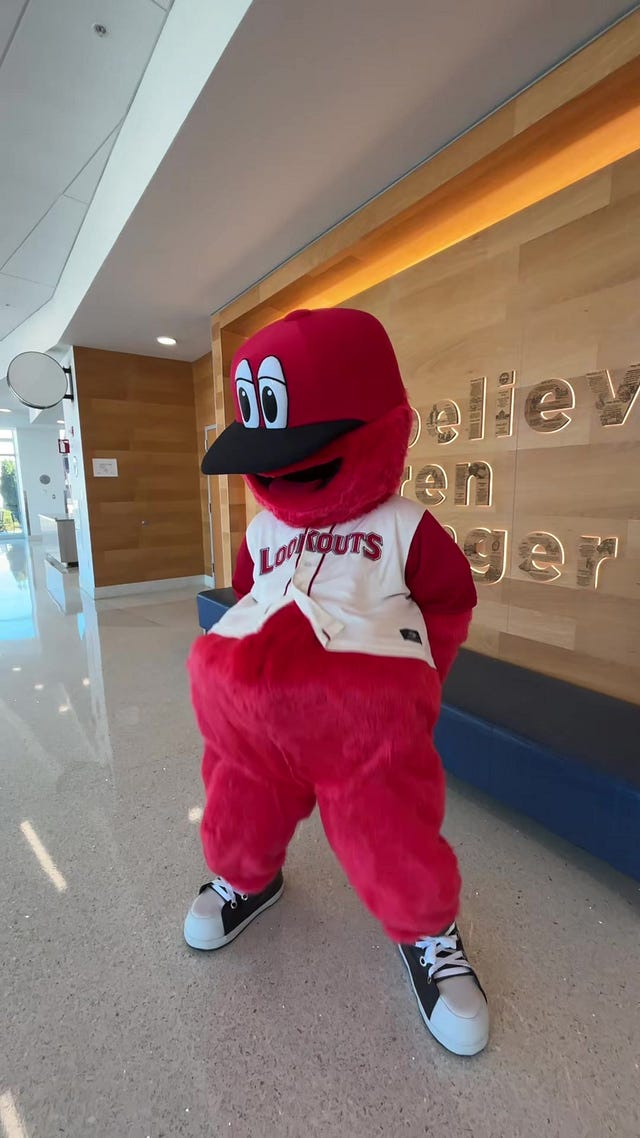
A little girl ran up to Looie, the Lookouts’ mascot. If you saw Looie walking down the street, you’d swear it was Elmo in a baseball jersey and Converse with a pot belly and a baseball cap with googly eyes stuck to it as his face. He bent down, wrapped his arms around her, patted her head, and sent her running back to her parents. A high school marching band was warming up somewhere past the outfield.
 Tiktok failed to load.
Enable 3rd party cookies or use another browser
It’s opening week at the Chattanooga Lookouts’ brand new stadium. The air was fresh. That stretch of spring where it’s warm but you can sit outside all day without the heat wringing you out. And while baseball ranks roughly second-to-last on my list of sports to watch live, there’s no better way to shake off winter than a night at the ballpark.
We made the obligatory stop for hot dogs and beer and found our seats — front row, behind home plate. The away team was the Montgomery Biscuits. Their logo is a fluffy biscuit with a pat of butter in its mouth. Or maybe that’s its tongue. I’m still not sure.
I settled in, balancing a hot dog, fries, and a shandy, ready for the game — and realized the real show had nothing to do with the field. Five young guys in the row at our backs, and one of them had taken up the noble sport of heckling the players loud enough to crack up everyone within three sections.
I caught some of it for you. Listen close.
The Kids Are Showing Up
A few years ago, if you’d told me young men were about to be the ones quietly filling the pews, I would have likely laughed. We were told that Gen Z was supposed to be the generation that buried organized religion for good. Every graph pointed down. Every headline about church closures read like an obituary.
Gallup dropped a poll this week that has a lot of people doing a double-take.

Forty-two percent of American men between 18 and 29 now say religion is “very important” in their lives. Two years ago, that number was 28%. That’s a fourteen-point jump, the biggest Gallup has recorded for any age or gender group in that window. It’s also the first time in a quarter-century that young men have outpaced young women on the question. Attendance is up, too. Four in ten young men now show up at a church, synagogue, mosque, or temple at least once a month. That’s the highest it’s been in over a decade.
Something’s happening.
I want to be careful here, because it is too soon to say “America is approaching a revival.” It’s not. At least not yet, we can pray. Overall religiosity is still near historic lows. Tens of thousands of churches are expected to close in the coming years. Axios pointed out that this isn’t the Third Great Awakening. PRRI’s CEO told them the decline among Gen Z may just be flattening out, not reversing.
But here’s the good news. A generation that was written off as lost to faith is, in at least one corner, walking back toward it. Not because anyone told them to. Not because their parents dragged them. A lot of them, frankly, are walking back without their parents. That’s not nothing.
The Gallup senior scientist running the numbers, Frank Newport, put it plainly: the decline among young people is starting to stop. In his words, that’s significant.
There are a few ways to read this. The cynical one — the one the media loves to tell — is that young men are finding religion because the manosphere told them to. The Gallup data show that most of the growth is occurring among young Republicans. What the media doesn’t know or won’t acknowledge is that you also can’t reduce a person walking into a sanctuary on a Sunday morning to a political demographic. Something pulls them through the door. A question they can’t shake. A tether that they seek. A friend who invited them. A feeling that the algorithm isn’t feeding them anything real.
The generous read — and the one I’m choosing today — is that a bunch of young people are looking around at a world that feels thin and trying to find something with weight. Community. Ritual. A place where your phone doesn’t work and someone older than you knows your name. You don’t have to be religious yourself to see why that would be appealing right now.
A rabbi in Los Angeles told the AP her congregation has been growing steadily since the pandemic. She put it simply: people are looking for a sense of belonging in dark times.
It’s not just the boys. Young Republican women’s attendance is up eight points over the same period. Democratic women under 30 are the one group that hasn’t budged, and there are real reasons for that worth taking seriously, from abortion politics to a loss of trust in institutions.
But I see a light. Young people are showing up somewhere that isn’t a screen. They’re sitting in rooms with other humans. They’re singing. They are making friends. Some of them are having the first quiet hour of their week. They are reacquainting themselves with God.
This is a good thing. The kids are showing up. Let’s pray it continues.
Someone Pick Up the Phone
Somewhere on Commonwealth Avenue in Boston, there is a bright yellow payphone sitting outside a coffee shop. No coin slot. No instructions. Simply bold, bright blue letters that beckon you to just pick it up and CALL A BOOMER.
On the other end, 2,500 miles away in Reno, Nevada, a phone rings in the recreation room of a senior living facility. Whoever is nearest answers. And just like that, two strangers — separated by decades and a continent — are talking.
It’s called “Call a Boomer,” a social experiment by a biotech startup called Matter Neuroscience. The payphone in Boston connects to a matching one at the senior facility that reads, on that end, “Call a Zoomer.”
Maria Jaynes is 73. She grew up a small-town girl in Texas, met her husband Chris when he was stationed nearby with the Army, and married him when she was 18. He was 21. They spent the next forty years building a life together, Texas to California to Nevada, where Jaynes cried the first time she saw the mountains. Chris passed away in March of 2011, and she still lights a candle for him at mass.
When a BU student called her recently and asked how she managed to fall in love and make it last, Jaynes didn’t hesitate. She gave a list. Four things. Get to know someone slowly. Keep communicating. Hold hands and never stop. And live a life outside your partner.
She also, in the gentlest possible way, offered her opinion on dating apps. “Maybe meet someone in town that you know of,” she suggested.
How great is that?
So what’s with the phone? The startup behind it describes itself as a “happiness company” focused on neuroscience and feel-good brain chemistry, which sounds like the kind of thing that belongs on a hippie wellness podcast you listen to while doing something you don’t enjoy. But their actual intervention — the thing they built to make people feel better — was a payphone. A dial-age technology planted on a college campus, designed to do nothing but make two lonely people talk to each other.
Because that’s the thing they identified as the gap. Not a new app, not a subscription, not a curated digital experience, not another text message. A conversation with a stranger that goes well. That’s the whole formula.
The company noted that Gen Z and seniors are two of the loneliest demographics in the country. The ones on opposite ends of a life. And somehow, a yellow payphone on a random street in Boston is quietly bridging that gap, one half-hour conversation at a time.
Maria Jaynes told the student who called her: “I’m not just learning from you, you’re learning from me.”
That feels right. That feels like something we used to know and forgot.
I think about the things that are likely to be asked, while standing at that payphone with the wind in my face and a stranger’s soft voice coming through the line. What did a marriage look like before you had to perform it online? What did it feel like to see a mountain for the first time? What do you do with grief when there’s no algorithm to distract you from it?
Pick up the phone.
The Man Who Decided Only 400 People Mattered
There is something almost poetic about a man who spent his entire life deciding who belonged — and died alone because of it.
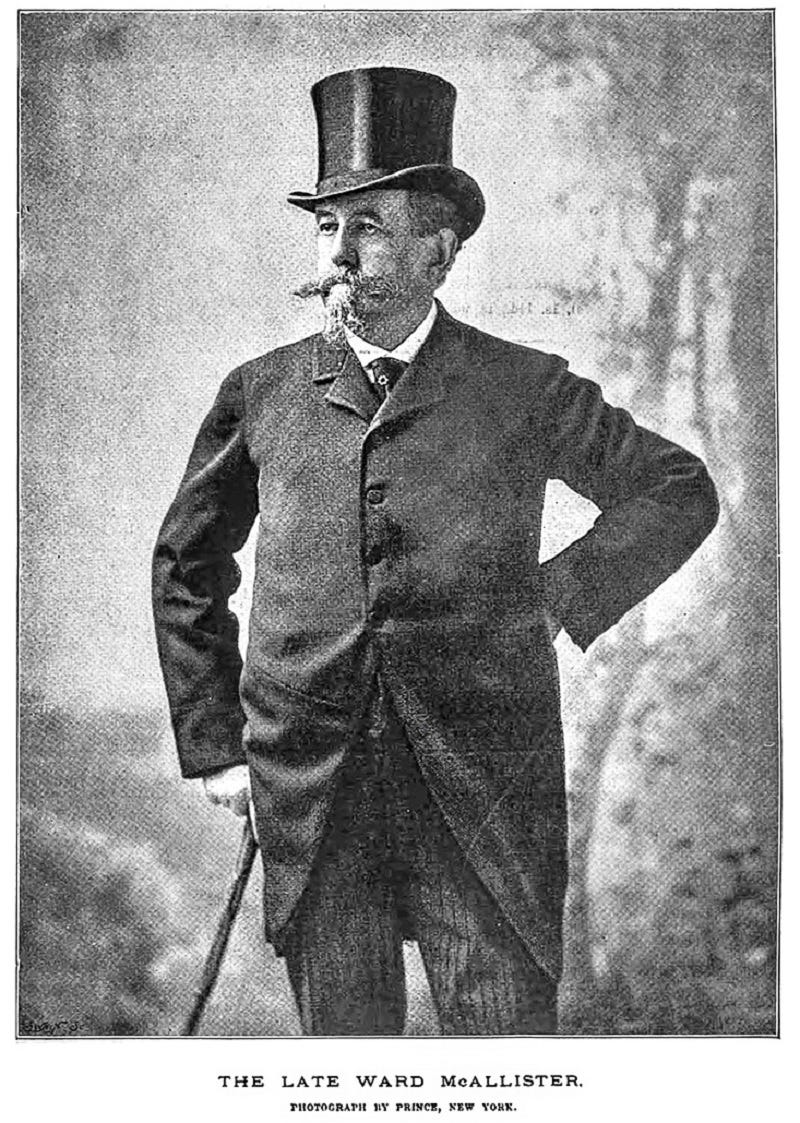
Ward McAllister was not born rich, not born famous, and not born into the kind of New York society he would eventually come to rule. He was a short, pudgy lawyer from Savannah, Georgia, who studied the mannerisms of the European elite the way some people study a second language, obsessively, with the desperate hope that fluency might pass for native speech. He married a wealthy woman, bought a farm in Newport, and set about constructing the most elaborate social scaffolding in American history.
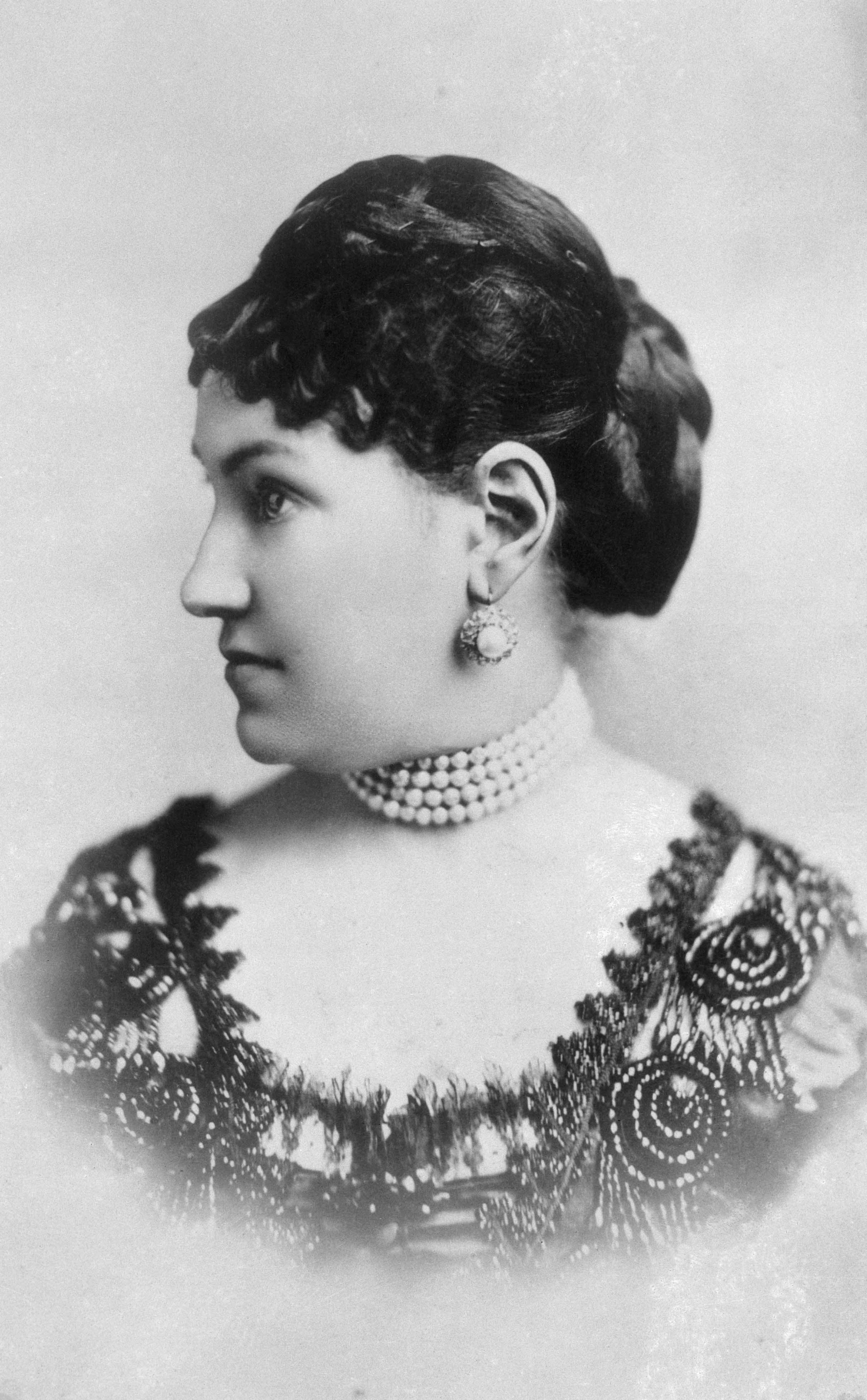
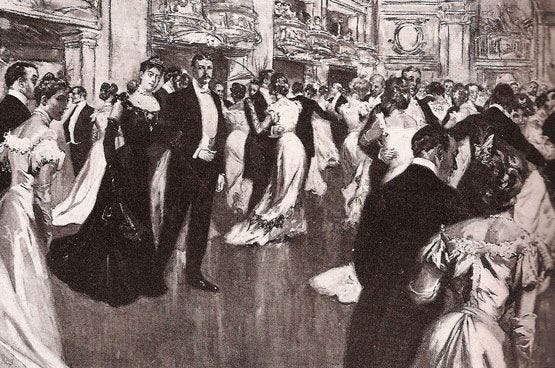
It worked. Alongside Caroline Astor — the Mrs. Astor, the undisputed queen of Gilded Age New York — McAllister became the gatekeeper of the city’s most exclusive circles. He organized the famous Patriarch Balls, decided which new-money families were acceptable and which were not, and in 1892 coined the phrase that would define an era: The Four Hundred. According to McAllister, there were exactly 400 people in New York who truly mattered in society. Coincidentally — or perhaps not so coincidentally — that was precisely the number of guests who could fit inside Mrs. Astor’s ballroom.
For decades, an invitation to one of his carefully orchestrated evenings determined whether you existed or didn’t, in the only world that McAllister considered worth inhabiting. He called Mrs. Astor his “Mystic Rose.” He could spend ten minutes deliberating over the wording of a single invitation. He was, by all accounts, entirely humorless about the whole enterprise, which is, if you think about it, the funniest thing about him.
Then he wrote a book.
In 1890, McAllister published Society As I Have Found It, a memoir of his years at the center of New York’s elite. He was careful, technically. He didn’t name names outright. He used initials. He thought that was enough. It was not. Everyone knew exactly who he was talking about, and the people he had spent his life cultivating stopped inviting him anywhere. Slowly, then all at once, the doors closed.
He spent the next five years fading from the only world he had ever wanted. And on January 31, 1895, Ward McAllister — the man who had decided only 400 people mattered — died while dining alone at New York’s Union Club.
Mrs. Astor did not attend his funeral. She had a prior engagement.
There is a lesson buried in there somewhere about the difference between access and belonging, between influence and love, between being at the center of every room and actually being wanted in one. McAllister built a world and then discovered, too late, that he had never really lived in it; he had only been allowed to manage it.
The Four Hundred moved on without him. They always do.

Witnessing this younger generation of 18+ year olds going to church and doing Bible studies on campus with my youngest son in college now. He and his baseball teammates do a weekly bible study in the dorms and open it to anyone interested. Even his coach came and started going to back church again!! Love to see it and their enthusiasm to learn more about Jesus! 🙌🏻
I love the ‘Call a Boomer/Zoomer’! What a way to connect generations!