

Sunday Desk | The Prayer of Pancreatic Cancer
Ben Sasse isn't performing peace. That's what makes it so hard to look away.

I finished my office. Mostly.
The window situation remains unresolved, and I still haven’t figured out the TV wall, but everything else? I love it. Actually love it, which — if you’ve ever poured a month of decisions and dollars into a space and then held your breath waiting to feel something — you know that’s not guaranteed.


It’s intimate. Cozy. The kind of room that wraps around you instead of demanding something from you. I walk in, and my shoulders drop half an inch. That’s the goal, honestly. I wanted a space that felt like mine, not a productivity aesthetic from Pinterest, not a content creator’s backdrop. Just a room that says yes, you can relax here, go make something.
And my husband built that for me. Patiently, without complaint, with actual skill. I don’t take that lightly.
Now. The windows.
Here’s the thing: I have no emotional resistance to spending money on things I want. Furniture, books, a good meal, zero internal conflict. But certain categories of spending make me irrationally annoyed, and window treatments are apparently on that list. After a full month of remodel spending, the idea of also paying for Roman shades has me behaving as if someone asked me to tip on a to-go order. Unreasonable? Completely. Do I understand it? Not even a little.

I’m thinking wood or reed Roman shades with heavy drapes. The inspo image above is the vibe, ignore the blue and the zebra print, we are obviously not doing that. But color, pattern, fabric weight? Still no idea. So for now I have grommet panels on a pressure rod. Muy classy.
If you have opinions, drop them in the comments. I genuinely need the help.
Ben Sasse: A Calling to Die
I watched the Ben Sasse interview on Ross Douthat’s Interesting Times podcast this week, and this one left a mark.
If you don’t know the story: Sasse, the former Nebraska senator, was diagnosed last December with Stage IV pancreatic cancer. By the time they found it, it had already spread. Five forms of cancer. Doctors gave him three to four months. He sat down with Douthat anyway — face visibly covered in dried blood from a drug that’s shrinking his tumors but won’t let his skin heal — and he was funny, clear-eyed, and at peace in a way that had nothing to do with denial.
That’s the thing that got me. It wasn’t performed peace. It wasn’t the practiced calm of someone who has rehearsed the right things to say about faith and suffering. He was genuine; you could feel it.
He talked about death plainly, calling it a “wicked thief,” something to be genuinely hated. He didn’t soften it. And then in almost the same breath, he said something I keep turning over: “I would never want to go back to a time in my life where I didn’t know the prayer of pancreatic cancer. I can’t keep the planets in orbit. I can’t even grow skin on my face.”
The illness, for him, wasn’t the interruption of a good life. It became the thing that finally told him the truth about himself.
At the end of the interview, Douthat asked if he felt ready to die. He was honest, he didn't feel ready, not exactly.
But then he talked about being able to approach God, to call him Father, Abba, Daddy, and said, quietly, “That’s pretty glorious. And I know that that’s what I need.” Douthat, a professional keeper of composure, choked up and could barely close out the episode.
I don’t think Douthat was moved by tragedy. I think he was moved by witnessing someone actually mean what they believe. I know I was.
As a Christian, I found myself convicted. Not in a guilt-spiral way, but in the way that happens when you see someone living out a faith you share with a clarity and a joy that you feel you fall short of. I want that. I want to draw closer to God.
And I hope — genuinely hope — that when my time comes, I can face it with even half his grace.
Go listen to the interview. It’ll do something to you.
What I Consumed
Sam Altman May Control Our Future—Can He Be Trusted? - The New Yorker
Glenn Greenwald vs. Coleman Hughes Debate: Does Israel Control U.S. Foreign Policy? - Conversations with Colman
The Mansion, the Heiress, the Jewel Heist, and Me: A Bel-Air Fairytale - Vanity Fair
I Don’t Care If Gen Z Likes Me - The Free Press
Time to Dust Off the Grill
Am I the only one whose husband has a grill problem? I mean, this man has at least four types of grills. Well, technically, one is a smoker, one is a flat-top, one is gas, and he also has a charcoal grill.
To be clear, I am not complaining because when the temperatures rise, the grills get dusted off, and my days slaving over a stove become fewer.
As the days get longer and warmer, we are all looking for easy dinners that don’t heat up the house. A tried-and-true grilling recipe is always my go-to.
Let me answer some questions I know someone will ask.
You can marinate the chicken ahead of time and have it ready to go.
You can use chicken breast if you like less flavor. 😉
The same goes for boneless skinless thighs, but they are better than boneless skinless chicken breast.
If you cannot tell, I am not a fan of white chicken meat.
Sazón can be found in the Hispanic/International food aisle of most grocery stores.
Enjoy my favorite grilled chicken recipe. Make extra and shred
for salads and sandwiches.
The Most Chaotic Race in Olympic History
Thirty-two men showed up. Fourteen finished. The one who crossed first hadn’t actually run most of it.
Welcome to the 1904 Olympic marathon, the race so catastrophically botched that people seriously considered removing the marathon from the Olympics entirely.
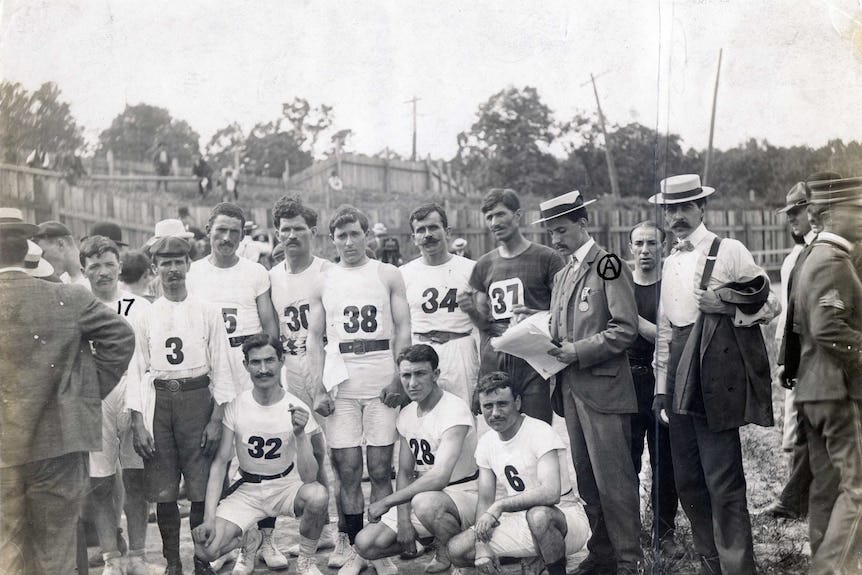
St. Louis, August 30th. The temperature was 90 degrees. Race officials had set up exactly one water station along the 24-mile course because the games director, James Sullivan, believed dehydration was actually good for athletes. Athletic science was at its peak in 1904.
The course ran on dusty country roads, open to traffic. Race officials rode in cars ahead of the runners, which sounds helpful until you realize those cars kicked up massive dust clouds that made breathing nearly impossible. One runner, William Garcia of California, inhaled so much dust he ended up in the hospital with internal hemorrhaging.
And that’s before we even get to the cast of characters.
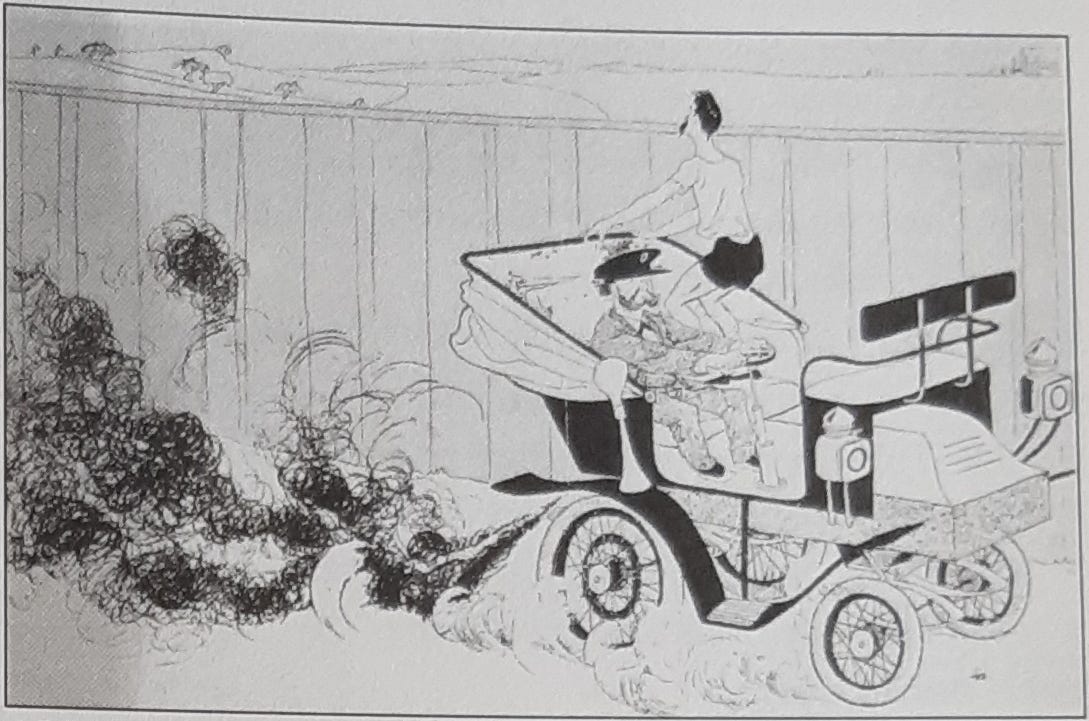
The guy who hitched a ride
The first man to cross the finish line was American Fred Lorz, who received a hero’s welcome, got photographed with Alice Roosevelt, and was about to be handed a gold medal when someone figured out he’d spent a good chunk of the race riding in a car. When the car broke down, he jumped out, ran the last few miles, and let everyone think he’d won. He was banned for life by the Amateur Athletic Union, a ban that was quietly lifted just in time for him to win the Boston Marathon the following year.
Cool.
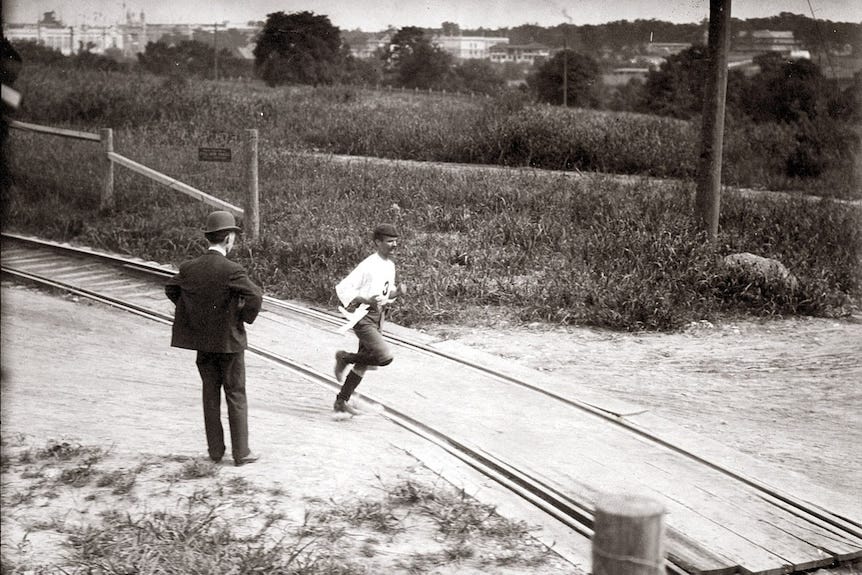
The Cuban postman who refused to lose
Félix Carvajal was a Cuban postman who showed up to the St. Louis World’s Fair, decided he was running the Olympic marathon, and somehow made it happen. He arrived at the starting line in full street clothes, long trousers, a white shirt, and walking shoes, very Cuban. A competitor took pity and cut his pants into shorts on the spot.
He hadn’t eaten in 40 hours. When a spectator refused to share his peaches, Carvajal stole them and ran. Later, he spotted an orchard, stopped to eat some apples, discovered they were rotten, got stomach cramps bad enough that he had to lie down for a nap mid-race, and still finished fourth.
Yo go papi!
The South African who got chased by dogs
Len Taunyane, one of the first Black Africans to compete in the modern Olympics, was chased nearly a mile off course by a pack of wild dogs and still managed to finish. He likely would have placed much higher without the detour. Nobody seemed particularly bothered by this at the time.
The actual winner, who probably should have died
Thomas Hicks spent the last ten miles of the race in agony. His support team, watching him deteriorate, made a decision: they fed him a mix of strychnine and egg whites, the first recorded instance of drug use in the modern Olympics. Strychnine, for context, is rat poison. In small doses, it stimulates the nervous system. In larger doses, it kills you.
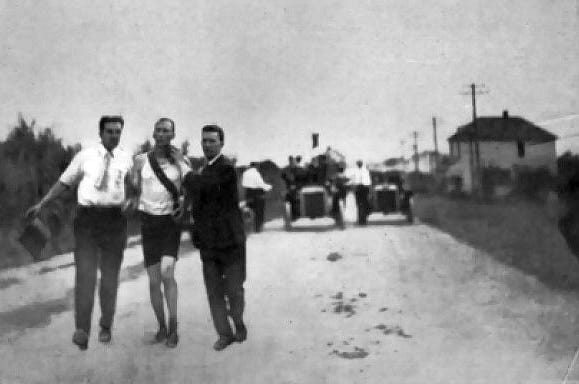
Hicks spent the final miles hallucinating, believing the finish line was still 20 miles away. His support team essentially carried him across the finish line, holding him upright while he shuffled his feet as if still running. He had to be treated by four doctors afterward and might have died on the track without intervention.
His finishing time — 3 hours, 28 minutes, 53 seconds — remains the slowest in Olympic marathon history by half an hour. He never ran a marathon again.
The aftermath
James Sullivan, the games director who organized this entire disaster, later declared the marathon “indefensible on any ground, but historic.” Which is one way to describe it.
After the race, many argued it was too dangerous and should be abolished. It wasn’t — the marathon returned for the 1908 London Games — but the chaos left a mark. The 1908 marathon included the first anti-doping rule in Olympic history and significantly more water stations.
The whole thing reads like someone tried to design the worst possible conditions for a footrace and then handed out medals at the end. With a body count and a car ride thrown in for good measure.
The marathon survived. Barely.

The Wildest Race Ever by Meghan McCarthy is a favorite book amongst my kids!
The Wildest Race Ever: The Story of the 1904 Olympic Marathon https://a.co/d/0133T3q0
West Elm has beautiful, long-lasting velvet drapes. I bought some in gray from them probably 10 years ago that still look like new. I checked and they do have them in green. Paired with the Roman shades, it would be beautiful.