


If you Google “creative office decor ideas,” you’ll be accosted by pegboards and enough color to trigger a juice-box flashback. But I cannot focus in rooms with bright colors, lots of light, white walls, and pegboards. It’s too much. It feels as if the room is trying to bully me into productivity. “How can you not be happy in this room full of pops of color!” Because Linda, I feel like they are yelling at me like a perky aerobics instructor demanding higher kicks.

My mind is a very busy place, running list after list. Lists of ideas, headlines, tasks, random thoughts — and sublists breeding beneath them. I need my workspace to be dark, quiet, soothing, and lit with lamps that cast a warm glow. I envision dark green walls and brass lamps with linen shades that cast warm light down towards the floor. As if I am camping in the forest, reading next to a fire. I want to feel like the room is giving me one of those bear hugs that releases all the tension in my body so I can relax and fall into my writing.
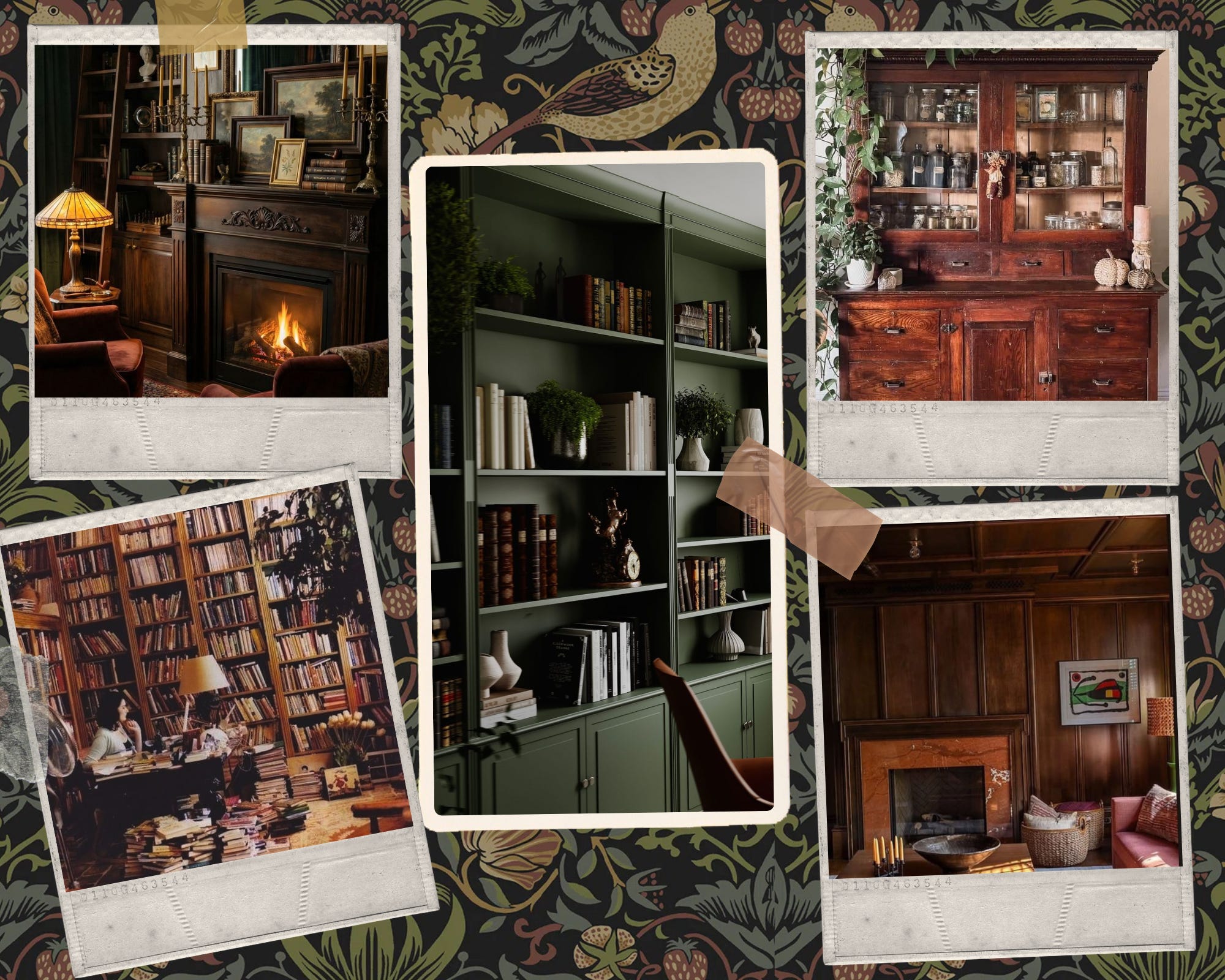
My current workspace does not hug me. Thankfully, it’s also not yelling at me to do high kicks. I do have elements of my dark, moody study, but I haven’t had the time to bring the vision to life. So I’m building my bear-hug office, one dark corner at a time, and I thought you would enjoy a peek at the first step, my moodboard.
A room flooded with my favorite green, accented with dark wood, dark cozy corners, and books. I want a wall of books and notebooks.
We are in the very beginning stages of this transformation, but I will bring you along in the process, and you might even get some sneak peeks in the podcast video.
What kind of space helps you think?
Annotation
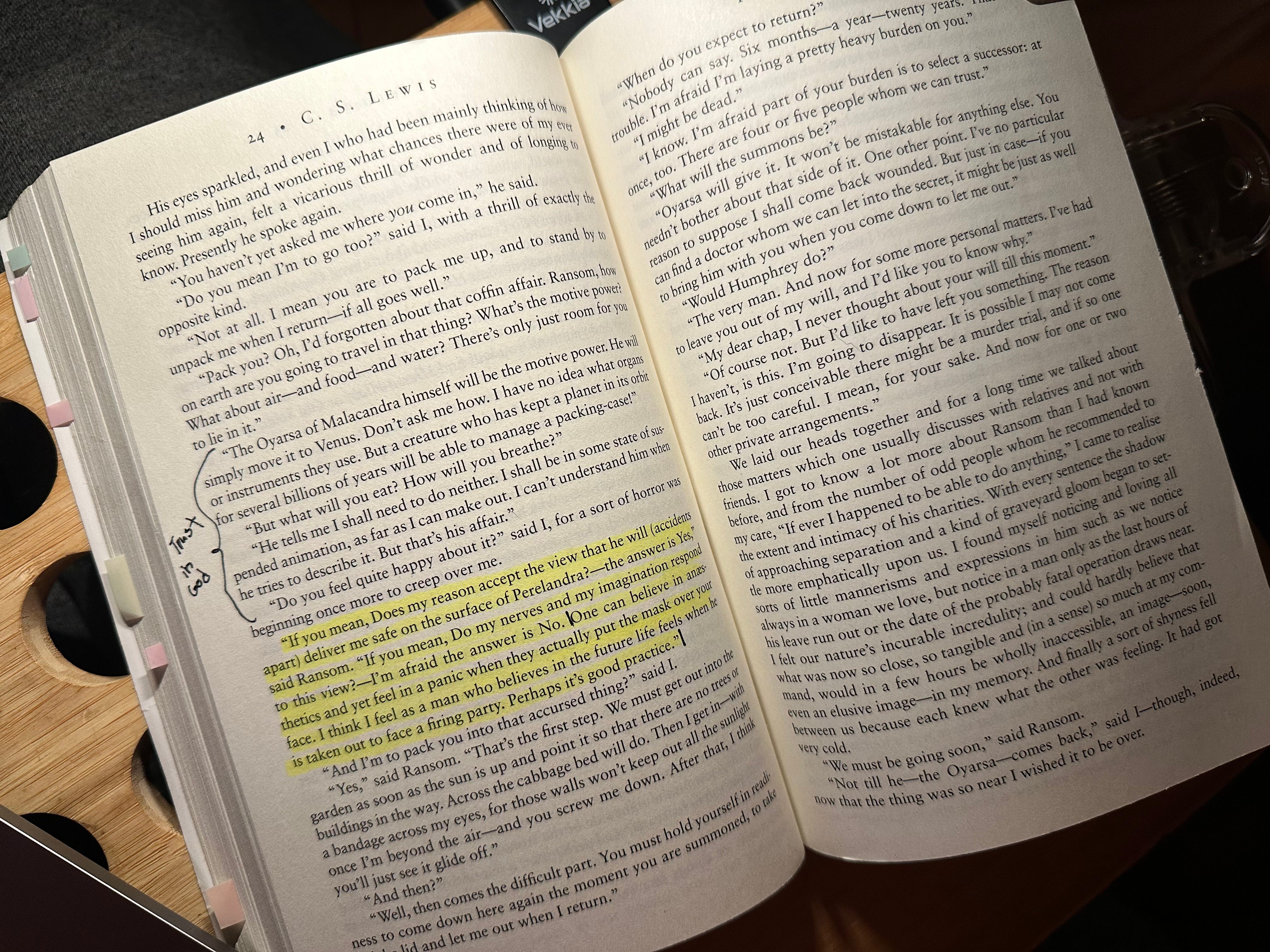
I've Started Doing Homework Again (On Purpose)
We are about sharing, right? Yes? Cool.
Well, I’ve started something new, and I want to tell you about it—it feels a little weird, but I think some of you might enjoy it.
First, let me set the record straight. I am not in the midst of a midlife crisis, believing that I am suddenly going to pump out a magnum opus of my life. And this is definitely not a “I’m going to write a novel in a cabin” situation (though it could unironically be a possibility).
If you’ve been reading my work for a while, you know how much I think about narrative — the way it’s constructed, the way it persuades, the way it frames reality before a single fact enters the room. A lot of what I do is dissecting the stories being told. But there’s another side to that coin I’ve been sitting with lately: what does it look like to build narrative intentionally?
So I’ve started a structured creative writing discipline. Structured sounds stiff — it’s really just me, a notebook, and some very good material.
ChatGPT Study + Learn as my writing coach.
Yes, I know many have strong feelings about AI. But I don’t have time to enroll in a course, so I'm working through the curriculum, the text analysis framework, and the feedback on my writing exercises with AI assistance.
It’s not doing the reading or the writing for me. I’m still the one sitting with Hemingway and O’Brien doing the work. But having a tool that can help me build a structured learning framework and give specific, thoughtful feedback on my drafts on my schedule? That’s genuinely useful—and using it well feels like a skill worth developing.
We’re all figuring out what an honest working relationship with these tools looks like. This is me figuring it out in public.
Week One is all about foundations. Close reading. Structural awareness. Learning how tension is created without emotional hand-holding.
The texts I started with: Hills Like White Elephants by Hemingway and the first fifteen pages of The Things They Carried by Tim O’Brien. Two very different writers, same essential lesson. Power lives in restraint. Not what’s declared, but what’s implied. What’s circled around. What never gets said directly but lands like a stone anyway.
Reading like a writer rather than a reader is surprisingly humbling. You slow way down and ask different questions. You are not just consuming, you are understanding. How is tension created here? Where does the emotional weight actually sit? How does dialogue carry subtext that the characters themselves won’t speak aloud? Where does the writer trust the reader, and where do they guide?
The Hemingway, especially. All subtext, almost no surface. Two people talking about nothing and everything at the same time, and you feel the whole weight of what they’re avoiding and the power shift. All done with no dramatic speeches. No, “she felt devastated.” Just cadence, body language, omission.
As someone who spends most of her days writing about politics — where rhetoric is loud and theatrical, and the subjects love the sound of their own voices — studying quiet storytelling is like encountering a different life form. Power doesn’t always announce itself. Sometimes it whispers. And that’s worth understanding.
Narrative shapes culture. Culture shapes politics. If I’m going to critique the stories being told about our world, I should be equally serious about understanding how those stories are built from the ground up.
If you’re a paying subscriber, later this week I’ll share my actual writing exercises from Week One, the assignments themselves, and my attempt at applying what I’ve been studying. You’ll literally get to see my writing notes, not just a finished piece. It’s messier and more honest than anything I usually publish. Look, you guys, I am trying.
If you’ve been thinking about upgrading, that’s a good reason to do it. Just saying. 🙂
More soon.
Some of What I Consumed
Astronauts Are Going Back to the Moon For The First Time in Half a Century - Time
When Coyotes Threatened Livestock on Central Texas Ranches, the Solution Was to Unlock an Ancient Ability in Dogs - Smithsonian
‘Lolita,’ Jeffrey Epstein, and the Real Meaning of a Challenging Classic - The Free Press
Nick Fuentes Is a Tool of the Left - Rufo & Lomez
The Duel That Started Over a Wrinkle
Picture this: It’s 1792. You’re a London socialite hosting a perfectly lovely afternoon visit when your guest — your guest — has the audacity to suggest you’re pushing sixty.
Oh, it is on.
That, according to legend, is exactly what happened between Lady Almeria Braddock and a Mrs. Elphinstone, whose ill-advised comment about Lady Braddock’s age sparked what history (or at least gossip) would come to call the Petticoat Duel.
Lady Braddock, who claimed to be somewhere in her thirties and was not taking questions, did not reach for a cutting remark in response. She did not write a strongly worded letter. She did not simply never invite Mrs. Elphinstone back for tea. No, she demanded satisfaction. The Georgian way.
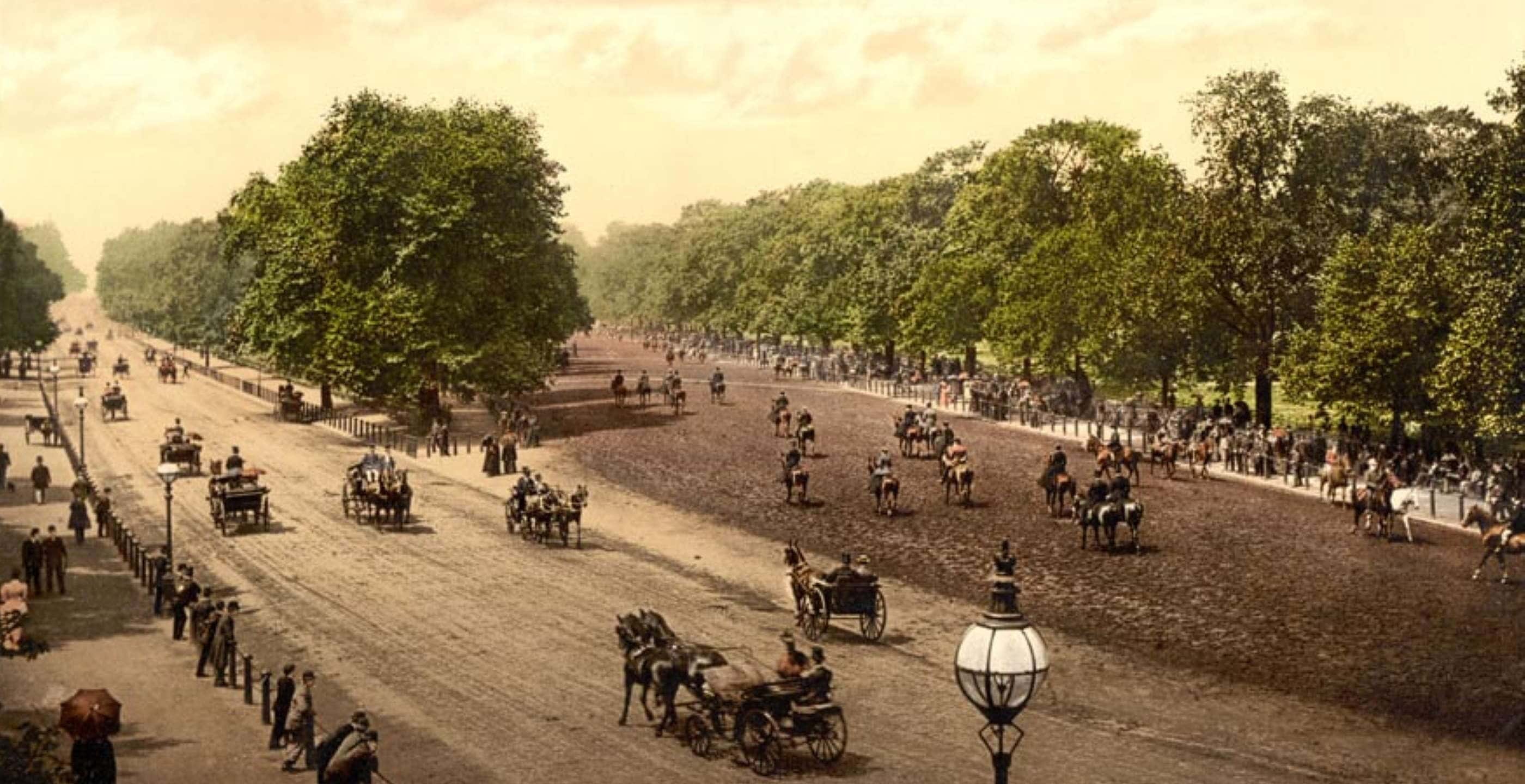
The two women met at Hyde Park — classic duel territory — and squared off first with pistols. Both shots missed. Mrs. Elphinstone’s bullet, however, did clip Lady Braddock’s hat, which honestly feels poetic. Then, because apparently pistols weren’t enough to settle a dispute about crow’s feet, they switched to swords, at which point Lady Braddock nicked her opponent’s arm. Blood drawn, honor restored. Mrs. Elphinstone wrote a formal letter of apology, and — depending on which version you believe — the two may have reconciled over tea afterward.
Which is very, very British.
As much as I would love to tell you this is a true story, it almost certainly is not. The primary source is the Carlton House Magazine, a 1792 publication best described as the Georgian equivalent of celebrity tabloids, known more for satire and sensationalism than straight reporting. Some things never change.
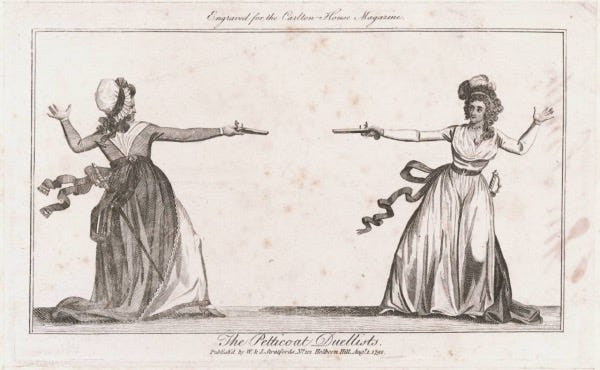
A contemporary engraving titled “The Petticoat Duellists” ran alongside it that same August, which is either evidence or very committed illustrative fiction. No diaries, letters, or records corroborate any of it. The names themselves — Lady Almeria Braddock, Mrs. Elphinstone — remain unverified.
And yet, it has lived for over two centuries in the cultural imagination because, real or not, it captures something true: vanity can make you do some wild things, like a duel to the almost death.
Whether the Petticoat Duel was a real act of defiance or a satirist’s joke about society’s obsession with a woman’s age and beauty, it a story that has earn its place in history not because it happened, but because it should have.
For A Laugh
That’s the Sunday Desk. A moodboard full of dark green walls, a duel that probably never happened but absolutely should have, and Week One of me doing homework on purpose.
Three things before you go: Tell me what your workspace looks like — I’m genuinely curious. If you’ve read either Hemingway or O’Brien, reply and tell me what you noticed. And if you’re a paying subscriber, the writing exercises drop later this week. If you’re not, well, you know where to find the upgrade button. 😉
See you next Sunday.

If you enjoy this slower, reflective corner of the newsletter, that’s what Sunday Desk is for.
My workspace is currentl all white and light but now I'm tempted to make it dark and cozy. Guess we gotta paint the whole basement now!
I fully support your use of AI as a study tool! I just fought my way thru The Count of Monte Cristo and Claude Ai was immensely helpful in dissecting the language and deeper nuances I may have missed. Really looking forward to watching your journey with this!