


Before we get into today’s newsletter, thank you for the kind words in response to my piece on Bad Bunny’s Super Bowl performance. I don’t usually share much, not out of opposition; it’s just not my nature, but your feedback was encouraging.
It also made clear that while you value the news and research here, many of you are interested in more opinion and personal perspective as well. Admittedly, that’s not my strongest area. I don’t consider myself especially reflective, but this year I’m trying to write more.
On Bad Bunny, Belonging, and Why I’m Just Annoyed

I was asked about my thoughts on Bad Bunny’s performance at the Super Bowl Halftime show. It wasn’t a surprise that I was asked, being that I’m from Puerto Rico. So I took a moment to find a word that expressed how I felt, and my response was: annoyed.
I spend much of my day online, scrolling social media, sourcing stories, and analyzing how outlets frame the news. I’m also making an effort to read more, write more, and be a bit more reflective. We’ll see how it goes. I don’t like to force things, so I’m making no promises.
That said, Sunday Desk is part of that exercise. I appreciate your encouragement and support. No promises, but I’ll do my best. ❤️
“Out of the Silent Planet” by C.S. Lewis
Sometimes you pick up a book expecting one thing and get something entirely different. I cracked open Out of the Silent Planet—the first installment in C.S. Lewis’s Space Trilogy—anticipating vintage science fiction. What I got was something closer to a theological adventure wrapped in the trappings of interplanetary travel.

And honestly? It works.
The story follows Dr. Elwin Ransom, a philologist (think: language nerd with impressive credentials), on a walking tour through the English countryside. Needing a place to stay for the night, he approaches a remote estate—and this is where things take a hard left turn.
At the estate, Ransom stumbles upon something sinister involving two former school acquaintances: Dr. Weston, a brilliant but coldly amoral physicist, and Devine, his opportunistic financier. When Ransom intervenes in their plans, they decide he’ll make a fine substitute. They drug him, haul him aboard a spacecraft, and set course for Malacandra, what we know as Mars.
It’s a kidnapping plot that launches, quite literally, into the cosmos.
The valley is solemn at their departure, but I see no signs of passionate grief. They do not doubt their immortality, and friends of the same generation are not torn apart. You leave the world, as you entered it, with the “men of your own year. Death is not preceded by dread nor followed by corruption.”
The bulk of the novel follows Ransom after he finds himself alone on Malacandra. He wanders the alien landscape, encounters its intelligent species, and slowly pieces together the planet’s social and spiritual order. If this sounds slow, well—it can be. The middle section lingers in exploration, and readers looking for pulse-pounding action might find themselves impatient.
But here’s what Lewis does beautifully: he builds a world that feels almost Edenic. Malacandra is a place of striking natural beauty, harmonious creatures, and an order guided by something higher than human ambition. There are clear biblical echoes here, whispers of paradise, of celestial hierarchy, of rebellion and its aftermath. Lewis isn’t subtle about his influences, but he weaves them into the narrative rather than preaching from a pulpit.
What resonated with me most was watching Ransom’s intellectual certainty erode. He arrives on Malacandra armed with the assumptions of his education and era. By the end, he’s humbled, not broken, but genuinely awed by something greater than himself. It’s a quiet transformation, and it positions him as the trilogy’s moral compass going forward.
At roughly 150 pages, it’s a quick read despite the slower middle stretch. The prose is accessible, the worldbuilding imaginative, and the payoff satisfying.
Lewis himself noted that the second book, Perelandra, can be read independently. But I’d recommend starting here. Out of the Silent Planet establishes the themes and characters that anchor the entire trilogy, and frankly, it’s worth the journey just to see Lewis apply his theological imagination to the stars.
If you’re looking for something that blends classic science fiction with deeper questions about humanity’s place in the cosmos, this one’s worth your time.
Next Up: Perelandra, C.S. Lewis
Currently: The True Believer: Thoughts on the Nature of Mass Movements, Eric Hoffer
Come Inside My Commonplace Book
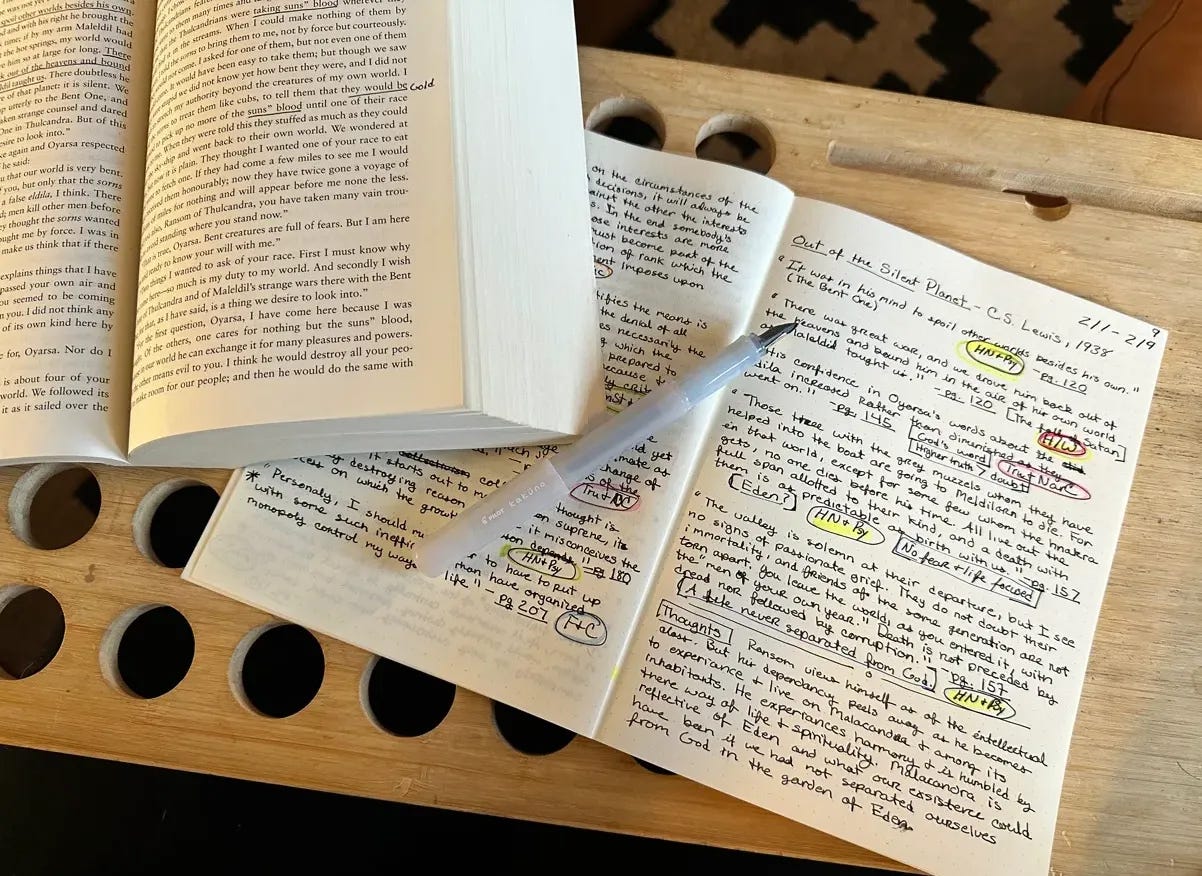
A reader asked if I’d share a tour of my commonplace book. I’m happy to oblige—partly because I’m proud of it, and partly because explaining it forces me to understand why I do it.
First, the basics: I’m using a Midori MD Notebook, dot grid, A5 size. And a Kakuno fountain pen, which is my first fountain pen. I think I’m in love. There’s something about the weight of it, the way the ink flows—it makes the act of writing feel intentional. Which is probably the point.
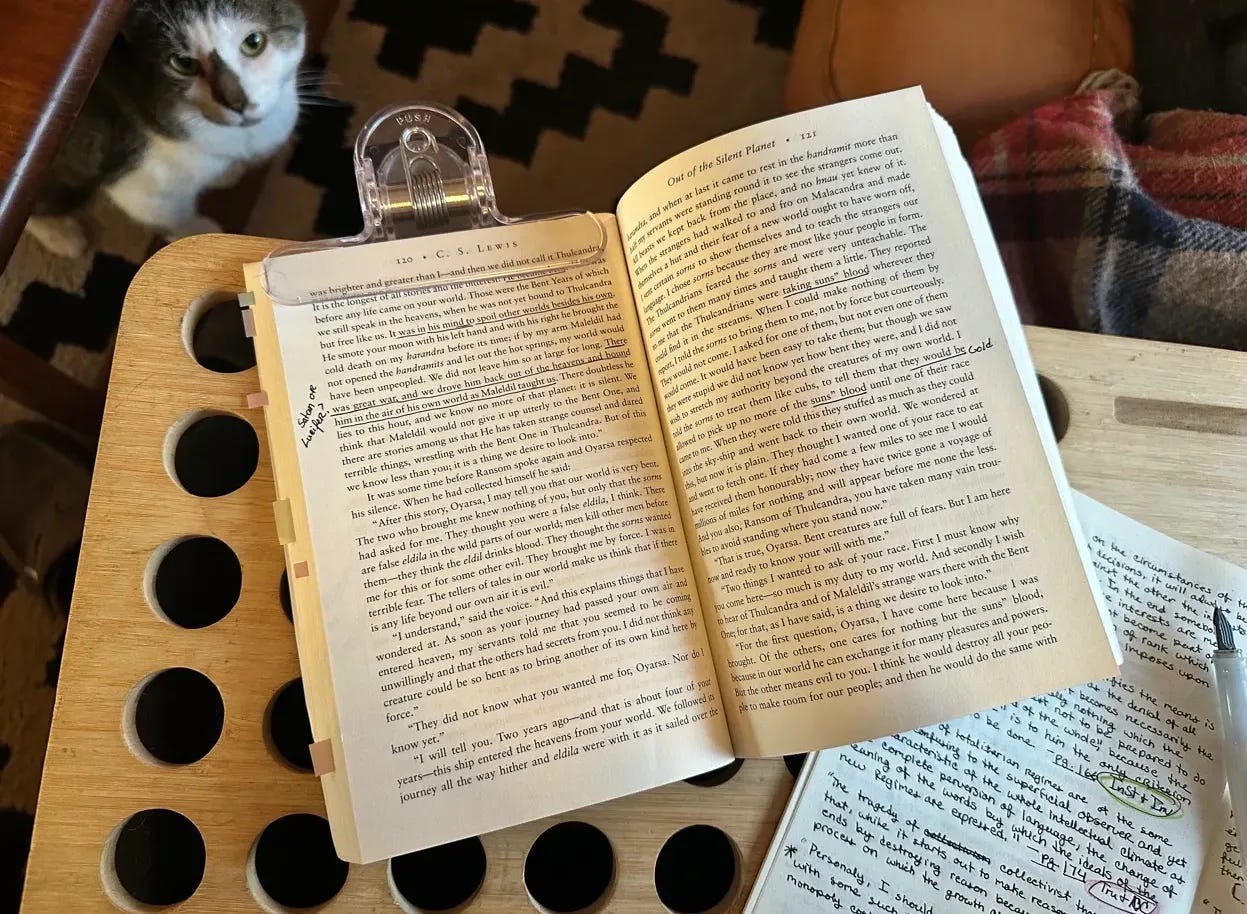
One more tool worth mentioning: a book clip. You can see it in the photo, holding my copy of Out of the Silent Planet open. When you're copying quotes by hand, you need both hands free—one for the pen, one for steadying the notebook. A clip keeps your source book open to the right page without you fighting the spine. I can't remember the brand of mine, but you can find similar ones on Amazon or Jet Pens.
A commonplace book, if you’re unfamiliar, is an old practice. Writers and thinkers have kept them for centuries—notebooks where you collect quotes, passages, and ideas from what you read. It’s not a diary. It’s not a journal. It’s more like a personal anthology, curated over time.
I’ve kept quotes on and off for years, but this is my first proper commonplace book. I started it in January with a goal: read more and retain more of what I read.
Here’s how it works.
The Categories
At the front of the notebook, I have a key with ten thematic categories, each assigned a color:
Human Nature & Psychology
Narrative & Language
Nihilism & Absurdity
Wit & Humor
Class & Society
History as Warning
Freedom & Coercion
Institutions & Individuals
Power & Incentives
Truth & Narrative Control
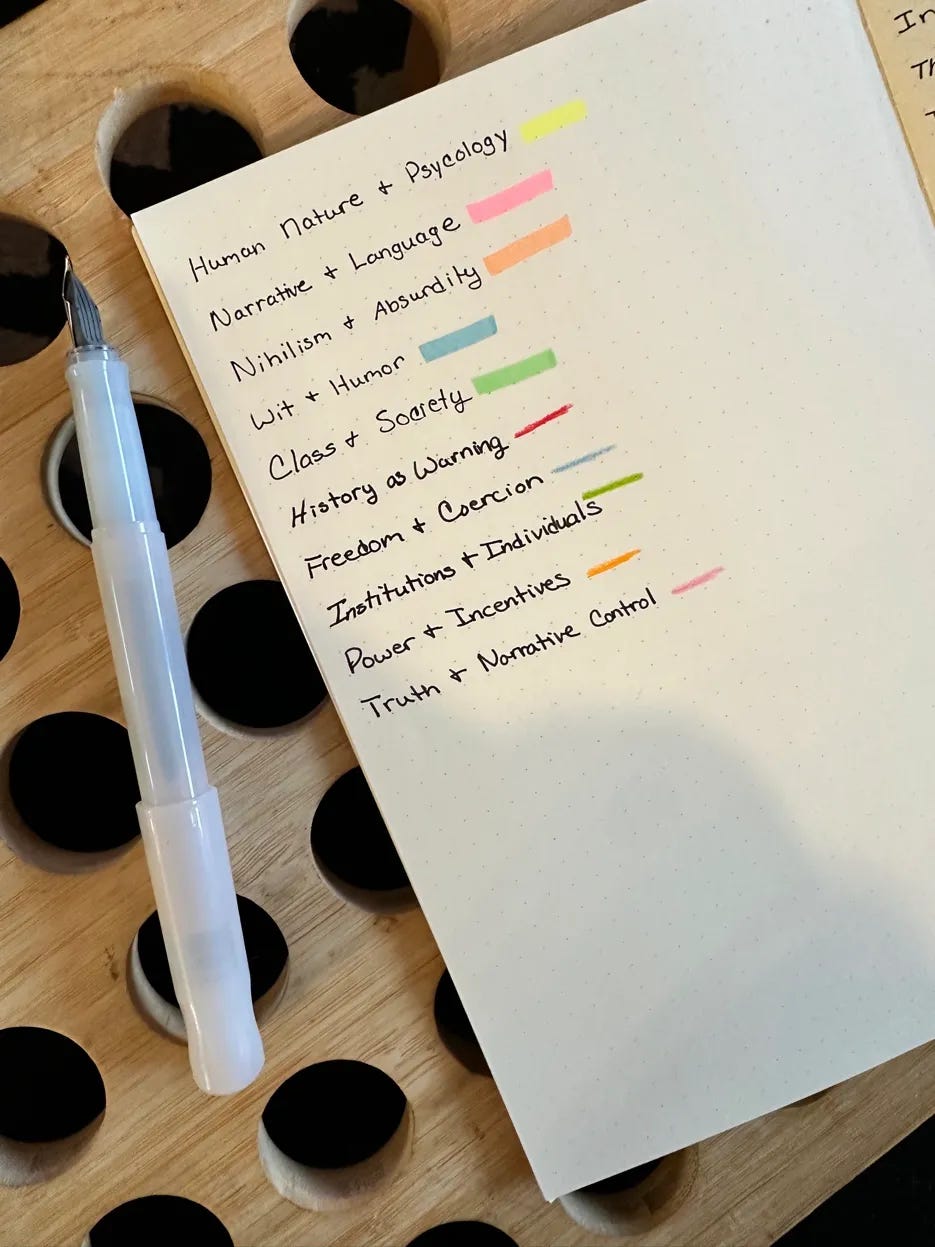
I developed these based on my reading list for the year, which leans toward classic literature, philosophy, and political and cultural non-fiction—books that complement my work. The categories help me see patterns across books and make connections I might otherwise miss.
The Index
After the category key, there’s an index page. Each book I finish gets a line: the title, the date I completed it, and the page number where its entries begin.
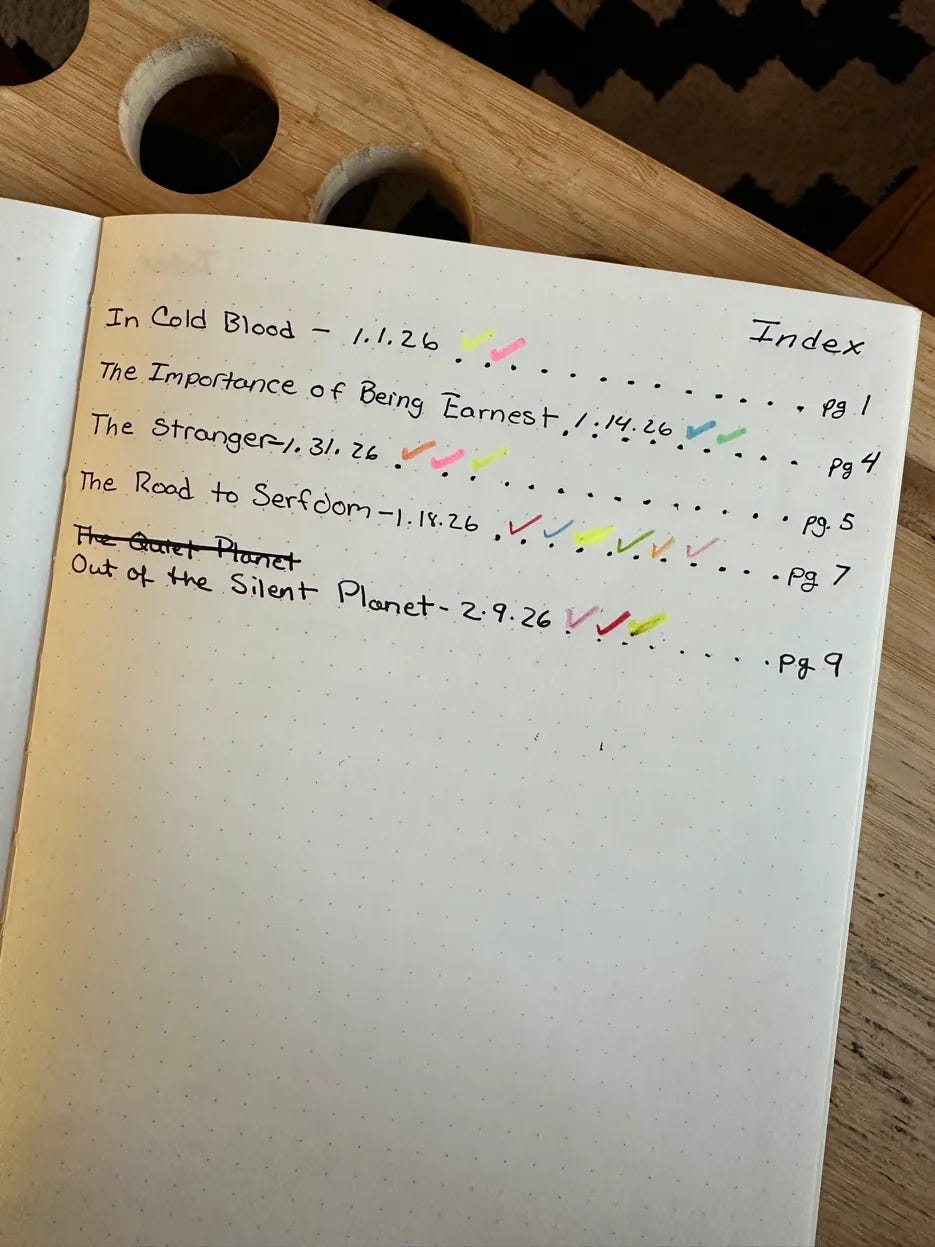
But here’s the part I like best: next to each title, I add colored checkmarks corresponding to which thematic categories showed up in that book’s entries. So at a glance, I can see that The Stranger hit on Narrative & Language and Nihilism & Absurdity, while The Road to Serfdom touched nearly every category in the key.
It’s a small thing, but it turns the notebook into something searchable. If I’m writing about narrative control and want to pull from my reading, I can scan the index and see which books had something to say about it.
The Process
When I read, I annotate. Margins, highlights, the occasional post-it note when I need more space. I add a sticky flag to anything worth revisiting.
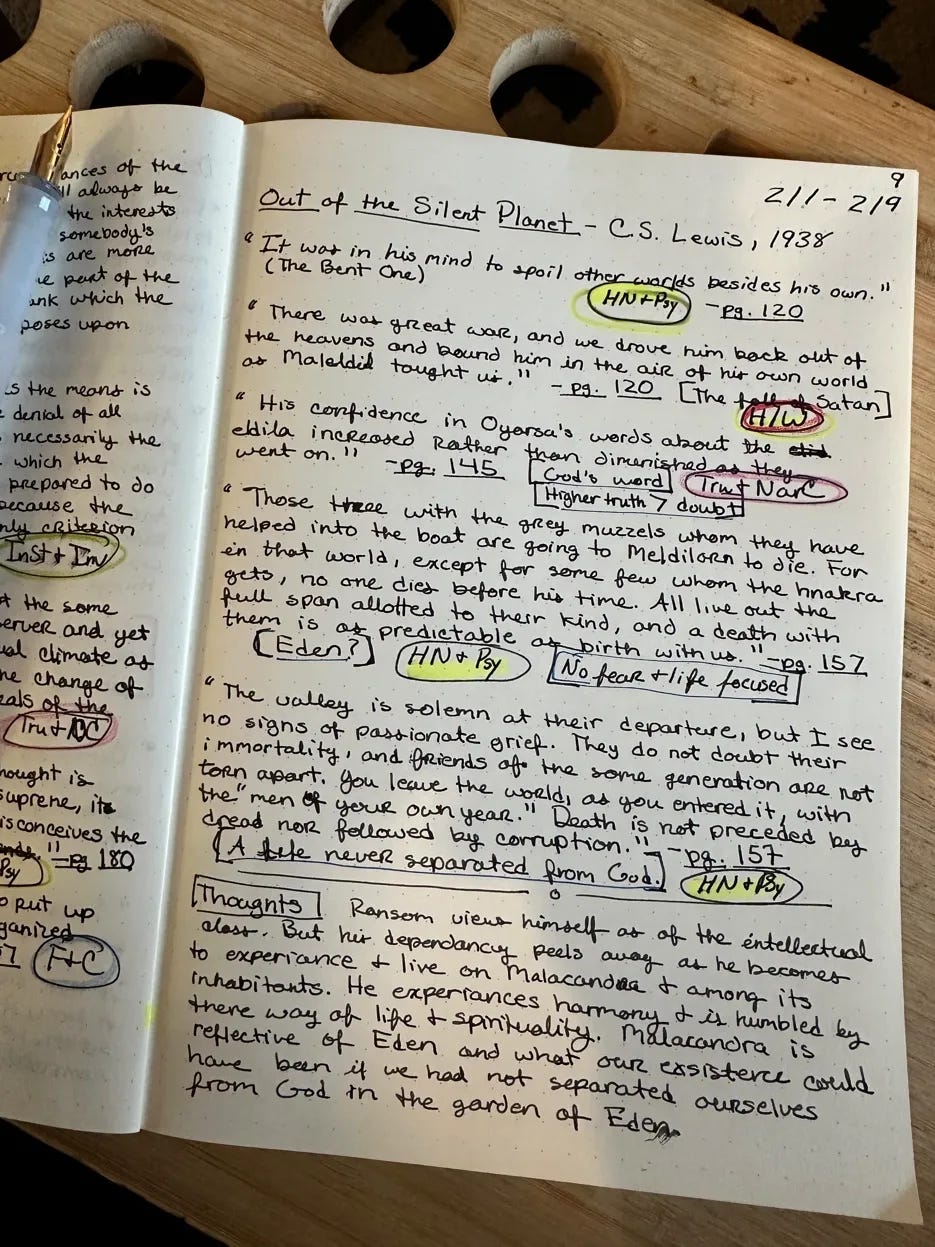
After I finish a book, I go back through everything I’ve marked. Not all of it makes the cut. I copy only the passages that still resonate—the ones that made me stop, or that I know I’ll want to return to.
Each entry gets the quote, the page number, and a color-coded tag linking it to one of my categories. At the bottom of each book’s section, I write a “Thoughts” paragraph—my synthesis of the book, or at least what I’m still chewing on.
Why Bother?
The obvious answer: retention. Writing things by hand makes them stick. But there’s something else, too.
I spend most of my day consuming information—scrolling, sourcing stories, analyzing how outlets frame the news. A commonplace book is the opposite of that. It’s slow. It forces me to decide what actually matters, what’s worth preserving.
And over time, it becomes a record of your own thinking. You can flip back and see what caught your attention six months ago, and ask yourself: do I still believe that? Would I still underline that sentence?
I don’t know yet. This book is only a few weeks old. But I like the practice. It feels like building something.
My Go-To Meatloaf
We like to buy a half a cow once a year, which means we get a ridiculous amount of ground beef. I have a handful of go-to recipes for our ground beef, and I will be sharing them over the next few editions of the Sunday Desk.
Today, let’s start with a trusty meatloaf!

Meatloaf
1 medium carrot, chopped
1 small onion, chopped
3 garlic cloves, minced
1 tablespoon fresh thyme leaves, minced
5 oz seasoned croutons
1/3 cup beef broth
18 oz ground chuck
18 oz ground pork
2 teaspoons salt
2 teaspoons paprika
2 teaspoons granulated garlic
2 teaspoons onion powder
6-8 strips of bacon (optional)
Sauce
1/2 cup ketchup
2 tablespoons brown sugar
1 tablespoon stone-ground mustard
1 teaspoon onion powder
Instructions
Heat oven to 325° F. Line a rimmed sheet pan with foil.
In a food processor, add carrot, onion, and garlic. Pulse until the onions and carrots are finely minced but not pureed.
Heat a large skillet over medium-high heat and sauté the vegetables with the thyme until tender, about 5 minutes.
While the vegetables are cooking, add the croutons to the food processor and process until they become breadcrumbs. Add the beef stock to the breadcrumbs and process until a paste forms.
In a large bowl, combine cooked vegetables, breadcrumbs, ground meat, and meatloaf seasonings. Mix together until well combined.
Wet the inside of a 10-in loaf pan. Line the inside of the loaf pan with plastic wrap. The plastic wrap will stick to the wet sides. You can also clip the plastic wrap to the sides with binder clips.
Press the meatloaf mixture tightly into the pan. Using the plastic wrap, pull the meatloaf away from the sides.
Invert the meatloaf onto the prepared sheet pan, remove it from the loaf pan, and discard the plastic wrap.
If adding the bacon, arrange the bacon slices on top of the meatloaf, overlapping slightly and allowing the ends to drape down the sides.
In a small bowl, combine the sauce ingredients and mix until well combined. Spread half of the sauce over the meatloaf.
Bake in the oven for 45 minutes or until a meat thermometer reads 155 degrees.
Remove the meatloaf from the oven and let it rest for 10 minutes. Brush remaining sauce over the meatloaf before serving.
The Near-Death of the Conversation Heart
If you grew up in America, you’ve eaten a Sweetheart. Those chalky pastel hearts stamped with “Be Mine” and “Kiss Me” that show up every February get tossed into Valentine’s boxes by elementary schoolers and then mostly sit in desk drawers until they’re thrown away in March.
They’re not anyone’s favorite candy. But they’re essential. Valentine’s Day without conversation hearts feels incomplete—like Christmas without candy canes, or Halloween without those little orange pumpkins nobody actually likes either.
So when Necco, the company behind Sweethearts, declared bankruptcy in 2018, people panicked.
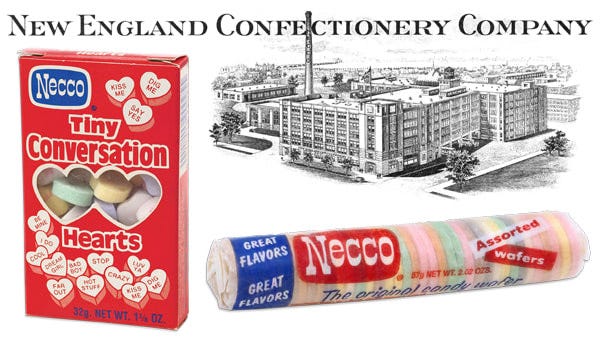
Necco—the New England Confectionery Company—was one of America’s oldest candy manufacturers. The company traced its origins to 1847, when a Boston pharmacist named Oliver Chase invented a machine to cut lozenges. His brother Daniel later developed a way to print messages on the candy, and by 1902, the iconic heart-shaped variety made its debut.

For over a century, Necco cranked out conversation hearts—nearly 8 billion per year at their peak, all sold in the six-week sprint leading up to Valentine’s Day. The messages evolved with the times. “Fax Me” got retired. “Text Me” took its place. The most sought-after motto was always “Marry Me.”
Then came 2018. Necco announced it was going out of business, and candy lovers were devastated. The company shuttered its factory in Revere, Massachusetts, laid off hundreds of workers, and halted all production. Panicked fans scrambled to find remnants of Necco wafers and other candies at local corner stores and across the internet.
Valentine’s Day 2019 came and went without Sweethearts on shelves. It was the first time in over a century.
The rescue operation was dramatic in a way only the candy industry can manage. Spangler Candy Company—the Ohio-based makers of Dum Dums lollipops—acquired the Sweethearts brand and set about reviving it. They dismantled, moved, and reinstalled 60 truckloads of equipment from the old Necco factory, some pieces had to be lifted out by crane through the roof.
By 2020, Sweethearts were back. Sort of. The printer responsible for stamping the hearts’ famous sayings proved unreliable, so many of the hearts that year arrived blank. Silent little hearts with nothing to say.
There’s something almost poetic about that—conversation hearts that had lost their words, returning from the dead but not quite themselves yet.
They’ve since recovered. Spangler got the printers working, brought back classic flavors like wintergreen and banana, and Sweethearts have reclaimed their spot as the most popular non-chocolate Valentine’s candy in America.
But for one strange year, the hearts went quiet. And America noticed.
That's the desk. A book about Mars, a meatloaf, a notebook full of quotes, and a candy that almost died. Not a bad Sunday, if you ask me.
See you next Sunday!

If you enjoy this slower, reflective corner of the newsletter, that’s what Sunday Desk is for.
Enjoyed all of this! Thank you! Especially loved learning about your common place book. I’m glad someone asked you to share! I’m gonna try it!
Love your common place book!! I am starting too! Thank you for the inspiration. Enjoying your substack!