

Sunday Desk | I Said No More Taylor Sheridan!
I lied. Also: a foul-mouthed parrot, a dark road, and a very good surprise.

If you have the opportunity to toss aside your Saturday routine, ignore the disaster on your dining table and step over the pile of laundry as you rush out through the laundry room and to your car to surprise one of your best friends, I recommend you do it. Especially if they are only two hours away, a short distance to travel when it would normally take a plane ride. While it does mean that my Sunday will not be one of rest, surprising one of my oldest friends, who was having a very bad day, was worth it. ❤️
It also means this edition of the Sunday Desk is a little rushed.
Rivera and Reeves UnFiltered LIVE!
In case you missed it! Also, make sure you check out the show notes for a discount code and join us for the next UnFiltered LIVE!

Episode Highlights
Rachel attended CPAC and witnessed a speaker directly warn the audience to stop listening to podcasters and social media influencers—the same conference that invited content creators to carry their message
The “conservative unity” push at CPAC was less about principle and more about midterm survival: a scripted talking point delivered by multiple speakers, including Steve Bannon and Jack Posobiec
Tucker, Candace, and Megyn Kelly are playing a game—the hosts break down what that game is, who’s winning, and why their astronomical numbers may have foreign fingerprints
The Iran operation isn’t the betrayal the podcast right claims it is: Trump has talked about Iran as an existential threat for decades, and the hosts make the strategic case that this is America First
The CPAC crowd skewed heavily older—a sharp contrast from last year’s younger energy—and what that demographic collapse signals for the future of the movement
The Madison
I was on the Taylor Sheridan bandwagon when Yellowstone first came out. I did not miss an episode. Then the show started to get weird with the eco-activist girlfriend who could be John Dutton’s granddaughter, and Beth’s emotional irritants became abusive and annoying. Girl, trauma is not an excuse for terrorizing everyone around you.
Suddenly, everywhere I looked, there was Taylor Sheridan, 1883, 1923, Tulsa King, Mayor of Kingstown, Lioness, and don’t even get me started on Landman. I am beyond weirded out by the mother-daughter dynamic in that show.
You know how we all became exhausted with the “Marvel Universe” — well, I have never watched Marvel, but you get my point. As soon as one series would end, another was on its heels, and they all were basically the same plot and characters repacked and dropped into sun-drenched scenery.
No more Taylor Sheridan for me.
And then I get SUCKED BACK IN!
I got baited while minding my own business scrolling when Kurt Russell and Michell Pfeiffer appeared on my screen. These are two of my favorite actors. Have you watched Russell recently on Apple TV+'s Monarch about Godzilla? You should. Anyway, I discovered they are together in the new series “The Madison,” a Taylor Sheridan series. UGH! I move on. “No more Sheridan!”
But everywhere I look, I see “The Madison.” It stalks me across my social media and streaming platforms, and finally, I break down.
I am four episodes in, and I am HOOKED! This show is an emotional roller coaster — sometimes a little cheesy — but it’s beautiful. Very different from his other shows, which are about conflict and bending the rules. The tragic loss of a long and faithful love is at the center of this series.
Think Manhattan meets Montana. The Clyburn family — polished, wealthy, New York to their core — finds themselves in the rugged Madison River valley in the middle of Big Sky Country. A devastating tragedy sends this family to the last place any of them would have chosen, and what unfolds is really a story about grief, love, and what holds a family together when everything falls apart.
It’s Madison Avenue versus the Madison River, and the contrast between those two worlds is just as much a character in the show as the people are. Pfeiffer plays Stacy Clyburn, who has a driver, a townhouse, and an opinion about everything. Russell plays her husband Preston, a man who loves that cabin in Montana more than Stacy will ever understand, or so she thinks.
Sheridan describes it as his most intimate work, and that tracks. This is his quietest, most dialogue-driven work to date — worlds away from the body counts and power plays of Yellowstone. No one is fighting over land or threatening anyone with a branding iron. It’s quieter than that. And even for a stoic broad like myself, I had to keep the Kleenex on hand.
Writing…
I am behind on my writing curriculum, but I wanted to share a little ditty from one of this week's assignments. If you are new here and have no clue what I am talking about, visit the two previous editions of Sunday Desk.
The Prompt
A character has received significant news before the scene opens. The nature of that news is never stated. The scene takes place in an ordinary setting — a meal, a drive, a task they’re completing alone or with someone else. The news is never spoken. The scene ends without it being revealed.
The Rules
No interior monologue. Not one sentence about what the character is thinking or feeling. Remove every “she thought,” “she realized,” “she felt.” If the interior creeps in, cut it.
No backstory. The reader enters the scene already in progress.
The news must be present in the scene — it should shape every gesture and line of dialogue — but it must never be named.
End on a physical image or action. Not a reflection. Not a summary.
Work
This exercise was hard! First, I focused on where the limitations are. What I couldn’t say or write about. How does one tell a story with nothing? My nature is to be direct. I do not beat around the bush. And while that may be appreciated by some in personal relationships — sometimes not by others — it does not make for good storytelling. If I were left on my own, my “stories” would probably fit on a post-it note.
Eeeek! This is a draft. Here is my short story. Be nice! 🤪
Counting in The Dark
She grips the steering wheel tightly and rolls her fists forward. A leather-pressed groan escapes from beneath her knuckles. Her hands hesitate over the wheel. She lifts her fingers, and the diamond catches the dashboard lights. Twirling her ring with her thumb, she stretches her arms out, pushing against the steering wheel, gripping it again, and letting out a slow, deep breath. The headlights of her car are the only light on the road, other than the occasional passing car. She reads a worn sign illuminated by a single overhead light at the side of the road, Wyatt’s Slaughtering. The road narrows between mountains, two-dimensional in the dark, as if to fold over on top of her like cardboard cutouts.
Checking her phone and still no signal, she sets it face down on the passenger seat and counts the dashes in the center lane. Shifting in her seat, she feels her back ache. She begins to count the dashes again, and they morph into a solid line. Looking at the speedometer, she eases her foot off the gas. The engine groans and shifts gears as it begins to gain elevation. On a sharp turn, the headlights catch the eyes of a doe on the side of the road.
Suddenly, the sky opens up on her right. The mountainside is close and jagged, pushing against the car. The road winds up the mountain, guided by a thin barrier cable. Below are constellations of light separated by gaps of darkness, and her fingers stiffen on the wheel as she pushes her back into the seat.
She reaches the crest of the mountain to a clear sky, no moon. A thumping rhythm is muffled by the tires. With her thumb, she turns her wedding ring, listening to the thumping of the road, and she gently nods her head to the beat. She approaches a bend, obscuring her view ahead, and slams the brakes. The tires screech, and her head rocks forward. Her back stabs at her, and the phone thuds on the floor between her feet. She groans and braces herself with the armrest, staring at the dark mound in the road glistening under the headlights. Stretching her leg, she searches for the phone and slides it closer to her. The pain stabs when she bends to grab it.
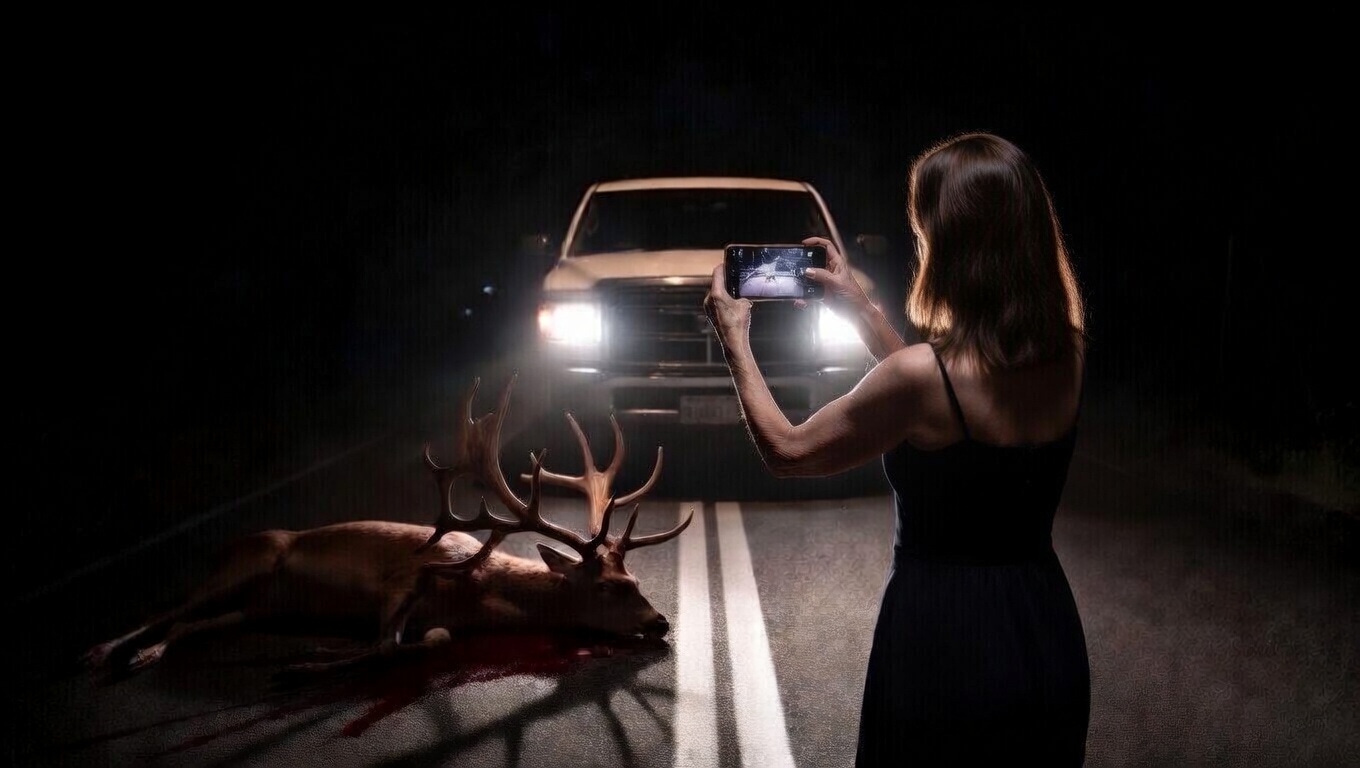
Slowly, she sits up and looks around — no other vehicles. She covers her nose with the back of her wrist when she opens the door. The air is putrid and rotting. The asphalt crunches under her feet as she gets closer to the source of the stench. Black button eyes looking back at her. The head is grotesquely contorted with a hoofed leg caught in its large antlers. It is a mature buck, its broad chest edged with a noble coarse ruff of fur matted with blood. Staring at it, she touches her back. Lifting her phone, she takes a picture, framing only the head. The blood runs onto the asphalt, black. A flood of light washes over her, causing her to shield her eyes from the oncoming headlights. An old pickup truck slows down. A man cranks open the window.
He wears a tattered Carhartt cap, leathered by sweat. His eyes are kind and hooded, with deep creased corners. A mustache conceals his upper lip.
“Are you ok? Do you need any help?”
She pulls her spine in, arching her back slightly. Looking towards the buck, she says, “I didn’t hit it.”
The old door groans low and tired, cutting through the silence with a single, worn-out creak. The man echoes his groan when he steps out of the truck. “Looks fresh. I can get it out of the way. Dangerous leavin’ it there.”
She nods, still staring at it.
“Do you need me to call anyone for you?”
She looks at him, sucking on her bottom lip. She squeezes the phone in her hand. “No.”
“Okay, then.” He tips his hat toward her.
She turns back toward her car, watching her feet as she walks back, gently lowering herself into the vehicle. In the car, she watches the man as he trusses the buck with some straps, tight and contorted, like a parcel. Her hands are resting in her lap, fiddling with the pop socket of her phone. Watching as he takes his gloved hands, wraps them around the straps, and heaves it into the bed of his pickup truck, slamming the tailgate shut. He pulls forward, signaling her to roll her window down.
“Are you sure you don’t need me to call anyone?”
“You’re kind,” she replies as she nods her head.
He tips his hat towards her as he drives off. She looks back at the black stain on the road. It doesn’t catch the light anymore. Sitting up in the seat, she flips the visor down, and the small light reveals her eye darkening to a bruise. Her lip is split again, and she runs her tongue across it.
She looks at the phone: four bars and a voicemail. Looking at herself again in the mirror, she sees black button eyes looking back at her. Quickly flipping the visor closed, she presses her back against the seat and sets the phone face down on the center console. Her thumb finds the ring. She hits the start button and starts counting the dashes again.
History’s Greatest Funeral Crasher
Okay, I need to tell you about Andrew Jackson’s parrot. Because somehow, in all the chaos of American history — the duels, the bank wars, the Trail of Tears, the general unhinged energy of the man — I am fixated on the parrot.
Which tracks, because I am randomly obsessed with talking birds.
Have you seen that “bacon, pancakes” bird? Or the one that struts on the back of the sofa, pulls up close to the camera, and says, “Hey baby!” The sudden onset of cute aggression is too much.
My husband has now walked in on me — multiple times, and every time, without fail, he delivers the same verdict:
“We are not getting a bird.”
Deflated and disappointed I respond with "I know.”
But, enough about my bird brain, let's talk about Jackson’s parrot, because this bird, I thought. This bird understood the assignment.
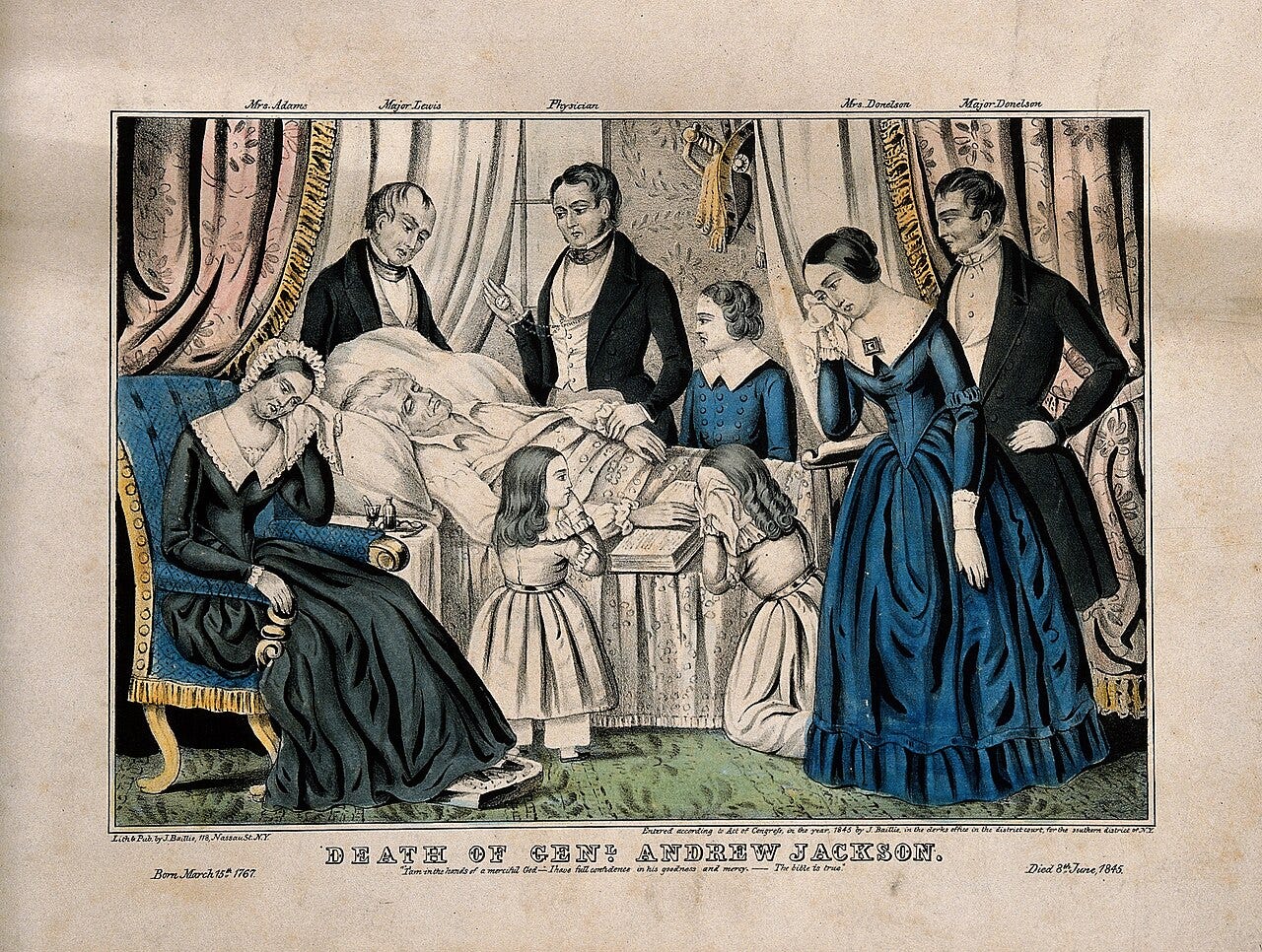
Here’s what happened:
When President Andrew Jackson died in June 1845, the nation mourned. Dignitaries gathered at The Hermitage, his Tennessee estate. The mood was appropriately solemn. The minister prepared his remarks. And then — Poll, Jackson’s African Grey parrot, decided this was his moment.
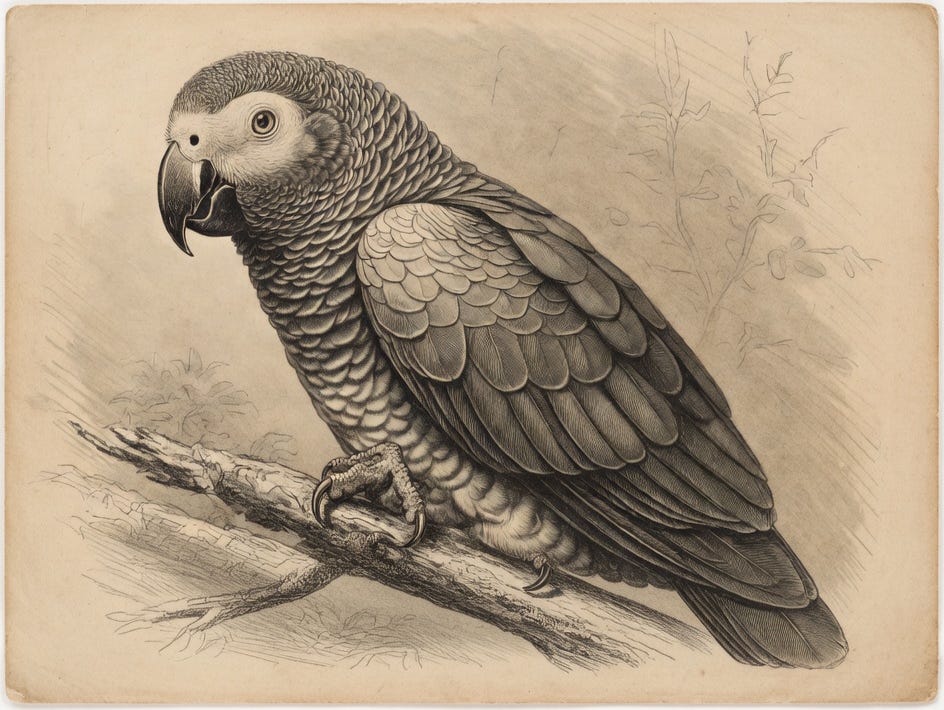
The bird, who had spent years in Jackson’s company absorbing the vocabulary of a man famous for his volcanic temper, his absolute refusal to be polite, and his enthusiastic commitment to dueling, opened his beak at the funeral and let it rip. Profanity. Loud, enthusiastic, completely unfiltered profanity. The kind of language that makes mourners look at their shoes. The kind that made the minister have to physically pause the service.
Here is a quote from the Rev. William Menefee Norment, who was presiding at the service, and found in Volume 3 of Samuel G. Heiskell’s Andrew Jackson and Early Tennessee History:
“Before the sermon and while the crowd was gathering, a wicked parrot that was a household pet got excited and commenced swearing so loud and long as to disturb the people and had to be carried from the house.”
The Rev. Norment goes on to report that the presidential parrot was “excited by the multitude and … let loose perfect gusts of ‘cuss words.’” People were “horrified and awed at the bird’s lack of reverence.”
They had to remove the parrot from the funeral.
This story gave me a chuckle. I think about it the way I think about the Petticoat Duel of 1792 — with a specific, delighted awe at the fact that history is mostly just unhinged people doing unhinged things, and we just call it “the past” to make it sound dignified.
Poll didn’t mourn quietly. Poll went out like his owner lived — loudly, defiantly, and with absolutely no regard for the room.
Now. If you spend any time in political commentary circles, you’ve heard people describe certain politicians as “Jacksonian,” meaning they operate with that same populist fire, that same combative energy, that same general “I will fight you in the street and also reshape the entire federal government” vibe. The comparison to Trump gets made constantly, and honestly? Whether you love it or hate it, you can see why.
Imagine what a Jacksonian parrot in the modern era would look like.
Picture it: a gilded cage. Not just gold-toned. Not brushed brass. Gold. Ostentatiously, aggressively, unapologetically gold-gilded, probably with the bird’s name on it in large block letters. The parrot inside is enormous, well-fed, opinionated, and completely unbothered by your reaction to any of this.
And what does it say?
“You’re fired.”
That’s it. That’s the whole vocabulary. Every greeting. Every goodbye. Every time someone walks into the room. The housekeeper. The chef. Foreign dignitaries. The dog, if there is one. You’re fired. Delivered with the flat, unblinking confidence of a creature who has heard it so many times it now considers it a form of punctuation.
And when the day comes — as it does for all of us, presidents and parrots alike — and there’s a funeral?
That bird is going to walk right up to the microphone during the eulogy and say:
“You’re fired.”
And that is this week’s Sunday Desk. Sorry, this one is quick. I am literally finishing this up right before church. But we have a fabulous and short surprise visit, ahem, the best podcast live there is, two very different love stories, and a foul-mouthed parrot. And before you ask. Yes, of course, I still want a bird.
Till next Sunday!

I live for random history like this! It makes history more alive. Thank you! This was fun! My best friend showed up for a surprise visit to me this week-she is four hours away. It was the best!!