

Sunday Desk | I Built a Footstool and Benched C.S. Lewis.
The office ceiling is winning. The emus were always winning. And my loop-closing instincts are fighting for their lives.

So. The office.
We’ve hit a speed bump, and her name is the ceiling.
The was the popcorn ceiling gets painted, panels go up over it, crown molding goes back on, beams run across the seams to create a coffered effect. Clean. Architectural. Exactly the kind of moody, intentional space I’ve been dreaming about. Easy, right? Wrong. It turns out you cannot simply strap decorative wood strips to a ceiling and call it structure; it requires a completely different approach. And the most upsetting part? It means removing the crown molding we already installed. The crown molding we spackled, caulked, and prepped to paint.
I am devastated.
We gave ourselves a weekend off after that discovery, which I needed and resented simultaneously. Because here’s the thing, the space is already pulling me in. It’s cozy in a way that feels earned, moody in a way that feels deliberate, layered with just enough warmth that it’s become the only room in the house I want to sit in. The gallery wall is mapped out in my head. The window treatments are calling my name. I’m ready. And I cannot do any of it until we sort the ceiling.
So for now, we wait. Grudgingly, impatiently, but we wait.
The $400 Char I Got for $40
Since the ceiling had me in a chokehold, I redirected my energy somewhere I could actually make progress: the lounge corner.
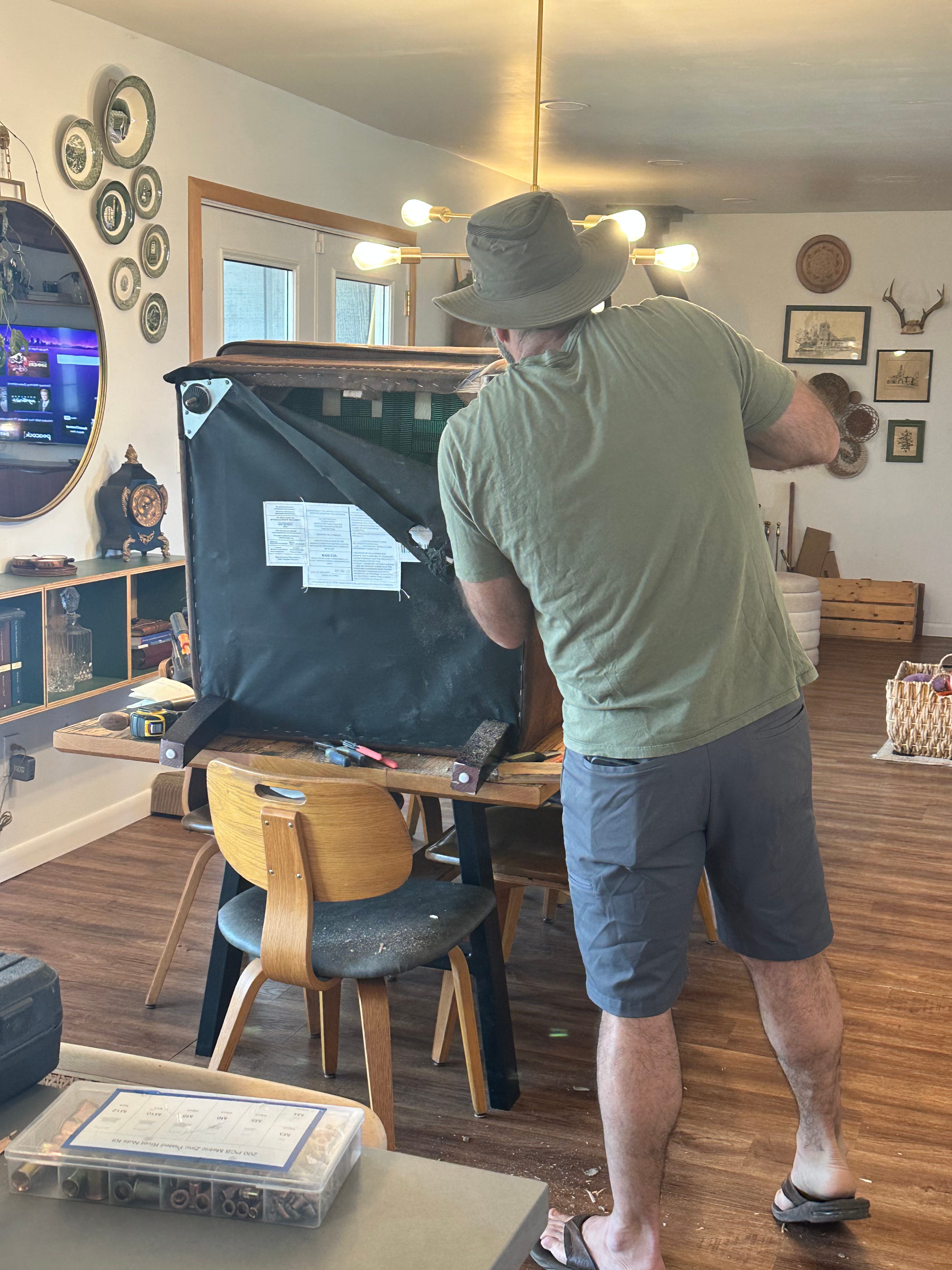
The chair I’d been using for the past five years — a tall, high-backed, mid-century modern piece I bought from Wayfair when we first moved in — has seen better days and no longer belongs in a room that has evolved into something darker, warmer, and more intentional than it was. It needed to go.
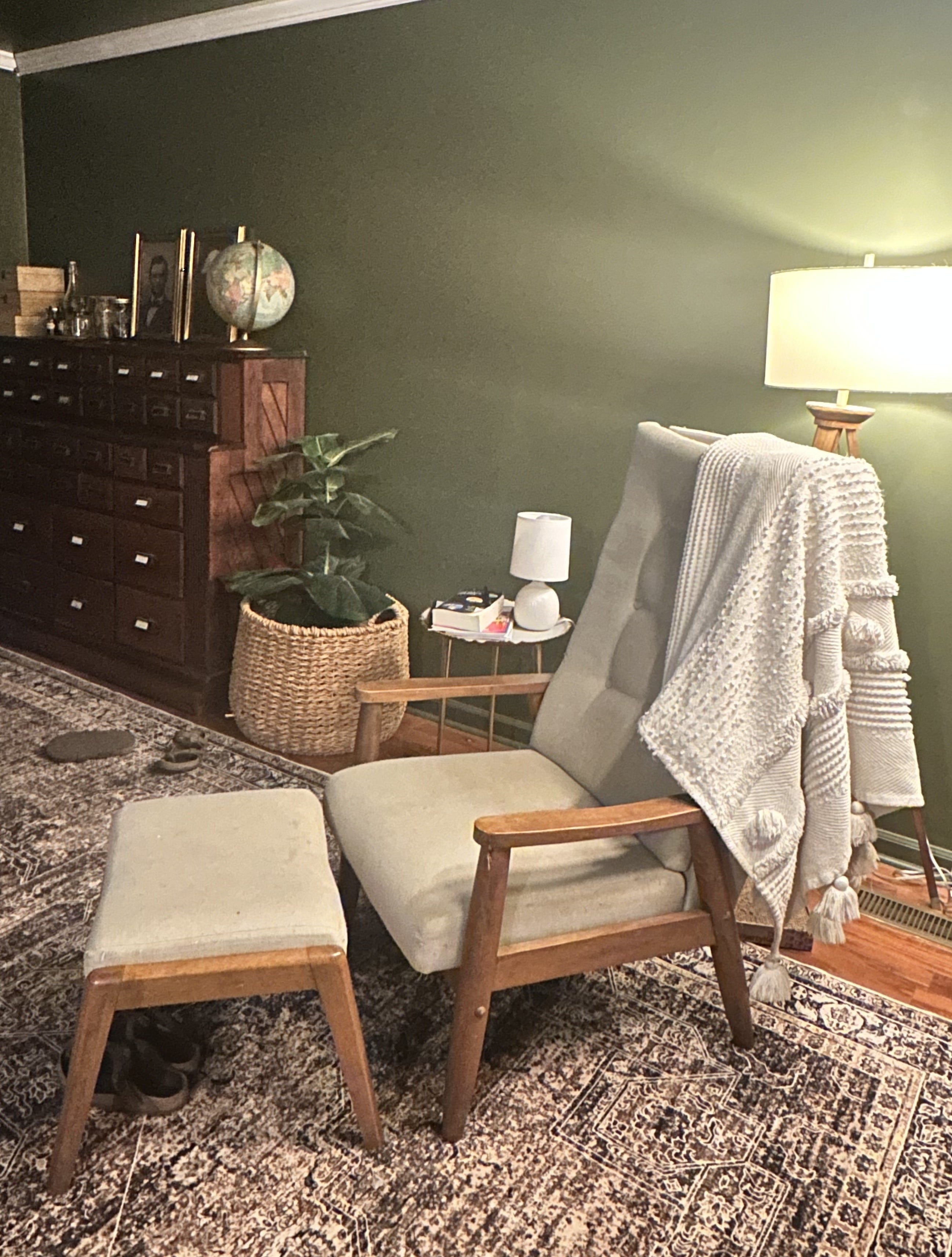
I started hunting for a lounge or club chair that felt right, and eventually found one on Facebook Marketplace for $40. When I did a reverse image search, it turned out to be the exact same chair I’d been eyeing on Amazon for $400.
I will not pay $400 for a chair off of Amazon. I will absolutely drive across town for $40.
The only catch was a wonky leg, which, if you have a handy husband, is not really a catch at all. He fixed the leg. And while he was doing that, I — a woman with no chill and no patience for waiting — decided to make an ottoman.
The Footstool I Made Myself (Because I Have Zero Chill)
The sensible version of me would have found a matching ottoman on Facebook Marketplace and waited. The actual version of me remembered that I had purchased some decorative legs with the intention of swapping them out on the chair, realized they weren’t structurally designed for a chair at all — better suited for a footstool or small table — and immediately interpreted that as a sign from the universe.
So I built one. And it is genuinely one of the most satisfying things I’ve made.
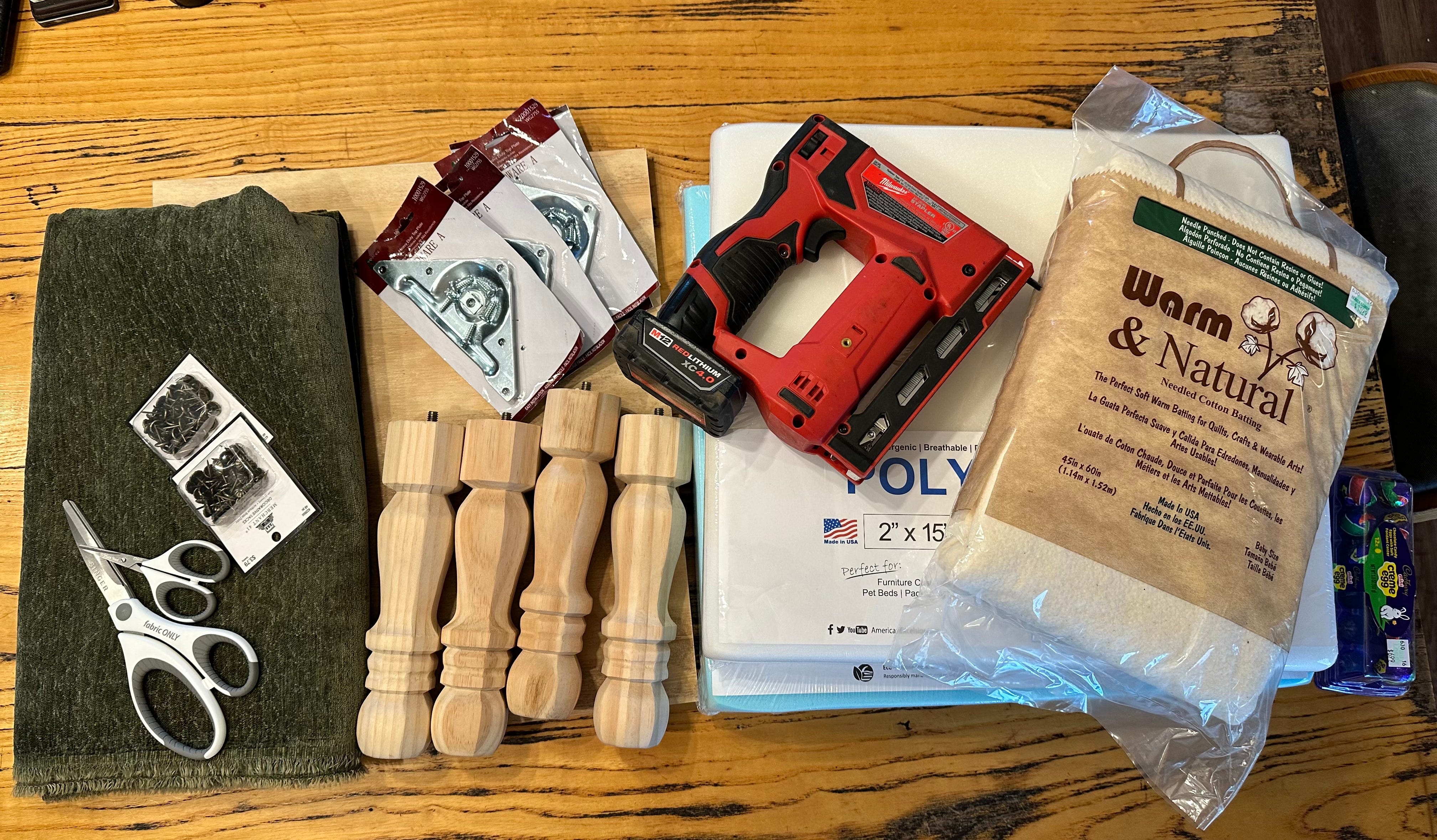
The project sounds more intimidating than it is. Here’s exactly how it came together:
Step 1: Prep the legs. My legs were pine, which needs to be conditioned before staining. Skip this step, and the stain will go on unevenly and blotch. I used a wood conditioner first, then finished with Deep Colonial Walnut stain for that dark, rich tone I wanted. If you’d rather paint them, skip the conditioner and use whatever paint you have on hand.
Step 2: Build the cushion. Spray-glue the plywood, adhere the 3-inch foam, spray the foam, and adhere the 2-inch foam on top. You’ll end up with a surprisingly satisfying stack that already looks like something.
Step 3: Wrap with batting. Staple gun time. Wrap the batting all the way around the cushion, pulling it taut as you go. This is what gives the final piece its soft, rounded edges.
Step 4: Add the fabric. Same process as the batting,
wrap and staple. The corners are where your patience gets tested, but take your time. The goal is flat and smooth. If you gather too much fabric at the edges, the staples won’t reach, so keep it even.
Step 5: Finish the back. Use your leftover fabric to create a clean backing on the underside. It’s a small detail, but it’s the difference between something handmade and something that looks handmade.
Step 6: Attach the legs. Hand this part off if you can. My husband installed the brackets; I supervised. It was a good system.
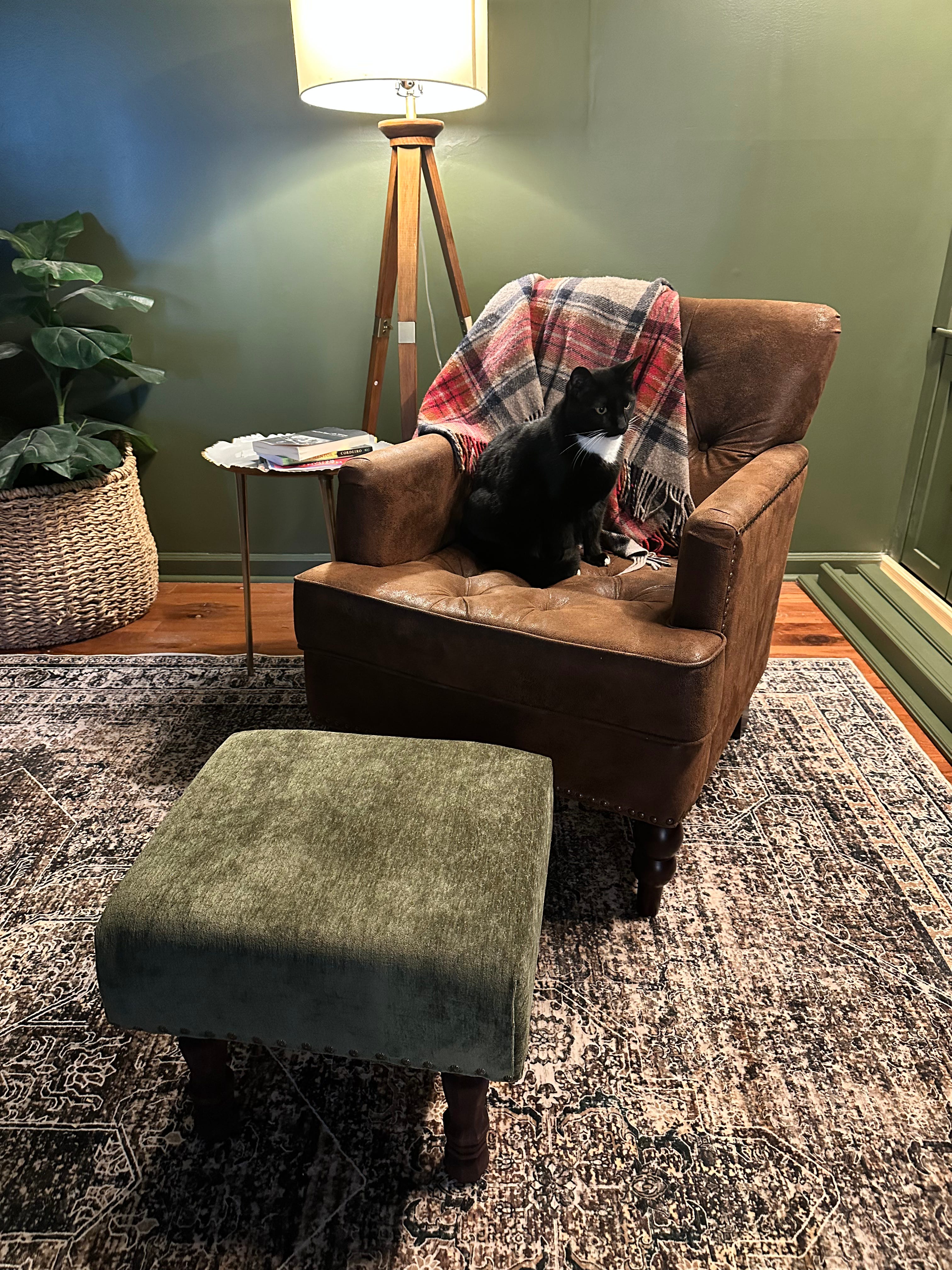
One thing I wish someone had told me: once everything is stapled, do a few small hand stitches along the corner seams where the fabric folds over. It keeps everything lying flat and tight instead of puckering at the edges. A small extra step that makes a big visual difference.
The whole thing cost a fraction of what I would have spent buying one, fits the corner perfectly, and I made it with my own hands in an afternoon. My dark, moody office now has a lounge corner that actually feels like a lounge corner, and that is deeply satisfying.


Supply List
From Home Depot:
2×2 ft., ¾-inch plywood sheet
9-inch furniture legs (pine)
4 leg mounting brackets
Decorative upholstery tacks (optional but worth it)
From Hobby Lobby:
Spray-on adhesive
15×17-inch, 3-inch thick upholstery foam
15×17-inch, 2-inch thick upholstery foam
Polyester batting
1 yard upholstery fabric of your choice
Staple gun + staples
Also needed:
Wood conditioner (if staining pine legs)
Stain or paint for legs
What I’m Reading (Or Trying To)
Let’s talk books, and specifically the small, persistent cloud of reading-related shame I’ve been carrying around this week.
I have been reading — or attempting to read — C.S. Lewis's Space Trilogy. I am on the second book, Perelandra, and I will be honest with you in a way that feels mildly embarrassing to admit: it is not going well.

Lewis builds worlds the way someone furnishes a room, layer by layer, with tremendous care and almost no urgency. And in its own right, that’s remarkable. He was imagining the cosmos well before humanity had ever left Earth, filtering it through a medieval theological framework that is genuinely fascinating to sit inside. I love what his mind was doing. I just cannot stay present long enough to fully appreciate it. The pace is slow in a way that loosens my grip on the story, and Perelandra, in particular, is giving me a kind of narrative motion sickness I was not prepared for. I’ll spare you the spoilers, but: bro. Something needs to happen.
So, I’ve made a decision.
I am officially pausing the Space Trilogy. I’m not ready to call it a DNF — I cannot bring myself to say those letters out loud — but I am shelving it for now, with what I choose to describe as “hopeful intentions” rather than denial. My actual goal was always That Hideous Strength, the third book, which is the one I wanted to read in the first place. I simply made the mistake of obligating myself to read the first two in order, as a person of integrity and principle, and now I am suffering the consequences of that decision.
We’re taking a break. The books will be here when I’m ready.
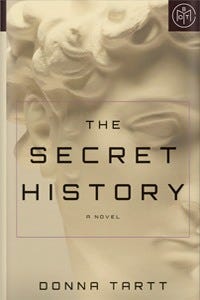
In the meantime, I’m moving on to Donna Tartt’s The Secret History.
If you know Tartt, you know her from The Goldfinch, but The Secret History came first, published in 1992, and I’ve had it on my list for longer than I’m comfortable admitting. The premise: “Under the influence of a charismatic classics professor, a group of clever, eccentric misfits at a New England college discover a way of thought and life a world away from their banal contemporaries. But their search for the transcendent leads them down a dangerous path beyond human constructs of morality.”
The first sentence grabbed me immediately. Which, after the struggle of the last few weeks, felt like relief. I will probably open it the moment I finish writing this newsletter.
So: C.S. Lewis is benched, I’m in partial denial about it, and I’m cautiously — carefully — optimistic about what’s coming next. I’ll keep you posted.
Writing Curriculum. Here’s Week Two.
Look, this week broke me a little.
Not in the way Week One did, where it was mostly about shaking off the stiffness of not writing fiction in a while. This week was harder in a more specific, more personal way; it exposed something about how my brain is wired, and what it exposed surprised me.

The entire focus of Week Two was learning to not close the loop.
Don’t explain. Don’t answer the question your own words have already answered. Don’t be so obvious. Build the tension, put the reader in the room, and then stop, before the resolution, before the explanation, before the moment where you tie everything together neatly and make sure they understand. Let them sit with it. Let them feel it without being told what they’re feeling.
My analytical journalist brain looked at that assignment and said: absolutely not.”
Most of what I do on a daily basis requires me to clearly and definitively land the point. That is the job. State the thing, back it up, answer the question, close the loop, and do it without ambiguity, because ambiguity in my line of work is a failure of craft, not a feature of it. So being told to deliberately leave the door open, to trust that the reader will feel what I never named? That went against every instinct within me.
It was not in my nature. And it showed.
But we’re getting ahead of ourselves.
Assignment
Week Two is called Scene Architecture & Escalation, and it picks up exactly where Week One left off. If Week One was about learning to find tension in a piece of writing, Week Two is about learning to build it, deliberately, beat by beat, through behavior and environment, without ever naming what you’re doing.
The core instruction for the week is a single line:
When you feel the urge to explain — pause. Cut the sentence. See if the scene survives.
It will. Almost every time.
The objectives: understand how a scene escalates through behavior rather than statement, recognize and practice a three-beat structure of rising tension, write a complete escalation scene that ends just before resolution, apply that pressure to one paragraph from my journalism, and build a daily journaling habit running alongside everything else.
Five parts. Here’s how they broke down:
Part 1 — Reading. Two more Hemingway stories: A Clean, Well-Lighted Place (quiet, devastating — almost nothing happens, and yet you feel everything) and Indian Camp (brutal, strange, and shocking — Hemingway never explains the ending; he only describes what the child sees). The assignment was mechanics, not analysis: where does the emotional temperature rise? What does Hemingway withhold, and what does that withholding create? What’s the last image, and why does it land?
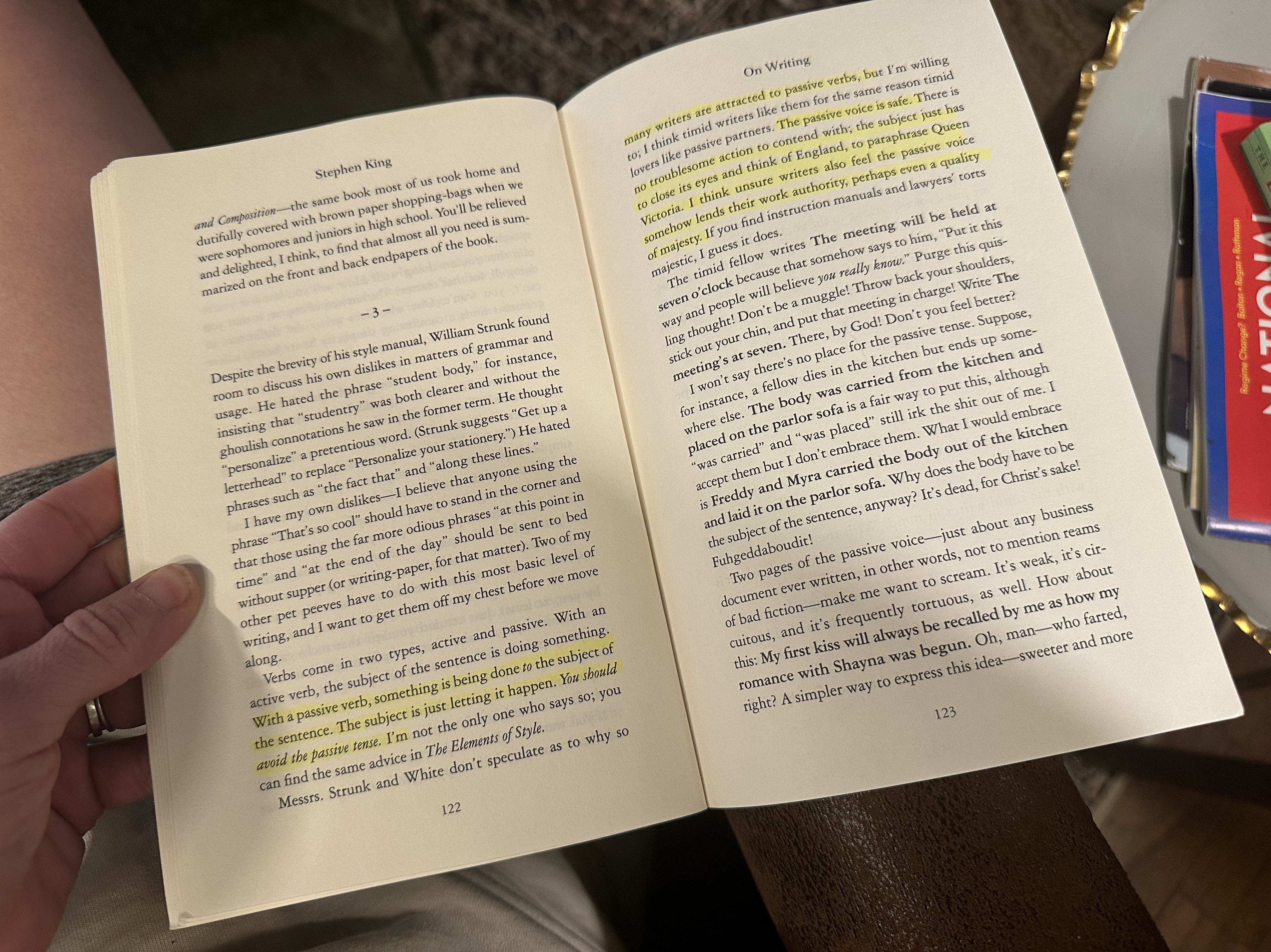
Part 2 — Craft Reading. The “Toolbox” section from Stephen King’s On Writing — a great book, by the way, if you haven’t read it — specifically on vocabulary and description. King’s argument is that description should feel inevitable, not constructed. The question to carry into the drill: what is the difference between a decorative detail and a load-bearing one? No written response required. Just read actively and let the question do its work.
Part 3 — Escalation Drill. Write a 700–900 word scene from a specific prompt — two people in a room, one wants to leave, one needs them to stay, no explanation of why — built across a strict three-beat structure. Beat One: managed tension. Something is slightly wrong, but no one has said it yet. Beat Two: the crack. Something small breaks the surface. Beat Three: the crack widens, and the scene becomes unbearable — but nothing has been said directly. End here. Not after. Do not explain. Do not resolve it. Trust the behavior.
This is the part that made me want to throw something and also the part I’m most proud of.
Part 4 — Journalism Application. Take one paragraph from a recent article — something explanatory, something that summarizes — and rewrite it as a scene. Find the physical moment where that information was happening. Same facts, completely different experience. I still have this one to complete 😉.
Part 5 — Daily Journaling. A new addition this week: five morning prompts designed to train observation without the pressure of craft. Monday was the anxious room — describe the one thing you’d notice if you were anxious. Tuesday was the unsaid thing — write a real conversation where something wasn’t being said. Wednesday was hands only — describe a person using only their hands, no face allowed. Thursday was the scene behind the story — take a moment from your journalism and write it as fiction. Friday was a free prompt with one rule: change your name.
I did everything except Friday. It’ll get done.
Want the full Week Two curriculum? I’ve linked it here: 👉 PHASE 1 – WEEK TWO | Scene Architecture & Escalation
This was a hard week. My loop-closing instincts showed up fully armed and I had to fight them the entire time. But something in Part 3 surprised me — and I think that’s exactly the point.
Paying subscribers can read all of my completed work below the paywall. ⬇️
The Time Australia Declared War on Birds. The Birds Won.
I need you to understand something before we get into this: the Australian government looked at a field full of emus and genuinely thought, we need to send in the military.
Not farmers. Not wildlife management. Not a very large fence.
The military. With machine guns.
And still lost.
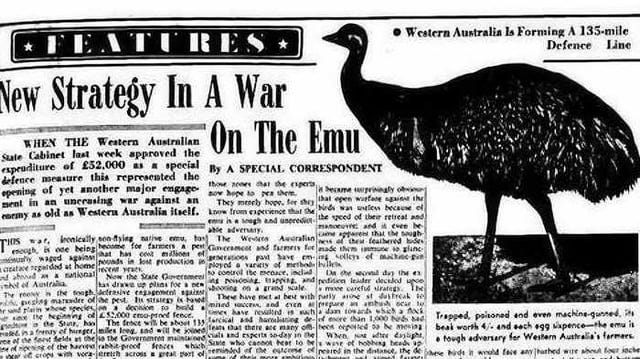
This is the Great Emu War of 1932, an insane historical disaster, a startling example of human overconfidence meeting nature's complete indifference. Nature didn’t even blink.
Here’s the setup. After World War I, the Australian government did what governments often do after wars: it handed out land to veterans as a thank-you for their service. Settle down, farm some wheat, build something. The land was in Western Australia, out near Campion, and for a while, things were fine. Then the emus showed up.
About 20,000 of them.
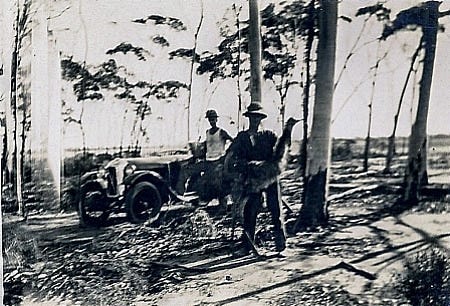
Every year after breeding season, emus migrated through the region, and they had apparently decided that the newly cultivated farmland — with its fresh water and abundant crops — was an excellent rest stop. The farmers, who were already struggling through the Great Depression and could not afford to lose their harvest, appealed to the government for help.
The government sent Major G.P.W. Meredith of the Royal Australian Artillery, two soldiers, and two Lewis guns.
Take a moment with that. Two machine guns. For emus.
The operation launched in November 1932 with tremendous confidence and went sideways almost immediately. The first attempt to engage a flock of about 50 emus ended when the birds scattered before the soldiers got within effective range. The guns jammed. The emus dispersed into the scrub in small groups, which, as it turns out, is nearly impossible to pursue across open terrain in a truck. The few birds that were hit often absorbed the shots and kept running. What is happening with emus? Major Meredith later reportedly compared their resilience to soldiers in battle, perhaps the most unhinged compliment ever paid to a flightless bird.
After less than a week, the operation was quietly suspended. Not because anyone officially called it off, but because it wasn’t working and everyone involved was aware that it wasn’t working, and the whole thing was becoming embarrassing.
The media, to their eternal credit, had an absolute field day. The ornithologist who had been consulted on the operation suggested that the emus had functionally adopted guerrilla tactics, dispersing into smaller, harder-to-target units when threatened. There was a proposal in Parliament to award the emus medals. Major Meredith was quoted as saying that if a military division had the same resilience as these birds, it would face any army in the world.
They tried again in December. Same result. By the end of the month, the military withdrew. Again. Permanently.
The farmers eventually got their fences. The emus are still there.
This story exposes how the government has an extraordinary capacity to escalate before trying the obvious thing. The farmers needed a fence. What they got first was an army. The army failed. Eventually, quietly, they built the fence.
How often do we do that? Reach for the biggest, loudest, most impressive solution — the machine guns, the grand gesture, the dramatic intervention — when what the situation actually required was something far simpler and far more patient?
The emus never changed. They just kept being emus. And that, in the end, was enough.
That’s the week. An office ceiling that is actively humbling me, a $40 chair I would die for, a footstool I built with my own two hands and zero patience, a curriculum that is forcing me to fight my own instincts, a book I finally want to stay up late for, and the story of a government that lost a war to birds and then quietly built a fence like none of it ever happened.
See you next Sunday.

For paying subscribers only
If you’re a paid subscriber, everything from Week Two is waiting for you below: the Hemingway reading notes, the escalation drill that surprised me, the break room scene with the thumb drive I had no business writing, and the daily journal entries, including the one that turned into something I wasn’t expecting.
This is the part of Sunday Desk I actually had to earn. And this week, it cost me something, which I think means it’s working.
Not a subscriber yet? The curriculum is built week by week, and this is where the real work lives. Come along.
