

Sunday Desk | Forty Years on Lookout Mountain
A bakery on St. Elmo, a Supreme Court ruling, and what came after.

True story ahead. Some details are approximate.
It’s a Wednesday afternoon. My husband has been on calls since morning. He lets out a loud sigh. I poke my head into his office.
“You done? Let’s get a croissant.”
“Where?”
“A new bakery at the old hipster pancake place,” I say. “Remember, it had that menu that was trying too hard—pansy garnishes, lavender lattes, and all that. You liked the corn pancakes, though.”
“No, but yeah, we can go.”
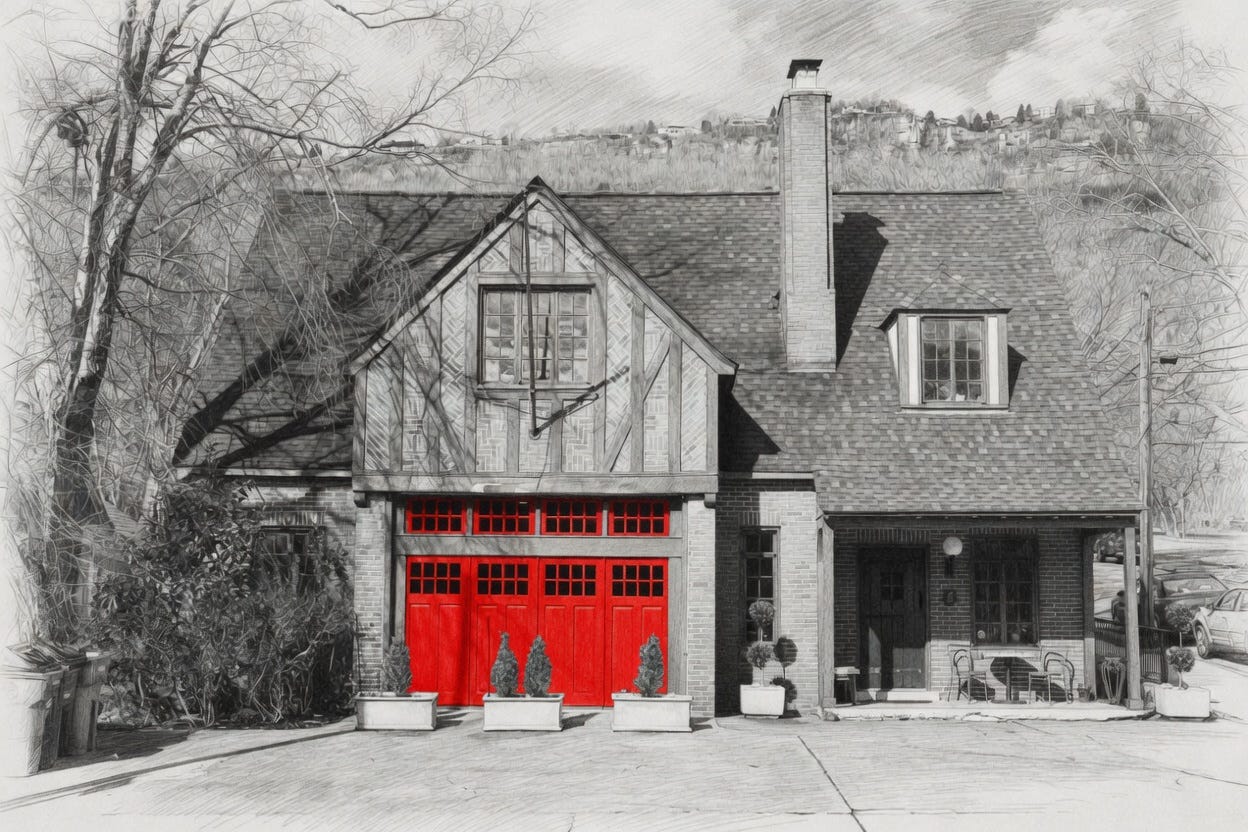
The Tudor revival at St. Elmo Ave. and W. 45th St. was built in 1934. It was Fire Station No. 14 for nearly fifty years. Now it's home to Wayward Pastry Co., the best croissants in Chattanooga. We park in front of the carriage house doors. They are fire engine red in the sun. A chalk sign by the door: one hour to closing.
Few pastries are left in the case. One looks as if it’s upside down, lacquered in sugar. The kind that hardens and cracks like crème brûlée. It reminds me of a turtle shell.
My husband asks, “What is it?”
The girl with a septum piercing says something that is meant to be Kouign-amann. I only know this because it’s written on the small chalk sign.
“But what is it?” I repeat.
“It’s like an inverted croissant with sugar.”
“Ooooh, I’ll get that! With a latte,” my husband says.
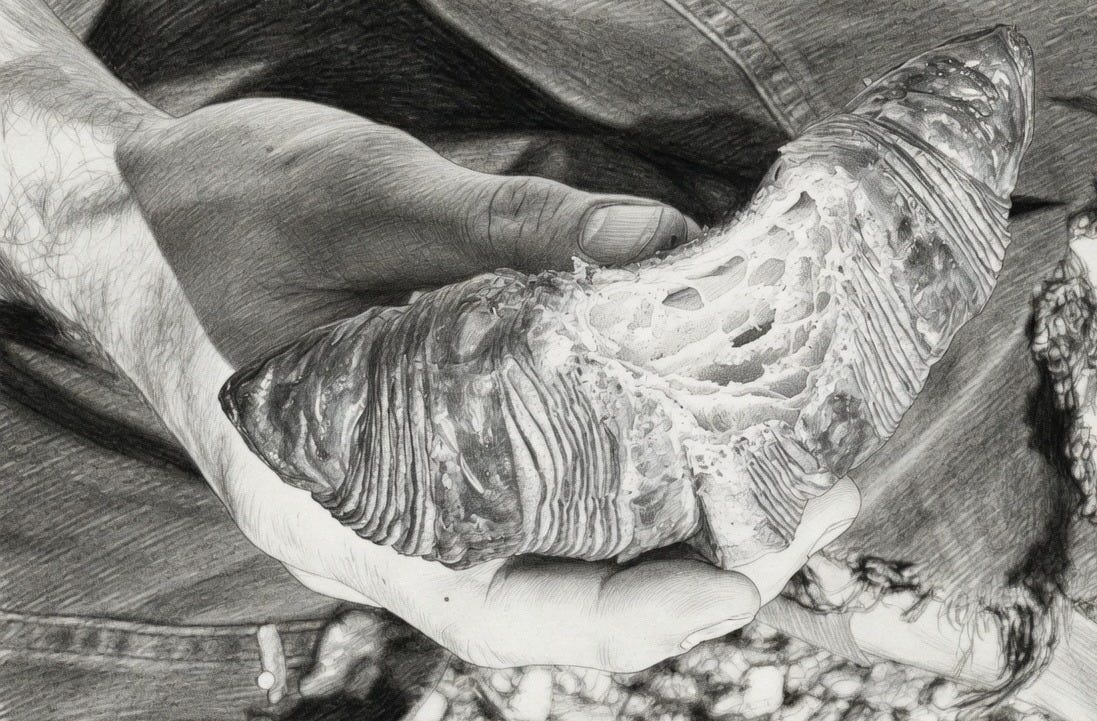
“I’ll have a latte too and a croissant. And a cookie. We can share,” I say to my husband.
Behind the girl, the barista grabs a ceramic mug. “Oh, and can we get the coffees to go?”
The septum piercing nods.
I turn around. A young woman sits at the bistro table below a large hole in the ceiling. Likely where a fire pole once was. Her eyebrows are pressed together. The keys of her laptop click. Behind the laptop are a mug and a plate of crumbs. She stops typing and makes a note. The clicking resumes.
Behind me steam bursts from the wand of the espresso machine; hissing echoes off the bare walls.
A gray-haired man walks in with a newspaper and stands in line behind us. He is wearing shorts with a button-down shirt. We make eye contact. His glasses are on his head. I smile as I leave with the box of pastries to sit outside. My husband stays to wait and pay for the coffees.
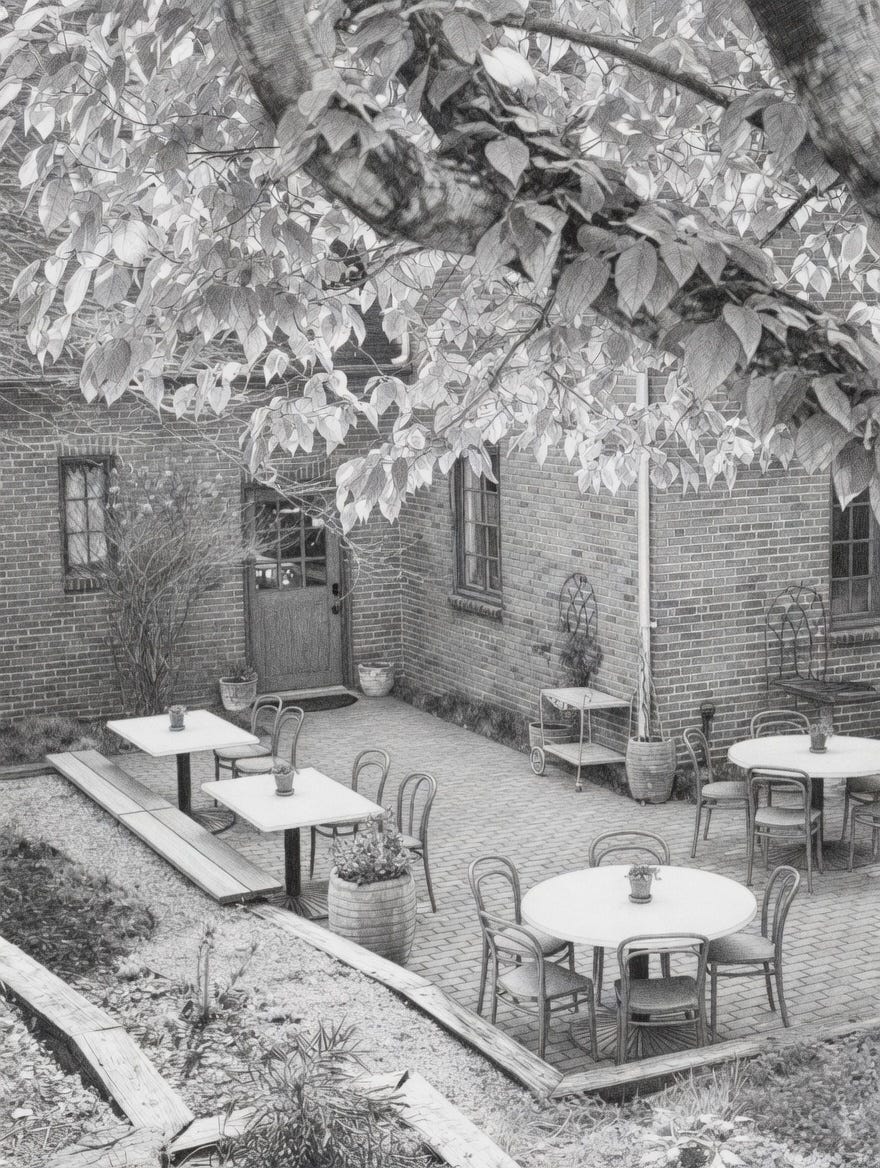
The courtyard is red brick, sunken into the earth, surrounded by tiered dirt beds held back by weathered timbers, silver with age. A woman wearing large sunglasses sits alone on the west side of the courtyard. Another laptop. The brilliant white tabletops hurt my eyes. She is focused. I wish I had my sunglasses. The only table in the shade is a bistro table along the back, next to two women engaged in conversation. One of them is waving her arms as if she were directing traffic. They laugh in matching pitch and tone. On their table are crumbed plates. One of the women has her quilted tote on her shoulder.
I sit at the bistro table.
I peek into the pastry box, tempted to steal a bite of the cookie, but I wait. The two women get up and say their goodbyes. I overhear one confirming plans for the weekend, something about snacks and a game, walking toward the courtyard steps. My husband comes out with the coffees, almost running into them. They exchange apologies. The other woman watches them as she closes her laptop.
We are alone in the courtyard.
I tease my husband that he is lucky the cookie is still untouched after taking so long with the coffees. He laughs, scrolling on his X feed.
“So what states are going to redistrict besides Louisiana, obviously?” I pull apart the light layers of my croissant and press them back together before putting it in my mouth.
He puts down his phone and cracks the shell of his Kouign-amann. “Several southern states. Five maybe before the midterms. Ten when it’s all done.”
“How is that inverted croissant?”
“It’s good. Do you want a bite?” He tears a piece and puts it on my plate. “Have some of the sugar too.”
“Mmm, that is good!—And Virginia is about to get overturned.” A chair scrapes across the brick courtyard.
“Yeah, that looks like it’s going to backfire.” He sets the coffee down. “Can you imagine if at the end of all this the Republicans are up 12 or more!”
“Lower your voice,” I say, smiling.
“Alito did awesome work with that opinion,” he says, lowering his voice.
“Sorry, are you talking about the Supreme Court ruling?” I hear from behind.
My husband stretches his neck to look behind me. I turn. It’s the man from earlier. His newspaper is on the table with his coffee and earbuds. I pause for a moment. His legs are crossed at the knee.
“Do you mean on the VRA?”
He shrugs. “The most recent one. What do you think of that?”
Like a dolt, I answer honestly. “I agree with the ruling.”
“But why?” He raises his hands and lets them fall. “I just can’t understand how anyone would think that this is a good thing.”
He asks if we know what it means. What will happen? Do we care about black people? Jim Crow 2.0! Every time we go to answer, he interrupts, pointing his finger. My heart beats in my ears.
I want to ask if he read the opinion, but he keeps cutting me off. I turn to look at my husband; he is smirking. In a brief moment of quiet, I say, “So you are okay with discrimination, and I am not.”
“I have black friends!”
“Congratulations,” we say together.
“I’ve lived on Lookout Mountain for forty years. You have to give back. I'm okay with a black district if it benefits them."
“So you’re prejudiced. I think we’ve established that.”
Trump’s Triumphal Arch over the bodies of dead soldiers. The ballroom. Trump’s name is everywhere.
“He thinks he’s a king!”
He had asked if I cared about black people, but he hasn’t mentioned one since.
My husband and I make eye contact. We chuckle.
I look at our plates with crumbs. My husband and I nod at each other.
We stand. “If you never cared to hear my opinion, why did you ask a question?” I say while placing my plate in the dish bin.
Putting his earbuds in, he mumbles something about this backfiring on the Republicans.
Did we allow this boomer to chase us out?
Last night, we sat on a different patio. Several tables with a bucket-o-beer. One table is discussing baby monitors and sound machines. There are empty bottles on the table.
Our server took our drink order. His t-shirt said, “Say sometimes to drugs.”
As he walks away, my husband is about to speak before I ask him if we cannot talk about politics or the news. He holds my gaze for a moment before he smiles and nods.
The man from Lookout Mountain didn't change my mind. He changed where I'm willing to open my mouth.

Eric Church and the Six Strings of Life at UNC
If you watch one thing this weekend, please watch Eric Church’s commencement address at UNC last Saturday. Twenty minutes and a guitar. The whole speech runs on a six-string metaphor about life.
Church, a graduate of UNC, built the speech around the strings of his guitar, one pillar per string: faith, family, marriage, ambition, community, and the original voice only you can bring. The spouse you pick is the D string. Ambition and resilience both live on the G and pull against each other. The high E is the thinnest one, the melody, the string most easily bent by outside pressure. “The world does not need another cover song. It needs an original.”

Then he hit the community string. He told 7,000-plus graduates to resist the temptation to perform for everyone and belong to no one, to be globally visible and locally invisible, to have thousands of followers and no one knows where you live. Plant yourself somewhere. Learn names, not usernames. Coach the team. Build the thing your community needs even if the internet never sees it.
This is how we all should live.
The Women on Either Side of Him
This summer, I made a pact. No TV unless I’ve already read. The idea is to spend more evenings with books and less time half-watching shows we wouldn’t remember a week later. It’s been working. Mostly.
Then a friend started hounding me to watch False Prophet. She had finished it, she needed to talk about it, and I am a good friend. I read first. Then I binged all four episodes in one afternoon.
False Prophet is the follow-up to Keep Sweet: Pray and Obey, the Netflix documentary about the FLDS church under Warren Jeffs. If you saw the first one, you remember thinking the story ended when Jeffs went to prison. It didn’t. It almost never does. False Prophet is about Samuel Bateman, an FLDS member who broke off years after Jeffs’s arrest, declared himself a prophet, and started collecting wives and children. Including his own daughters. I know, eww. Also the daughters of the men who followed him.
If you like true-crime cult documentaries, this is a good one. Four episodes, tight pacing, no fat. But the part that stuck with me wasn’t Bateman. The dude is something else, sure. It was the women.
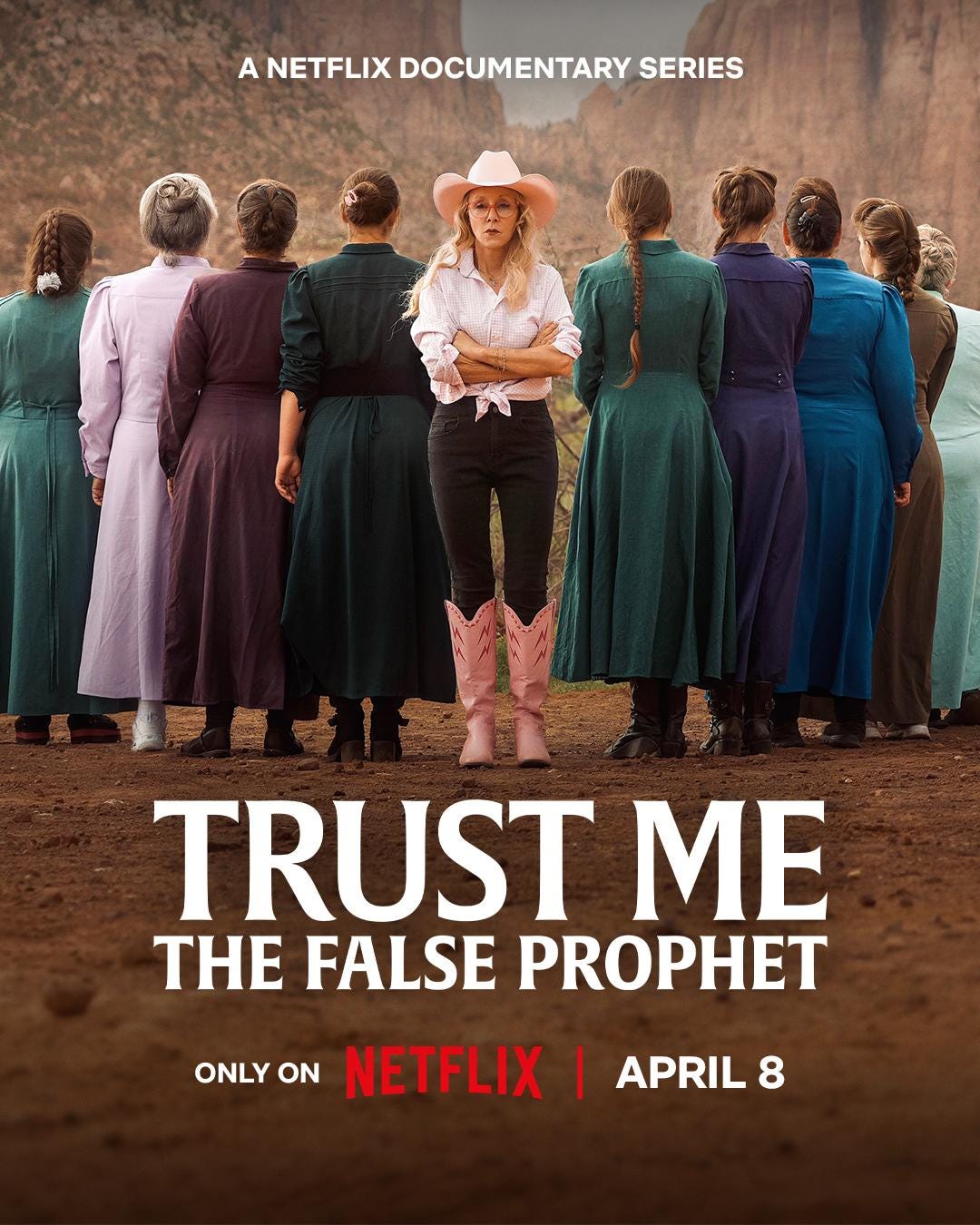
Christine Marie Katas runs an organization that helps women leave fundamentalist polygamy. She came out of a similar situation herself. When she got word of what was happening inside Bateman’s group, she didn’t call the FBI and wait. She infiltrated. She told Bateman she was making a documentary about his ministry, brought a camera, and spent months filming a man who believed she was promoting him, while she was actually building a case to get the women and children out. His ego was the lever, and she pulled it. She lied to a prophet to save the people he was destroying. The deception was the rescue.
And then there’s Julia Johnson. She’s the heart of the documentary. Her husband, Moroni, was one of Bateman’s first followers and one of the men who handed his daughters over as wives. Julia went along at the start because that’s what the structure required. Her husband was the head of the household. She was raised inside the FLDS framework, women second, don’t question authority, keep sweet, and Moroni’s word was the word she was supposed to obey.
By the time she realized her daughters were in danger, she had no tools to act. The structure she’d been raised in was the same structure now threatening her children. She had been taught her whole life that her instincts were the problem. So when her instincts started screaming, she didn’t know if she could trust them.
She turned to Christine. A stranger with a camera. That was the only door open to her.
This is the thing the documentary is actually about, even if it doesn’t quite know it. Bateman’s downfall is the plot. His ego, his greed, his sloppiness, the federal charges that finally stuck. All of it is satisfying in the way true crime is satisfying, which is to say it gives you a man in handcuffs and credits. The women are the story. Julia, raised to obey, learning to trust herself in the worst possible circumstances. Christine, already out, walking back into the fire on purpose because no one else was coming.
Documentaries package resolutions. Bateman is in prison. The children are out. Roll credits. Christine is still doing this work because there are more Batemans. There’s always another one. The false prophets are interchangeable. What outlives them is the theology underneath, the one that teaches women their second-class place, treats doubt as sin, and dresses obedience up as virtue.
If you like true crime and the culty stuff, watch False Prophet. It’s worth your time. Just know what you’re watching.
The Tree That Owns Itself
There is a white oak in Athens, Georgia, that legally owns itself.
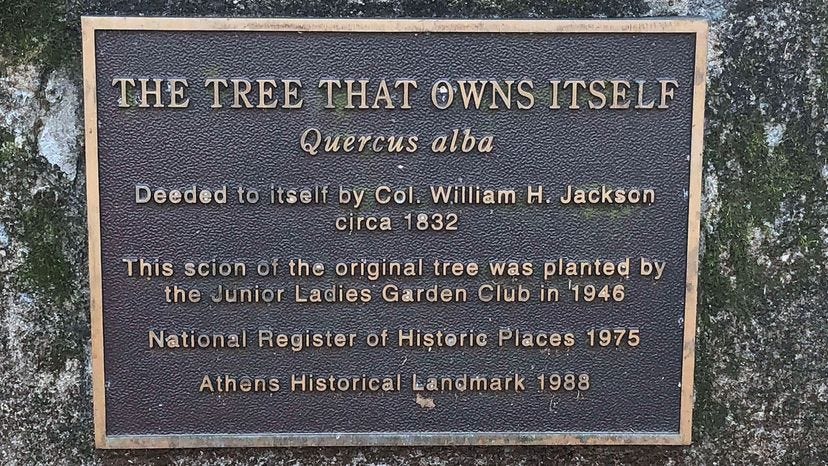
I am not making this up. The tree owns itself, and it owns the eight feet of ground around its trunk in every direction. It has a deed. A small stone plaque sits nearby. People take pictures with the tree.
Sometime in the early 1800s, a man named William Henry Jackson grew up playing under this oak. He loved it like it was a friend. Climbing its limbs and widdling its broken branches.
When he inherited the land as an adult, he decided the tree shouldn’t have to depend on whoever happened to own the property next. So, he wrote a deed transferring ownership of the tree and the ground it stood on to the tree itself.
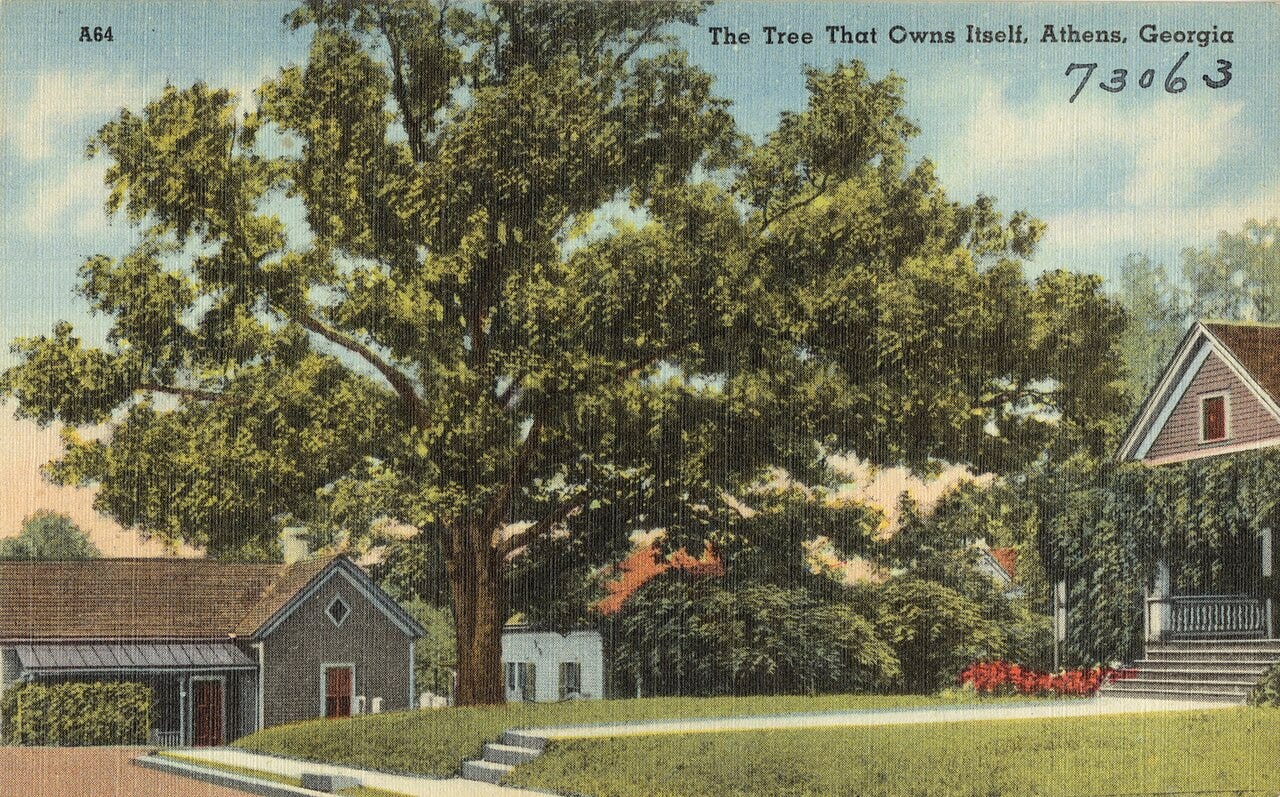
Whether the deed is legally valid is something lawyers like to argue about. Georgia has never said no. The city of Athens has treated the deed as real for almost two hundred years, which in legal terms means it is settled.
The original tree fell in 1942. Blown by a storm. By then, it was around 400 years old. The people of Athens were distraught, and the Junior Ladies Garden Club planted one of its acorns in the same spot. That tree is now in its eighties. People call it the Son of the Tree That Owns Itself. I think it would be more southern to simply call it Junior.
I love this story.
Yes, part of it is absurdity. A tree with a deed. It doesn’t pay property taxes if you were wondering, but it’s a legal person. Sounds like a good deal to me.
William Henry Jackson looked at something he loved and decided the only way to protect it was to give it to itself. He feared his future heirs would chop it down. He didn’t trust the next buyer to not clear the lot. So he removed the tree from the market entirely. He made it ungiveable. He made it un-sellable. He gave it the only thing a tree could plausibly own, itself.
The tree has had a quiet life. It has watched Athens grow up around it. It survived the Civil War, two world wars, the invention of the chainsaw, and at least one storm that killed its Pa’. It has been photographed by tourists, climbed by children, and visited by every sentimental writer who has ever passed through northeast Georgia.
I hope to be one of these visitors soon.

Your opening story is hilarious, as I've lived this same experience, except in Seattle. There's a French bakery walking distance from my parents house that we like to frequent. The baristas all have septum piercings and are in various states of gender transition. And they make darn good coffee. It's in an uppity neighborhood full of Amazon wealth and retired boomers who have lived there forever. We also like to get lattes and Kouign-amanns.
Except I relish talking politics loud enough to be overheard at the coffee shop. For some of these people, it's likely one of the few times they're hearing a different perspective. The default assumption in Seattle is that everyone else thinks exactly the same way you do. It throws them for a loop when you disagree or drop the dreaded "R word" (Republican).
One day, circa 2019ish, the guy behind me (white male, late 30s) in line was singing the praises of Jim Acosta (!!!) and how good his reporting on Trump was. Luckily I hadn't received my latte yet because there would have been a spit take. Coulda knocked me over with a feather after that.
I’ve watched secrets of polygamy, sons of perdition and escaping polygamy, and the Mormons (all available for free on Tubi). Lots of info about Jeffs and Bateman in all of those, as well as details on other polygamy groups that operate in broad daylight in Utah. It’s very disturbing. And I’m wondering why they are all allowed to operate when there is significant abuse, child abuse, incest and financial fraud going on. Clearly the state of Utah spends a lot of time ignoring the splinter LDS groups.