

How Democrats Manufactured Graham Platner for the Maine Senate
A face, a farm, and a $300 donation to Bernie. That was the whole vetting file for a must-win Maine Senate seat.

Allow me to set the scene. Leanne Fan is sitting on her living room couch next to her fiancé, Dan Moraff, with the vocal fry heard around the internet, scrolling BlueSky. And she stumbled upon a video of a guy with an oyster farm.
She sat up dramatically, “This is the guy!” and showed Dan. She handed him the phone to finish watching the video while she ran his FEC history on her laptop and saw he’d given Bernie Sanders $300. Done deal, they had a future Senator.
“That was enough information to know that we had the best prospect that we’d maybe ever had.”
There was no candidate interviewed. No question on his ability to run, advocate, or even policy positions. He’s a grizzled, white dude who voted for Bernie. Winner, winner, chicken dinner, a prospect found. The seat was Maine, the one Democrats needed to take back the Senate, and what better way to flip the seat than to put an “oyster farmer” who can read a script?
Blinded by their checklist of identity criteria, they had no idea it was due to fall apart.
Graham Platner didn’t climb a ladder. He got discovered. It was like one of those stories you would hear in the 90s of the high school girl discovered while walking through the mall. Except this time the model scouts were two activists from out of state, engaged to each other and running campaigns between a law-school final and a sociology seminar. They pictured a working-class hero in their mind and went scrolling for a face that fit. He also checked a few more boxes: a Marine veteran, a documented oyster farm that existed on paper. Never mind he was “making a living on the sea” subsidized by his mother, or bought a house thanks to his father, or that nobody had checked who he was under the beard, or that the people doing the casting particularly cared to.
These are the same people who swore off hand-picked candidates, then hand-picked one.
The casting directors
Matt Yglesias named it over on the New York Times, and he meant it as praise. Dan Moraff, he wrote, “approaches his job like a casting director,” hunting a particular type: military veterans with blue-collar jobs and no electoral experience. Moraff didn’t run from the description. He leaned into it. “We want people who didn’t run for student council,” he told the Wall Street Journal. “We want people who have not been spending their entire lives planning their ascent to political power.”
They both believe they’ve stumbled onto a new genius strategy for finding candidates. “We went through thousands and thousands of prospects,” Moraff says. What they’re actually doing is one more tired round of identity politics.
Moraff has a house style, too. “A healthy contempt for existing Democratic Party infrastructure is really essential,” he said, because the establishment builds campaigns where “a normal person can look at it and say, this looks and sounds like shit.” He’s not entirely wrong about that. He’s just describing a problem he then made worse.
The costume
They liked what they saw. The beard and the forearm tattoos. A sweatshirt, and an oyster farm that photographs like a Carhartt catalog. And the ad Morris Katz cut, where Platner stares down the lens and says Maine has become “essentially unlivable for working class people, and it makes me deeply angry.” Slate and the Free Beacon both clocked it early as working-class cosplay, markers picked for what they signal.
Watch the ad, and you can see the hands of young elitists all over it. Platner chops wood. He swings a kettlebell. The military service gets its beat, the guitars come up loud, and somewhere in there he drops an F-bomb, because nothing says regular guy to the Democratic Party like a well-placed F-bomb. All of it manufactured as a real person being himself. Then the script slips. The ad reaches for the word “oligarchy,” not a word you hear at the boat launch or the transfer station. It’s a word you hear in a DSA reading group. The costume is Maine; the vocabulary is Brooklyn.
Katz will tell you what he built. “I wouldn’t say it’s a progressive agenda as much as a populist agenda,” he said, “a common sense approach.”
“Common sense” is the exact language Yglesias pins on Daniel Lurie, the moderate San Francisco mayor and Levi Strauss heir. On Lurie it fits. Katz reaches for the same phrase to disarm his socialist agenda, to make it sound as reasonable as the blue blood’s when it’s nothing of the kind. That’s the costume. The socialist trying on the centrist’s clothes.
Everything a voter could see about Graham Platner was chosen to read a certain way to a certain Mainer. And the plan worked, until it didn’t.
The osyterman with no clothes
We already know the vetting was thin, because the candidate imploded. Moraff will even walk you through it. “We paid a nice firm a whole chunk of money and got some stuff back,” he said. “Some of what you’ve seen on the news we got back, other stuff we didn’t.” Some they caught, some they missed, and all of it was sitting in public for anyone who bothered: an SS-style tattoo, a trail of racist Reddit posts under the handle “P. Hussle,” explicit texts to other women, and a sexual assault allegation he denies. Nobody looked hard, because looking hard wasn’t the assignment. All that mattered was that he looked the part.
Then comes the line that should end a career in campaign management. Knowing at least some of what was there, Moraff decided, in his words, “none of this will or should stop him from becoming a US Senator.”
The PTSD is real. He’s a combat veteran who came home from Afghanistan carrying what a lot of them carry. He also uses it as a crutch, a blanket excuse to skate responsibility for the rest. “A bad stretch I’ve grown past” is bogus. He didn’t own the Reddit posts; he deleted them. The tattoo didn’t get explained; he first played dumb and then got it covered. That’s what you do with things you’re hiding, not things you’ve squared with.

This was no surprise; they knew early on. Graham didn’t confess to the texts of his own accord. His wife, Amy Gertner, brought them to the campaign herself, not long after the launch, handing them to Platner’s political director, Genevieve McDonald, who resigned that fall as the revelations kept coming. And when McDonald became inconvenient, Katz leaned on her — pressuring her to lie about the texts and warning she’d be branded a liar and a saboteur if she cooperated with reporters. They knew, and they tried to silence and discredit her. This isn’t a flawed man who slipped through the cracks. It’s a crew that kept building and covering for Platner after they’d been told.
Moraff’s whole pitch is that voters “do not want their candidates grown in vats.” They want a real human being, he says, not the establishment’s focus-grouped android. Bro, that is what you built, and you chose the worst foundation based on your girlfriend’s scroll. The country is full of real, decent people who chop their own wood and mean it, and they don’t have a Nazi tattoo or a racist Reddit history even after suffering PTSD. There are plenty of people with authenticity and without the baggage. But who cared? The guy was in Carhartt, driving an oyster boat.
Back in early June, when asked point-blank whether they’d vetted him enough, Moraff shrugged: “We will let the people of Maine decide.” Which, to me, read as a no, and he was deflecting any responsibility onto Maine voters.
The line they finally wouldn’t cross was a 2021 rape allegation from Jenny Racicot, a Democrat. Telling, given how fast they’d waved off the abuse allegations from Fifield, a Republican ex. Platner calls the allegations false. Racicot’s account is what finally led them to pull the plug, conveniently as Platner was already sinking in the polls. He suspended on July 9 and withdrew the next day; Maine Democrats have until July 27 to name a replacement.

When Katz finally spoke, his statement said he was “deeply disappointed.” In Platner. Not in the method that pulled a stranger off a video and bet a must-win Senate seat on him. The only line they wouldn’t cross turned out to be rape. Everything short of it, they’d already signed. That’s not a mistake anyone’s learning from. That’s a business model.
The people with the plan
So who cast this?

Dan Moraff went to Brown and then Yale Law, and he runs a shop called Dark Forest. His grandfather was Seymour Ginsburg, a president at Toys “R” Us. Leanne Fan is a sociology PhD student at the CUNY Graduate Center, where she studies labor and social movements, which is a polite way of saying she studies the working class she then packages. She’s also Moraff’s fiancée; they met on the Sanders campaign in 2020.
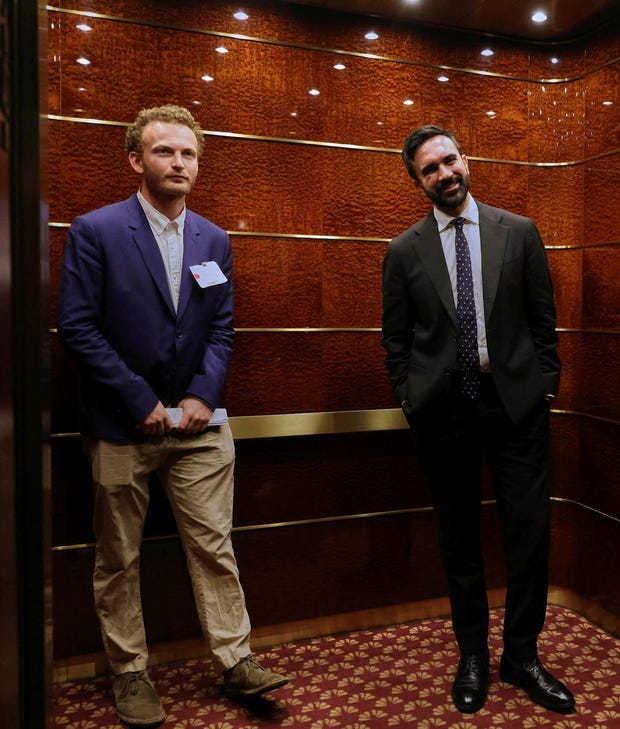
Morris Katz, the ad-man, is the son of a children’s-book author and a screenwriter, and he’s the guy who took Zohran Mamdani from one percent name recognition to the mayor’s office of New York.
You can hear the disconnect from the start. Fan talks in a rising question-mark lilt; Moraff has a flat, effortful vocal fry; both of them sound like the faculty lounge, not the boat launch. That’s not a cheap shot, it’s a fact. These are the “champagne socialists” the label was invented for, professional-class credentials deployed to sell a hard hat to people who actually own one. And the money is real for most of them. Platner’s own casters knew the type, because they are the type.
The best line about them came from the WSJ reporter, not from me. He called Moraff and Fan “itinerant activists who came from out of state.”
Then Fan, on camera, complained about exactly that sin in other people:
“It astounds me how many Democratic candidates are recent transplants to their districts and that they have appointed themselves the right kind of person to run in that district.”
She said this about a race she flew into from New York, about a nominee she and her fiancé handpicked and appointed the right kind of person for Maine. You couldn’t script it tighter if you tried.
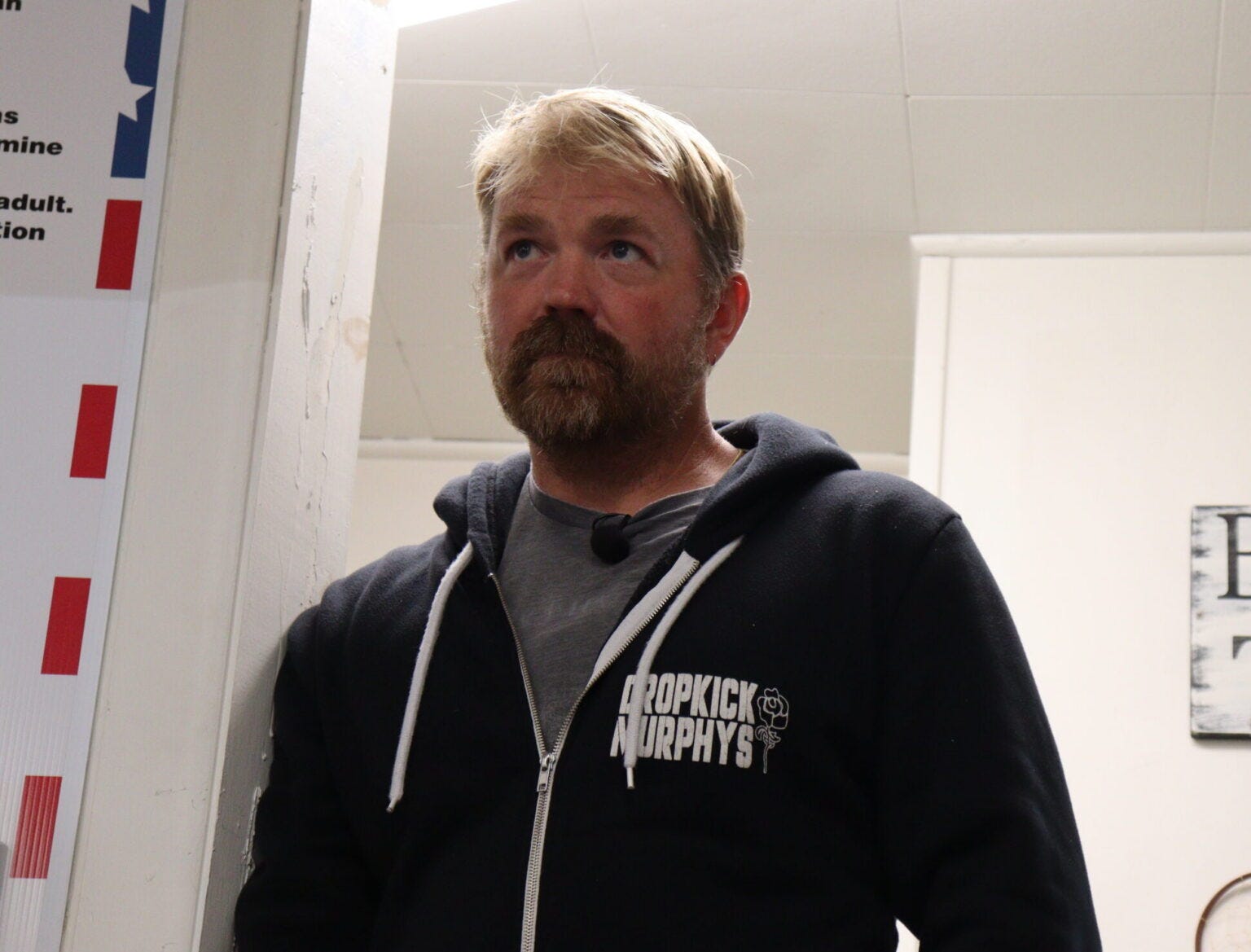
And the candidate came from the same world as the crew. The “working Mainer” is the grandson of the celebrated architect Warren Platner, son of a lawyer, sent for a stretch to Hotchkiss. His federal disclosure tells a truer story than the ads did. The oyster company reported no income at all. He drew a three-thousand-dollar stipend as harbormaster and cleared roughly five thousand selling oysters to his mother’s upscale restaurant, his main customer. What the household actually lived on was a VA disability benefit of about forty-eight hundred dollars a month, plus a two-hundred-thousand-dollar loan from his father to buy the house he falsely chalked up to veterans’ benefits.
The man is a fraud: the working-class hero was a part he played. Every detail checks out one at a time and still adds up to a lie, because the lie is in how you frame the true things. He is quick to point out that he attended Hotchkiss, fine, but the point is that he was there at all, a kid with access most working families never get near. The architect grandfather and the lawyer father. The loan that allowed him to buy the house he lives in. All of it comes from a family that did well precisely by not being “working class,” while scooting around selling oysters to his mom.
He built his campaign attacking the politics that built the privilege he benefited from, bankrolled in part by the family that climbed it, and told Maine he wasn’t just working class but of it. He is not of it. The story he sold and the story his records tell don’t match, and the crew that sold it came from money and credentials just like his. Same shop, same class, one roster: Summer Lee, then Dan Osborn in Nebraska, then Nathan Sage in Iowa, then Platner, with Mamdani’s ads on the wall as the trophy. A casting agency for the working-class everyman, run entirely by people who have never once been him.
I write these every week — the manufactured candidate, the consultant class, the stuff the glossy writeups leave out. Free. Come along.
Why they never learn
The Democrats have more than one bad oyster farmer. Yes, this is a socialist operation; we all know my thoughts about that. Let’s talk about the other issue, identity politics, the party’s familiar fallback, and this is the third cycle running they’ve played it and gotten burned. But they keep chugging.
It’s always the same. Find the demographic you’re bleeding, cast someone who looks like them, put them on a loop, and hope the costume covers all sins, personal and policy. 2020 was all about the identity checkbox. Then came 2024 and the white working-class everyman Tim Walz, bolted onto a losing ticket to win back the men who’d walked. Now it’s Platner. Same instinct, three cycles, nothing learned.
Even Yglesias admits this is what the party does. He rattles off the roster like it’s a defense: Lurie the Levi Strauss heir, a firefighter here, a sheriff’s deputy there, a Tejano music star. He’s right; he just doesn’t say it straight. The party stopped building candidates who can carry a state and started casting characters who look like “you.” Left and center both.
Let’s see who has been cast. Platner in Maine, the white working-class vet, costume over Hotchkiss. James Talarico in Texas, the “nice young Christian,” seminary student with the good clips, cast to talk to a conservative state with the hope that they don’t pay close attention to what he says or his policies. Tim Walz in 2024, the Midwest football-coach-and-soldier everyman, pulled up to patch the party’s problem with white men who’d decided the Democrats had become the party for everyone but them. Dig into Walz, and the image frayed fast, over an embellished line about carrying weapons “in war” and a viral clip of a man who couldn’t handle a shotgun. He served twenty-four years; later years of mismanagement and fraud forced him to cancel his bid for reelection as governor. The point isn’t that he’s a phony; it’s that all they cared about was white man and camo hat.
Then there’s Abdul El-Sayed in Michigan, the casting theory inside out. The bet was that a candidate of color consolidates voters of color. Why? Because to choose a white woman over a man of color would be unforgivable. However, a Detroit News poll this month said the opposite: among Black voters, Haley Stevens, a white woman, leads him 67 to 21, while his own base skews white, young, and college-educated.
That’s the point. Look at who actually buys these candidates, and it’s the professional class that cast them, white and diplomaed, most likely driven by their own white guilt; it’s not the working people they hope to attract. When the only customers for the authentic-worker product are the people who manufactured it, “authentic” is just the latest buzzword to make them feel good.
The one honest counter is the Intercept’s, and it’s worth taking seriously: socialists do win, including with voters of color, in New York primaries. True, and beside the point. Winning a deep-blue, low-turnout primary is not the same as flipping Maine or Texas, or a nationwide election, with a cast everyman. The primary is where the costume plays to the base. The general is where the candidate is tested.
What it means for you
There are occasions that the story that is told is exposed by the receipts it produces. In this case, a class that calls itself scrappy and insurgent and working-class turns out to be credentialed strangers who have never held a “working class” job ordering a hero off a video.
Now that the costume caught fire, you’d think the fix would be obvious: run a real one this time, someone who logged the hours instead of posing for them. Troy Jackson looks the part on paper, a North Woods logger and former state Senate President. But the replacement is manufactured too.
Jackson didn’t well up from the grassroots. He lobbied for the seat, publicly pushing Platner to drop out and calling himself the best person to replace him. Platner’s own machine lined up behind him. And the party is handing him the nomination by convention, 601 delegates in Bangor on July 25, no primary and no voters, the same top-down anointment that gave Democrats Harris and Walz once Biden got pushed aside. He’s the candidate the Platner operation wanted next, installed the way the establishment installs people, with a Sanders-insurgent label stapled on top.
And he’s a weak hand. He came third in this spring’s governor’s primary and lost, then got waved into a Senate race against Susan Collins, an institution Maine has sent back five times since 1996. He’ll spend the fall answering for every day he stood by Platner through the tattoo and the Reddit posts, and CNN and the Bangor Daily News are already digging into his temper, which involves throwing a water bottle at a fellow legislator. Whether Maine buys an insurgent over Collins is a real question, and nobody has the answer. The insurgents didn’t find a better candidate. They found their candidate, the way the establishment always has.
That is what makes me chuckle. This new class of operatives is sure it cracked the code, sure it reads the country better than the tired old party ever did. It’s running the identical play: pick the person you think wins, then sell him. The only thing they added is the identity politics like a cherry on top, the costume the establishment never bothered with. Manufactured is manufactured. Nobody wanted it from the party bosses, and nobody wants it from the wunderkinds either.
And Maine is its own animal. Susan Collins has held the seat since 1997, and the state loves to say it wants a change right up until the moment it has to make one. Jackson is younger than Collins and older than Platner, a lifer in Maine politics without the viral charisma the shop manufactured for its oyster farmer. Whether voters who’ve sent Collins back five times will turn out for a Sanders Democrat is the whole question, and nobody has the answer yet.
Here’s what I do know. The DSA base is motivated, organized, and votes in every low-turnout race the rest of us skip, and right now they’re working overtime to look palatable to normie Democrats. Unpopular ideas still win when they’re the only ones in the room. So spread the word on the crew really running this operation, and do the one thing that settles it either way. Get off the couch and vote.
If you read this far, you're my people. The free posts stay free. But the digging — the receipts, the follow-ups the day after a story breaks — runs on paid subscribers.
It's $65 a year right now. That goes up to $75 on Aug 3, so if you're in, lock it in now.