


The world feels chaotic, and it has for some time. We have moments of peace, but beneath the surface, chaos is always lurking. With the conflict in Iran, Ukraine, and the persecutions of Christians across the globe, I thought about how those in the past, in times of uncertainty, still celebrated Easter.
Because no matter how hard it has been tried, it refuses to stay contained. It keeps breaking out of the tomb, breaking through closed doors, breaking into moments that have no business being holy. Moments of rubble and trenches and basement apartments with the curtains drawn. Moments when the state has said no, and the church has said anyway.
Easter has a way of surviving things. Not just theologically, though yes, obviously, that too. But historically. Practically. In the stubborn, quiet, sometimes desperate ways that ordinary people have marked the resurrection, even when doing so is at a cost.
So this Sunday, instead of a reflection on springtime and pastel tablecloths, I want to tell you three stories. They’re not the Easter story, exactly. But they couldn’t exist without it.
The Church That Wouldn’t Close
Somewhere in Soviet Ukraine in the early 1930s, a congregation collected money to keep their church open.
The authorities took the money. Then they closed the church anyway.
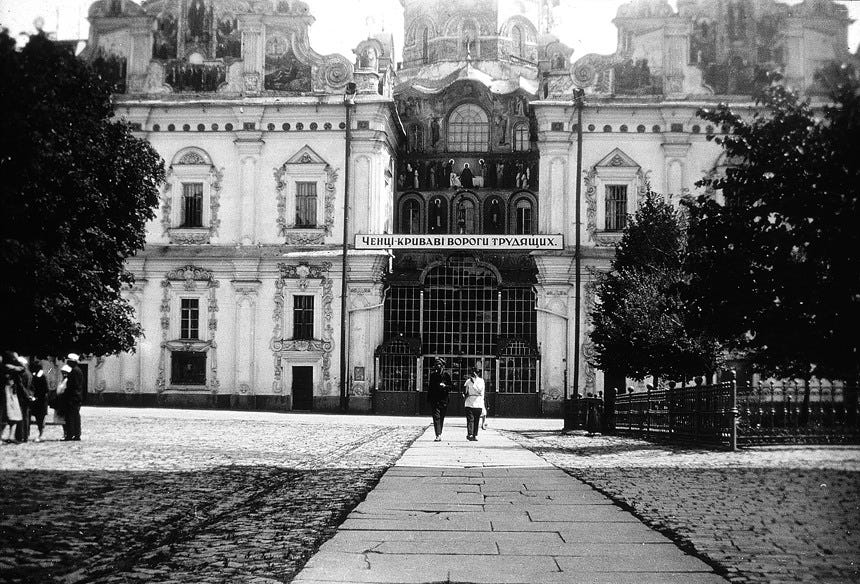
So on Easter morning, roughly 8,000 people gathered in the square in front of the shuttered building. The priests wore civilian clothes so they wouldn’t be identified. Someone started the hymn “Glory to Thy Passion, O Lord!” and the crowd joined in, improvised and unplanned and completely ungovernable. They did it again on Easter Sunday. Larger crowd this time.
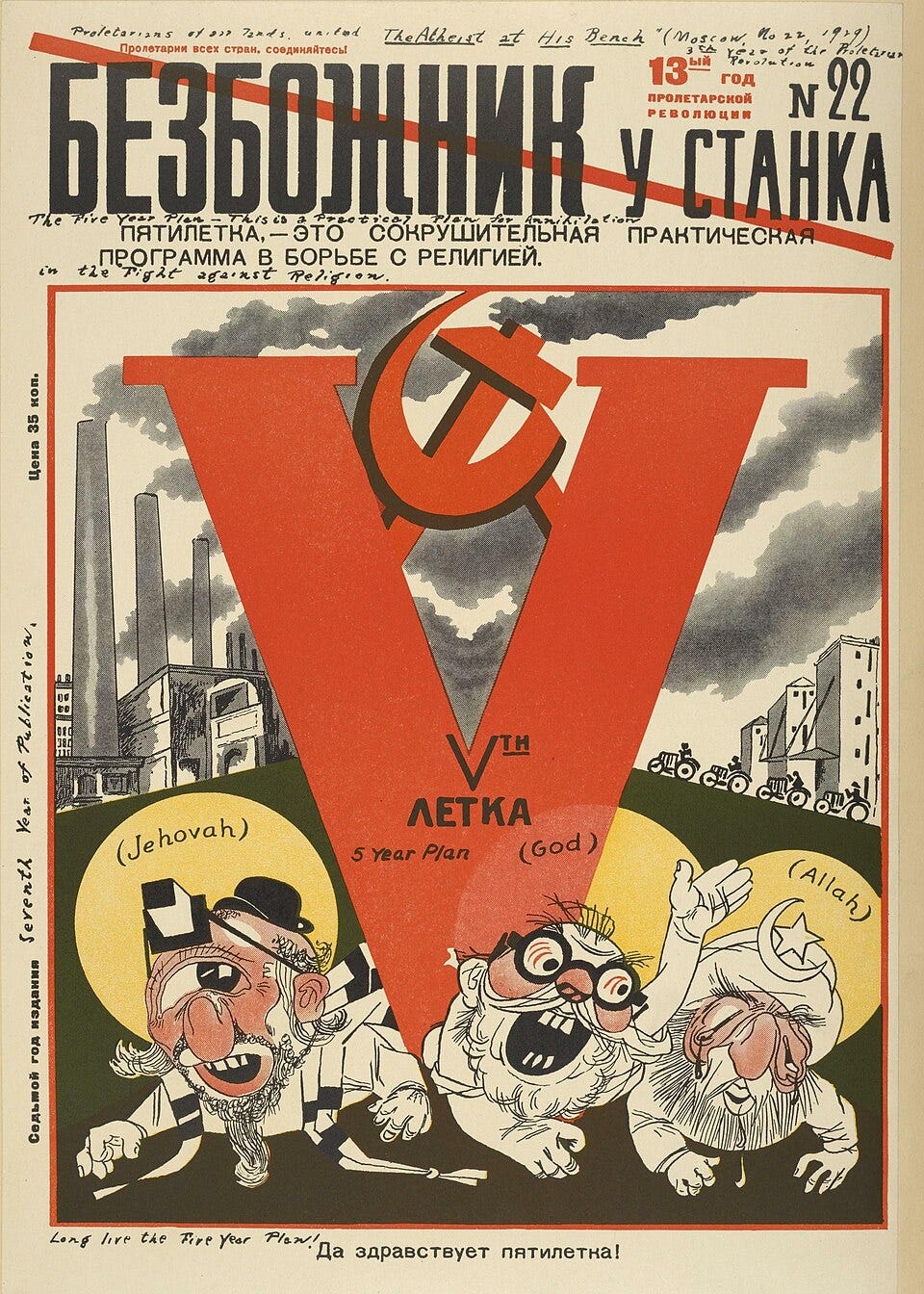
The Soviet state’s campaign against religion was not subtle. Churches were demolished or converted into warehouses. Priests were arrested, exiled, and shot. An organization called the League of the Militant Godless held events they literally called “Godless Easter,” mass burnings of icons, anti-religious street theater, and the whole performance. The goal was to replace the Paschal celebration with something secular and triumphant. It did not work. It had the same energy as a middle schooler who insists they don’t care, loudly, repeatedly, to everyone.
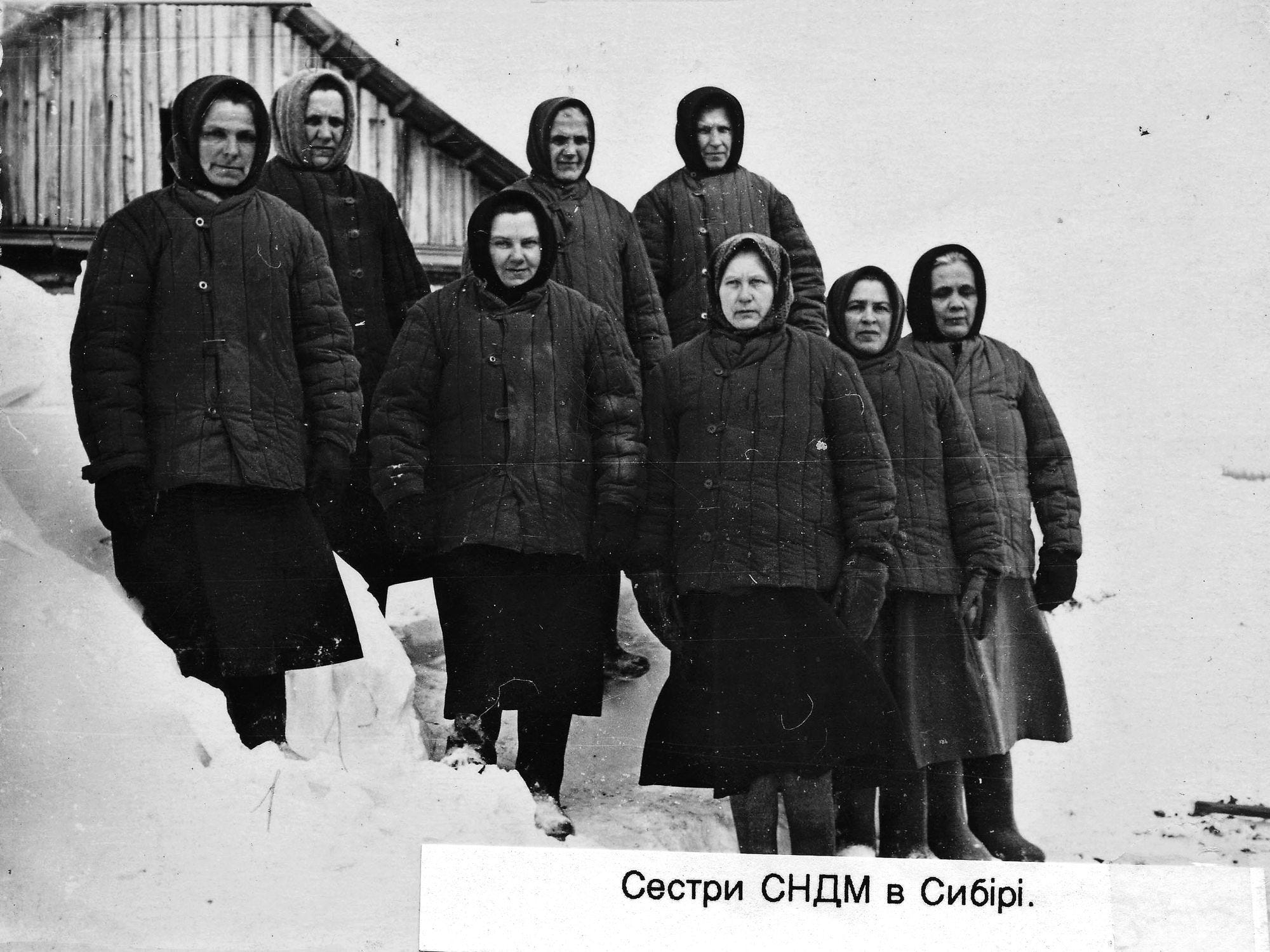
What happened instead was quieter and more durable. The Ukrainian Greek-Catholic Church, driven underground by Stalin after World War II, developed what historians call “traveling churches.” Nuns kept the Eucharist in their homes. They coordinated secret times and places for worship, especially for Christmas and Easter. They served as sextons and deacons. Laypeople’s kitchens became altars. Homes became sanctuaries. The bishops and priests moved through these underground networks like water finding cracks in stone, adapting, reshaping, refusing to stop.
In Central Asia, one documented community of believers held daily liturgies before dawn, every single morning, before going to work. Not just on Easter. Every day. Meanwhile, I sometimes struggle to make it to an 11 AM Sunday service when parking is difficult.
This patchwork of secret communities existed out of devotion and need because there were no functioning churches nearby. Many believers slipped back and forth between underground worship and the official state-sanctioned church to protect themselves. But regardless of the conditions, they made the conscious choice to worship.
Which is, if you think about it, exactly what the first Christians did.
The state said the tomb was sealed. They went anyway.
Easter in the Ruins
On April 1, 1945, the world woke up to two things at once.
It was Easter Sunday.
It was also the day 60,000 American troops stormed the beaches of Okinawa — the largest amphibious assault of the entire Pacific War, and what would become the bloodiest battle of that theater. Over the next 82 days, nearly 50,000 American casualties. More than 12,000 dead.
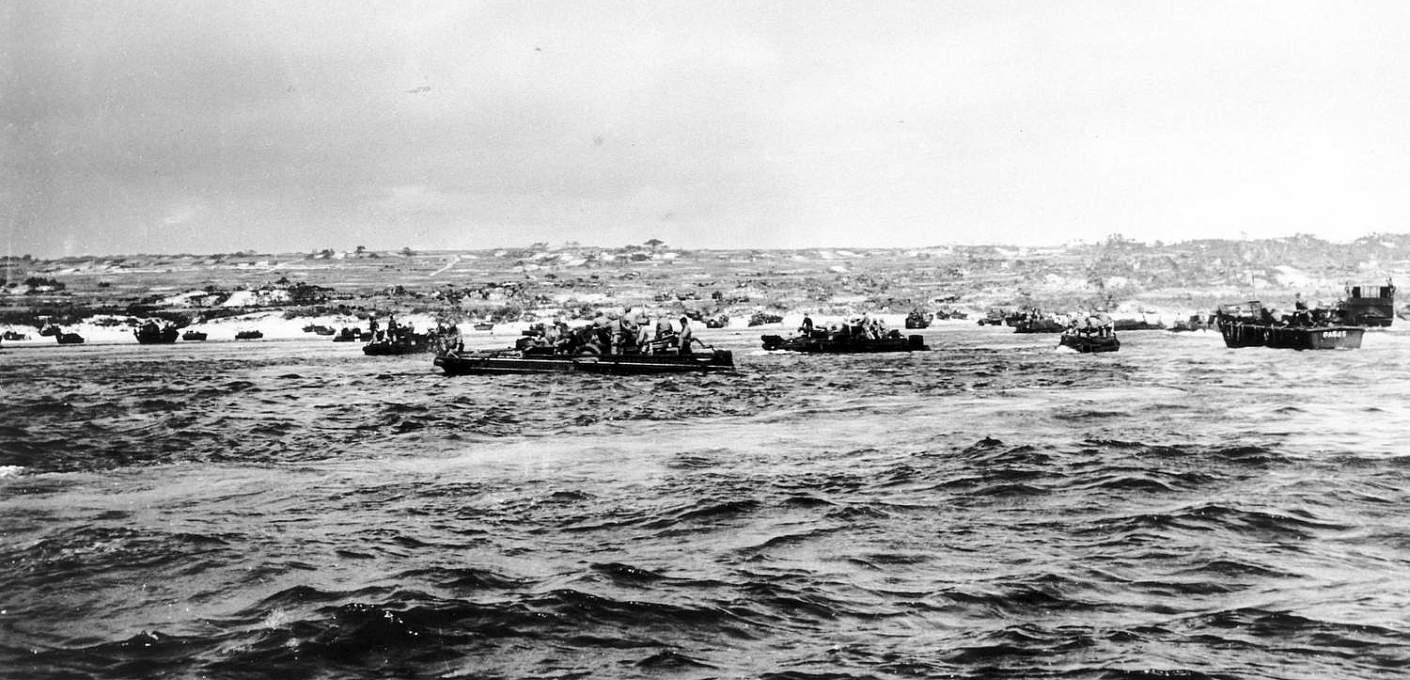
And yet, Easter.
Two days earlier, on March 30, churches across the Allied world had marked the resurrection while the machinery of death was still running at full capacity. A contemporary editorial in The Living Church, published April 1, 1945, named the tension directly: “Easter 1945 finds the world rejoicing in Christ’s victory over death while the machinery of death roars unchecked all over the world.”
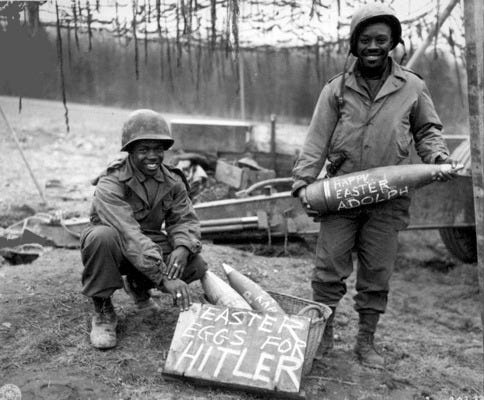
I keep coming back to that sentence. Written in real time, by someone who didn’t know yet how it would end. V-Day was still five weeks away. Nobody had surrendered anything. And yet there’s this editorial, holding the resurrection and the war reports in the same two hands, refusing to let either go.
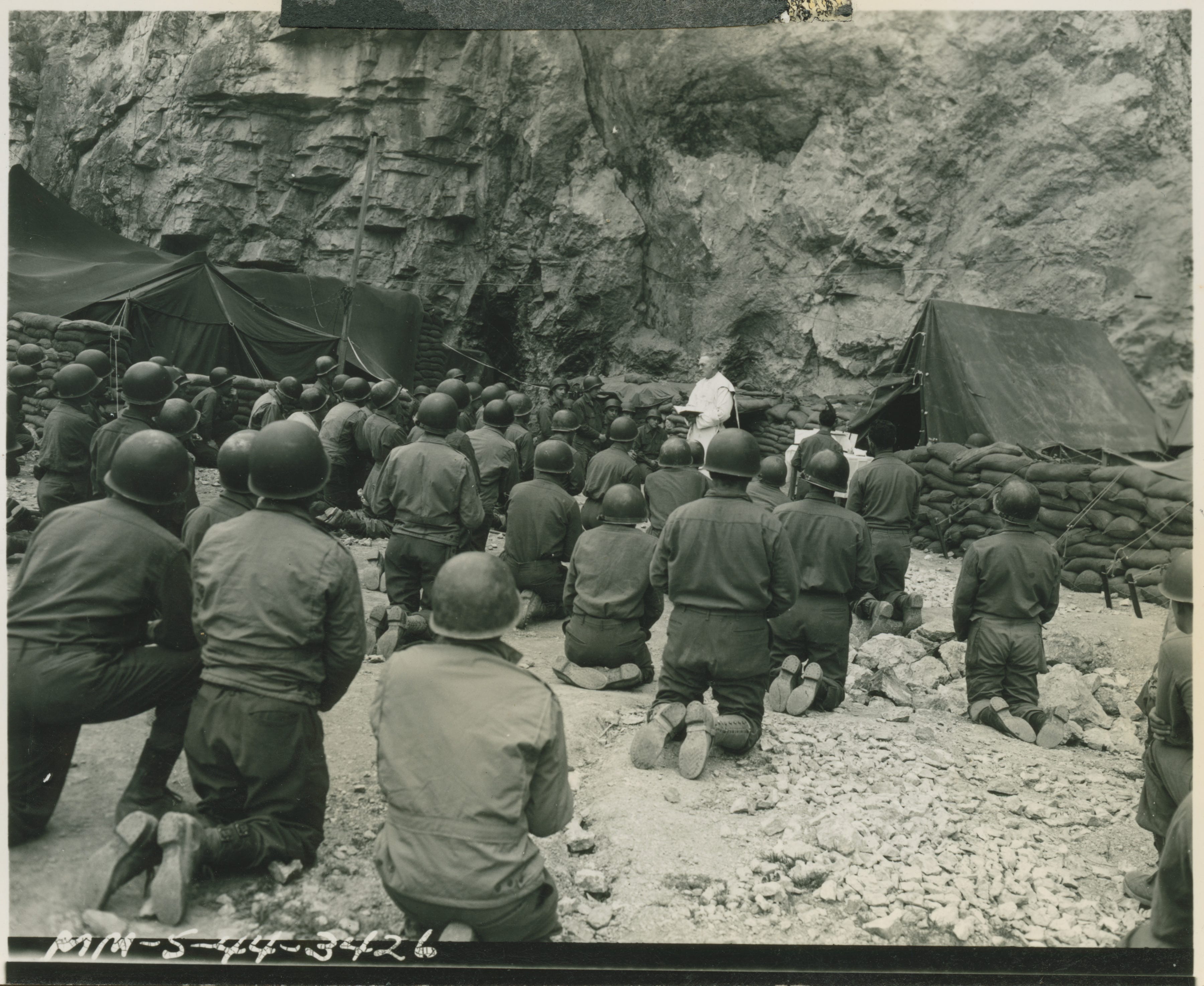
The year before, in 1944, Signal Corps photographers documented American soldiers kneeling for Easter morning Mass on the Italian front. Helmeted. In their field clothes. In the dirt. Father Gregory R. Kennedy of Dubuque, Iowa, saying Mass for men who had left their foxholes to attend.
I think about those men a lot during Holy Week. The ones who climbed out of a foxhole on Easter morning because something in them — something the Army couldn’t regulate and the war couldn’t reach — insisted on marking the day.
There’s a particular kind of faith that only becomes visible under pressure. The kind you don’t know you have until you’re in a foxhole and you find yourself getting up for Mass anyway. Not because everything is fine. Not because the machinery of death has stopped. But because He is risen is a claim that refuses to wait for better circumstances to become true.
April 1, 1945. Easter Sunday. And 60,000 men on a beach who were not thinking about pastel tablecloths.
The Truce That Almost Wasn’t
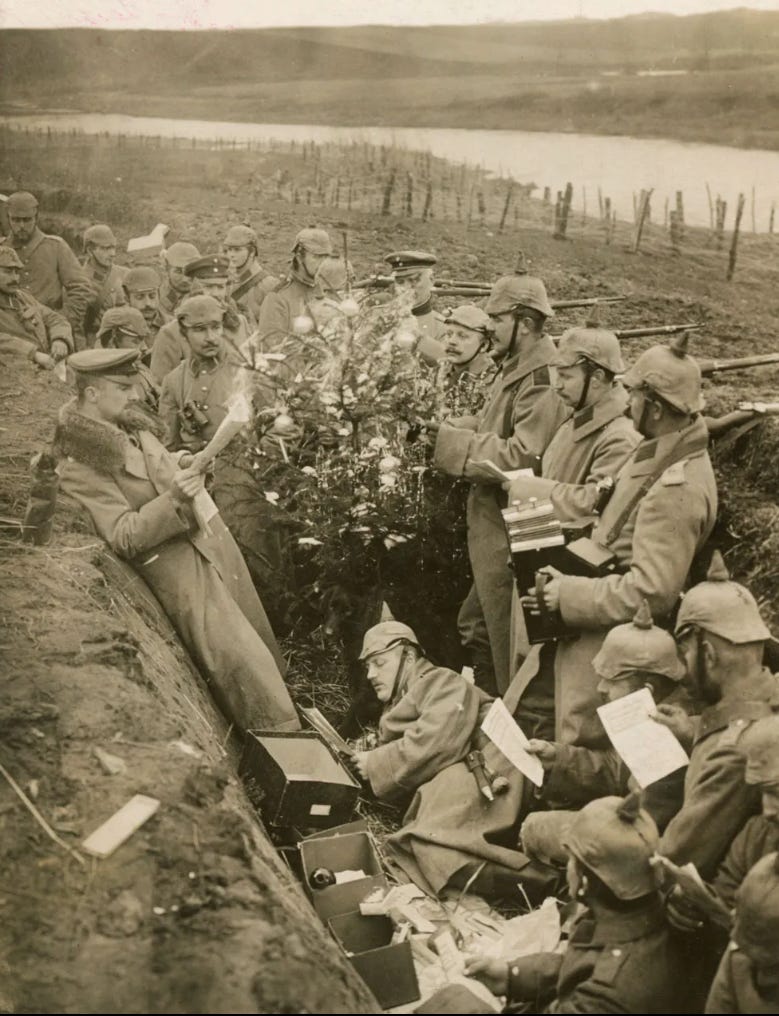
Let me tell you what the history actually says, because it’s better than the myth.
You’ve heard of the Christmas Truce of 1914, German and Allied soldiers crawling out of their trenches on Christmas Eve, exchanging cigarettes, singing carols in no man’s land. While this event has been extensively romanticized, it’s a true story.
What’s less known: attempts to repeat something similar at Easter 1915 were largely ignored. By then, high command had made the rules quite clear. The war had turned uglier. Men who had shared a faith on Christmas Eve were killing each other with gas by spring. The grand Easter Truce, as a parallel to the Christmas Truce, did not happen.
But one man saw something.
His name was Friedrich Kohn. He was a medical officer serving with a Hungarian regiment on the Eastern Front in Galicia in 1916, where Russian and Austro-Hungarian forces faced each other in conditions identical to the Western Front. In a letter written decades later, preserved by historians Malcolm Brown and Shirley Seaton in their 1984 book Peace in No Man’s Land, Kohn recalled what happened on Easter Sunday morning that year.
About twenty Russian soldiers came out of their trenches at five in the morning.
And the shooting stopped.
What followed — the sharing, the silence, the impossible pause in a war that had no pauses — lasted a few hours and then ended. The war resumed. Friedrich Kohn survived the Brusilov Offensive that came just weeks later. He survived World War I. He later survived imprisonment by the Nazis. And he spent decades with the memory: “I have seen demonstrated in front of my own eyes that suddenly people who are trying to kill each other, and will try to kill again when the day is over, are still able to sit together and talk to each other.”
This is not a story about war being secretly nice. It’s not a story about enemies who were really friends. The shooting started again. The Brusilov Offensive killed hundreds of thousands of people. Friedrich Kohn knew exactly what the men across from him were, and they knew what he was.
But Easter Morning made them set down their rifles for a few hours. Not peace. Not resolution. A pause. A recognition. Something too old and too stubborn to ignore even in the middle of a war.
Kohn’s story is not a legend. It’s not passed down through generations. It’s a letter, written by a man who lived it, preserved in a published historical record. A true story of a moment of peace.
And the only reason it happened is that Easter was still Easter even in the trenches.
As we head into this Sunday, remember the resurrection has never required good circumstances. It doesn’t need the war to be over, the church to be open, or the state to give its blessing. It just keeps being true — quietly, stubbornly, in the square outside the locked church, in a foxhole in the Pacific, in the silence between two armies on the Eastern Front at five in the morning.
He is risen.
Even here.
Happy Easter, friends. Thank you for spending part of your Sunday morning with me.
“I have seen demonstrated in front of my own eyes that suddenly people who are trying to kill each other, and will try to kill again when the day is over, are still able to sit together and talk to each other.” Powerful. While time marches on, still there is hope. Thank you for sharing these stories.
Happy Easter Meseidy, may your day be blessed!
Thanks for sharing these stories. This column is a keeper to share with others later. Thank you for all you do (even posts at 2AM)! Happy Resurrection Day!