

Desk Notes: Callais Is Reshaping the House Map - Here's How
Louisiana suspended its primary mid-vote. Alabama called a special session. Tennessee passed a new map. The Cook Political Report says Republicans net six to seven seats. Here's how we got here.

Friday is for errands and casually scrolling my feed in the checkout line. What I have seen today is a lot of misinformation, ignorance, and panic from the Democrats. Go into any comment section, and the left is convinced redistricting is rigged, illegal, or proof that the republic is collapsing.
The Virginia Supreme Court overturned the Democrat 10-1 map process as unconstitutional, nullifying the map. Tennessee passed a new map on Thursday in 1 day with two votes. Texas tilted 5 seats toward the GOP last summer, California countered with five toward Democrats, and somewhere in the middle of all of this, Democrats are trying to mash everything together into one tidy story about Republican cheating. Well, that’s fake news because there is not one story. There are roughly fifty.

The whole thing kicked off because of James Blair, White House Deputy Chief of Staff, and Susie Wiles’ right hand during the Trump campaign. Blair looked at the historical pattern — presidents lose the House at midterms, Democrats have TDS and will turn the House into an impeachment factory, putting an end to the Republican agenda — and asked the obvious question. Could anything be done about it ahead of time? The answer was yes, in some states, depending on legal posture. So he made a list and went to work.
The left is framing this as cheating, disenfranchisement, or a power grab. What is actually happening is what has been happening for almost 250 years. Politics and some serious legal homework. The legal backdrop is Louisiana v. Callais, where the Supreme Court ruled 6-3 that drawing districts based primarily on race violates the Constitution and narrowed Section 2 of the Voting Rights Act in the process. That ruling came on top of Rucho v. Common Cause from 2019, in which the same court said political gerrymandering is a political question federal courts won’t touch. So drawing maps for partisan advantage is fine; drawing them around race isn’t, you know, because of this pesky thing called the 14th Amendment.
A small and inconvenient history note for the Democrats. Gerrymandering originated with Massachusetts Governor Elbridge Gerry in 1812, whose Democratic-Republican Party — the political party that became the Democratic Party — drew up a state senate map shaped like a salamander to lock in their majority. Republicans didn’t become a party until 1854, founded as an anti-slavery party to counter the Democrats. The party currently calling foul actually invented the sport. Massachusetts has had no Republican district since 1997. Just worth noting.
Every state is different
So why does each state look so different? Because each state runs its own elections under its own constitution and its own statutes. There are 50 different conditions for redistricting.
Virginia is a state constitution problem. Voters there narrowly approved a referendum to override the 2020 amendment that had created a bipartisan redistricting commission. One day later, Tazewell County Circuit Court Judge Jack Hurley blocked it, ruling the referendum had skirted a 90-day public notice requirement and presented voters a “flagrantly misleading” question. The whole fight stays in Virginia courts because the issue is Virginia’s own constitution. Democrats reportedly poured $80 million into the play, championed by Hakeem Jeffries and former AG Eric Holder. It just blew up in their faces.
Tennessee was a much simpler problem. The mid-decade redistricting ban here wasn’t constitutional; it was statutory, which means a legislative supermajority could repeal it. Republicans hold that supermajority. They voted the statute away, drew a new map, passed it on Thursday, and sent it to Governor Bill Lee. The 9th District in Memphis was a racially gerrymandered majority-black district. Now, thanks to Callais, that’s clarified as unconstitutional, so the new map redistributes population so that districts run roughly 25 to 30 percent black across the board. Representation gets distributed more evenly rather than concentrated.


The seat that got shaken loose belongs to Steve Cohen, a white Democrat who has held it since 2007. His likely successor is Charlotte Bergmann, a black female Republican who has been challenging him for years.
Texas leaned on a population argument. Republicans there shifted five districts toward the GOP last summer under direct pressure from President Trump, citing the major in-migration the state absorbed during and after the pandemic, especially out of California and the coastal blue states. You can buy that theory or not, but the U.S. Supreme Court declined to overturn the new map, so it stands.
California, meanwhile, is its own situation. The state set up an independent commission years ago to look high-minded about gerrymandering. Mind you, the way they run their open elections has long solidified Democrat power in the state regardless. But when the redistricting math started turning against Democrats because of Texas, Newsom and the legislature spearheaded a ballot measure that suspended the commission and moved five GOP-held districts toward Democrats. SCOTUS declined to overturn that one too. So it stands.
Five different states, five different constitutions, five different legal postures. A lot of “differents” can feel chaotic from the outside. It’s just what happens when fifty parallel legal systems run at the same time on questions about elections, which the Constitution leaves to states in the first place.
Where the number stand right now
Forget the panic narrative for a second and look at the math. Republicans currently hold a 218-213 majority in the House with four vacancies. The Cook Political Report’s running estimate is that Republicans net 6 to 7 House seats once this cycle finishes, factoring in Callais, the Virginia ruling, and everything still in motion
The state-by-state breakdown looks like this.
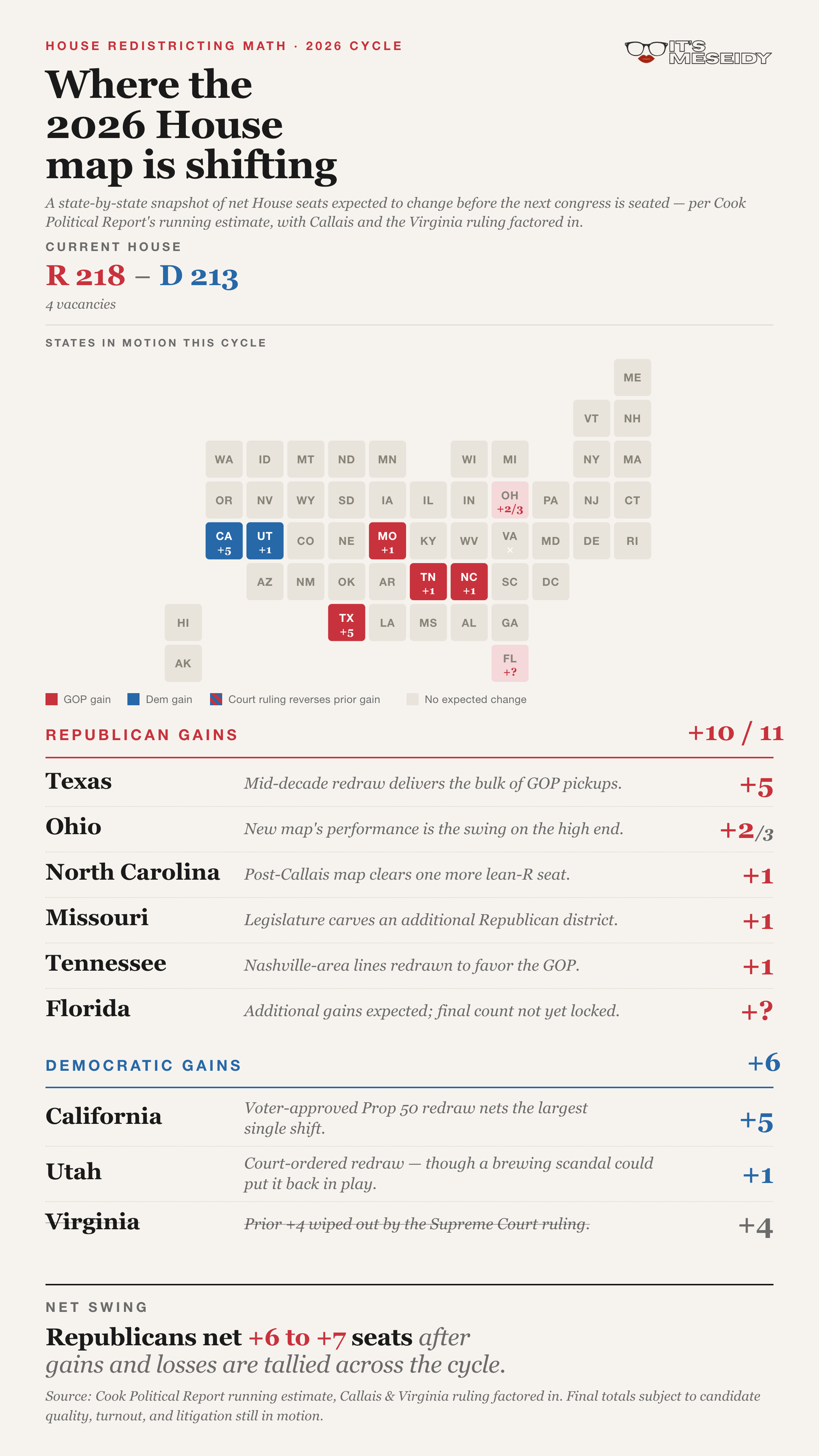
On the GOP side:
Texas +5
North Carolina +1
Missouri +1
Tennessee +1
Ohio plus 2 or 3, depending on how the new map performs
Plus additional Republican gains coming out of Florida.
On the Democratic side:
California + 5
Utah +1 from a court-ordered redraw (though a scandal is brewing there that could put it back in play)
Virginia’s plus four is now wiped out by the Supreme Court ruling.
Net swing favors the GOP, but not by a margin that locks the House on its own. The rest comes down to candidate quality, turnout, and whether Democrats can compete in districts where they previously didn’t have to.

The Callais fallout
After the Callais ruling on April 29, Governor Jeff Landry suspended the state's May 16 congressional primaries by executive order, even though early voting had already started and over 104,000 people had cast ballots. The state legislature is now in active redistricting, with plans to vote as early as next week on a new map that would eliminate one of the state's two majority-black districts. The Callais case itself is finished — SCOTUS finalized its judgment on May 4 and rejected an attempt to reverse that on May 6. But a separate set of lawsuits is challenging Landry's authority to suspend a federal election by executive order, including filings from Rep. Cleo Fields, the Louisiana Legislative Black Caucus, and the League of Women Voters. Those cases are still pending in state and federal courts. Louisiana is going through redistricting and litigation simultaneously, with the November ballot still unsettled.
Alabama is in similar territory. The day after Callais dropped, Alabama filed an emergency motion seeking to stay the injunction that had blocked the legislature’s preferred maps in favor of a court-appointed special master’s version. Governor Kay Ivey called a special session for May 1 to begin drawing a new map. Early voting in Alabama’s primaries had already started when the order came down. The state’s argument is that Callais essentially overrode the Allen v. Milligan precedent that had forced Alabama into two majority-black districts in the first place.
Florida already moved. Governor Ron DeSantis signed a new congressional map into law ahead of Callais dropping, expected to favor Republicans in additional House districts. Litigation followed immediately, but the map is in effect for now.
Tennessee, Missouri, Ohio, and North Carolina all completed their redraws between the 2024 and 2026 elections, ahead of Callais. Tennessee’s Thursday vote was the latest.
South Carolina, Georgia, and Mississippi are the next watch list — all three are signaling interest in moving before 2028 to take advantage of Callais, but none have called special sessions or introduced specific maps yet. Georgia and Louisiana also have pending litigation over their existing maps that could force court-ordered changes regardless of legislative action.
So the picture isn’t “states might act before 2028.” Louisiana and Alabama are redrawing in the middle of suspended primaries this month; Florida already redrew; the four central states have completed their work; and the remaining southern bloc is queuing up.
The 2028 question is really about whether any state can run a second mid-decade redraw on top of all this.
Democrats have to learn to compete
Here is the part Democrats don’t want to talk about. The Callais ruling means race-based gerrymandering, which the Supreme Court found unconstitutional, can no longer perpetuate the racialized politics that built so many of these majority-minority districts in the first place. Candidates in places like Memphis can no longer rely on running on racial identity. They have to answer to all voters in the district, on the issues that affect everyone in the district.
The Democratic panic over Tennessee isn’t really about democracy or fairness. It’s about losing a political advantage that allowed Cohen to hold a majority-black district for nearly two decades while running on identity politics rather than substance. Strip the racial gerrymander away and he has to defend his record on crime, jobs, schools, and cost of living against a black Republican challenger. He has to actually compete. That is good news.
The “Tennessee didn’t even vote, and Virginia did” comparison Democrats are running this week is apples and asteroids. Virginia tried to amend its state constitution and botched the procedure. Tennessee repealed a statute through ordinary legislative channels. Both states were operating within their respective frames. One of them just happened to follow the rules, and the other one didn’t.
Whether the House flips next November will depend on how each of these state-level fights ends up, plus whatever courts decide about the stragglers. The process itself isn’t illegal or unprecedented. It’s federalism, being played by both sides at the same at 11. And if Democrats want to win seats going forward, they will need to do what every party eventually has to do when the structural advantages dry up.
Compete for the votes.
A white man has represented the black folks of my hometown since 2010. Now the likely winner of TN-9th will be a black republican woman. All the SCOTUS ruling says is that states cannot redistrict by skin color. My, how racism has evolved.
https://torrancestephensphd.substack.com/p/democrats-and-the-tennesssee-two
I can’t seem to absorb and understand 🫠 this stuff about political redistricting and gerrymandering, I feel like I need to be super rested and fresh and relaxed and focused (when is that gonna happen) and read the last two desk notes and maybe I’ll get it processed in my brain 🧠 one can hope