

Candace's "CIA" is More Vision Board Than Investigation
After 40+ Episodes, the "Candace Intelligence Agency" Has Provided No Intelligence—Just a Vision Board of Feelings, Dreams, and Dangling Threads

Charlie Kirk sat under a white canopy emblazoned with bold red and blue letters reading “The American Comeback Tour” at the bottom of an open-air auditorium at Utah Valley University. With his water bottle on the table and a microphone in hand, he took questions from the student audience on September 10th. An estimated 3,000 students attended the event, many seated in elevated rows surrounding Charlie, who stood in the middle at the bottom of the bowl-shaped venue. The event began at 12:00 pm. Twenty minutes later, a shot rang out, struck him in the neck, and instantly took his life.
Speculation took shape immediately. Questions mounted, and less than 24 hours later, the local police released the first surveillance images of the suspect. After a 33-hour manhunt, Tyler Robinson turned himself in on the night of September 11, 2025.
By official accounts, the case appeared to be on track. But the public was already primed by years of institutional distrust, and for some, the real investigation was just beginning. What would then take place was not an investigation in any traditional sense. It was something else entirely, a sprawling, daily broadcast featuring timelines, flight paths, Wikipedia edits, and Austrian software developers. At the center of it stood Candace Owens, a former colleague and friend of the deceased, who transitioned from mourning to narrating an investigation, delivered with a mischievous grin.
“This is not an article about who killed Charlie Kirk. It is not about whether Candace Owens is lying — at least not yet — but about something more slippery and harder to pin down. It’s about how a person can assert authority over a story without ever producing evidence, and how an audience can come to accept speculation as settled fact.”
This is not an article about who killed Charlie Kirk. It is not about whether Candace Owens is lying — at least not yet — but about something more slippery and harder to pin down. It’s about how a person can assert authority over a story without ever producing evidence, and how an audience can come to accept speculation as settled fact.
Ever since I began sharing more about my criticisms of what Candace is doing on my IG, I have been accused of “not watching Candace” or “not knowing what I am talking about.” Well, the joke is on you suckers, because I wasted hours of my life over the last two weeks watching every episode and taking notes, pulling quotes.

And let me tell you, it is you who is being spoon-fed the performance of a lifetime, except nobody’s going to win an Oscar for what’s happening here.
Hey, this article is long and free, but I accept tips!

Grief to Gospel Truth
The first episodes after Kirk’s death establish Candace Owens as a grieving friend. “Charlie Kirk, my friend, is dead,” she announces on Episode 235. “I watched my friend get shot in the neck.” The emotion is raw. She describes weeping, speaking with a priest, and sternly struggling through a video tribute.
This is understandable. We were all experiencing some level of grief, and we did not have a personal relationship with Charlie like Candace. But something shifts over the following days and months. The grief does not disappear, not in the traditional sense, but instead it morphs into a self-declared credential.
Owens reminds us repeatedly of her personal proximity to Kirk. She knew him. She danced with him to Kanye West songs. She exchanged text messages with him about faith and power. This closeness is invoked not as personal memory but as epistemic license. In the same episode, just days after Kirk’s death, Owens took aim at Benjamin Netanyahu, who had quoted from a letter Kirk sent him in May. Netanyahu shared two sentences: “One of my greatest joys as a Christian is advocating for Israel and forming alliances with Jews in the fight to protect Judeo-Christian civilization.”
Owens was furious. “I know for a fact that he is misrepresenting some things that happened there towards the end,” she told her audience. Not “I believe.” Not “I suspect.” I know for a fact.
She went further: “Those sentences are real, but I am calling on Bibi Netanyahu, the dear friend to Charlie Kirk, to publish the letter’s entire contents. Don’t start with just two sentences, publish the entire thing.” She insisted that “in May Charlie was concerned about Israel and their influence on American politics and how they were pushing things that he felt were in conflict with his beliefs.”
She was essentially daring Netanyahu to release evidence that she claimed would prove her right.
He did.
On September 30th, the New York Post published the full seven-page letter. It opens with the line Netanyahu quoted. It closes with Kirk offering his private phone number and writing, “The Holy Land is so important to my life, and it pains me to see support for Israel slip away.” In between, Kirk describes spending “endless hours with Dennis Prager studying the Torah,” proposes an “Israel Truth Network” to debunk anti-Israel claims on social media, and repeatedly emphasizes his “deep love for Israel and the Jewish people.” He even suggests Israel hire spokespeople modeled on Stephen Miller and Karoline Leavitt. The letter is not about “concerned about Israel and their influence on American politics and how they were pushing things that he felt were in conflict with his beliefs.” It is a letter from a man who loved Israel so much that he wrote a seven-page strategic communications plan to help them win the “information war.”
Pro-Israel activist Gideon Askowitz put it bluntly on X: “Charlie Kirk’s letter to Israel is one of the most damning indictments on Candace Owens ever. The letter is dripping with LOVE for Israel.”
Candace’s “I know for a fact” was confronted with actual facts. However, she was already positioning herself as the keeper of Charlie’s true beliefs, the one person who understood what he really thought. She demanded that the evidence be released. The evidence was released. It said the opposite of what she claimed it would say.
Did she acknowledge this? Yes, but not in the way you might expect. By Episode 245, she had reframed the entire thing. “It took him a little over two weeks,” she told her audience, “but now BB Netanyahu, with maybe a little help from Turning Point USA, I’m thinking, is releasing the letter, the may love letter from Charlie Kirk to Israel.” She called it a “love letter” with audible sarcasm, then announced: “We’re going to slaughter that narrative that Charlie died pro Israel.”
Remember, she knew “for a fact” that Netanyahu was “misrepresenting some things” and demanded evidence. The evidence she demanded? Now it was suspicious that Netanyahu released it. The contents that contradicted her? She would “slaughter” them. The seven pages of Kirk expressing deep love for Israel and proposing ways to defend it more effectively? Irrelevant.
Owens also points to an interview Charlie Kirk gave to Megyn Kelly on August 6th, the day after a weekend gathering in the Hamptons. In it, Charlie expresses frustration with certain pro-Israel advocates who were calling him antisemitic despite his years of support. Owens presents this as evidence of Kirk’s transformation.
But listen to what Charlie actually says in that interview. He tells Kelly he has “a bulletproof resume showing my defense of Israel,” that he believes “in the scriptural land rights given to Israel” and “in fulfillment of prophecy,” that his “life was changed in Israel” and the “spiritual energy is so amazing there.” He says, plainly: “I want them to win.”
His complaint? That aggressive tactics from certain donors were “pushing people like you and me away” and “undermines their own cause.” He wasn’t rejecting Israel. He was warning that bad PR was hurting Israel. Which is exactly what his May letter to Netanyahu said, the whole reason he proposed an “Israel Truth Network” and better messaging strategies was because he believed Israel was losing the information war, especially with younger Americans.
Owens presents the interview as evidence Kirk had turned. The interview actually shows a man deeply committed to Israel who was frustrated that heavy-handed tactics were damaging the cause he still believed in. The frustration and the commitment were two sides of the same coin. Owens kept one side and discarded the other.
This is the pattern Candace would deploy over the next three months. She demands proof. Proof arrives. The proof contradicts her claims. So she absorbs the proof into the conspiracy itself. Netanyahu's release of the letter wasn’t a vindication of his original quote; it was evidence of coordination with Turning Point. According to her, the letter was not a correction to her narrative; it was a narrative to be “slaughtered.”
By employing this strategy, no piece of evidence can penetrate. Every confirmation confirms. Every contradiction confirms harder.
But before she developed that pattern, she was already laying its foundation. In that same early episode, she offered this: “I know that towards the end, Charlie was fighting for custody of himself. I want to say that. I want to say that plainly. And there are lies that are being told and they need to be slapped down right now.”
Fighting for custody of himself. That’s a bold statement, elevating Kirk’s supposed internal struggle to the level of a spiritual and moral battle. It’s emotive. It’s also completely unsubstantiated. She provided no evidence. No texts are shown. No recordings played, no witnesses named. The phrase does work, though. It positions anyone offering a different account as someone telling “lies” that need to be “slapped down.”
By Episode 245, the claims have hardened further: “Charlie Kirk’s perspective on Israel was not starting to shift. It had shifted entirely. There are no ifs, and there are no ands, and there are no buts about it.”
No ifs. No ands. No buts. This is not the language of someone piecing together a puzzle. This is the language of someone who has already finished the puzzle and is annoyed you’re still asking her questions.
The substitution is subtle but total. Emotional proximity becomes narrative authority. Having been Charlie’s friend becomes synonymous with understanding what really happened to him. And anyone who knew him differently? Their proximity apparently doesn’t count. Convenient how that works.
The Illusion of Inquiry
I will say one thing: the girl has a flair for “evidence.” She has screenshots. Flight tracker data. Tail numbers. A map drawn by a local man who retraced the shooter’s footsteps. Video frame analysis. A name extracted from a German hiking blog.
In Episode 245, Owens identifies an Austrian man named Gernot Omer based on matching his face to images from a European hiking trip and a corporate YouTube video. She notes that a Utah gubernatorial candidate’s nephew, or cousin, depending on who’s asking, scrubbed his LinkedIn and Instagram after her broadcast. She presents a photograph of a man in a blue hat and invites her audience to determine whether he resembles a blurred figure seen ascending stairs in a video.
The accumulation of detail is impressive. But detail is not the same as evidence.
None of this information is independently verified. The sources are screenshots and public posts. The connections are inferred, not demonstrated. The documentary rigor is aesthetic rather than functional; it creates the feeling of investigation without establishing any verifiable conclusion. What looks like journalism is closer to a vision board craft project.
“The fragments are real. The pattern is invented. And the invented pattern is presented with such confidence, rapid sequence, and quantity that questioning it feels like denying the obvious.”
Think of it like this: I could compile a dossier on my neighbor that includes his car’s license plate, a timeline of his daily walks, screenshots of his LinkedIn employment history, and face-matched photos from his cousin’s vacation blog. That doesn’t mean my neighbor committed a crime. It means I am bored and have too much time on my hands.
But nowhere is the gap between presentation and substance more obvious than in what became her centerpiece: the Egyptian planes.
By Episode 266, Owens had constructed an elaborate theory involving two Egyptian-registered jets, SU-BTT and SU-BND. She claimed these planes had tracked Erika Kirk’s movements across the United States from 2022 through September 2025, overlapping with her locations between 68 and 73 times. She presented a spreadsheet on screen, assuring her followers that it is “completely verified,” but never saying how or by whom, and that the calculated odds of coincidence at “less than 0.00000001%.” The implication is that foreign surveillance is tied to a multinational conspiracy involving Egypt, Israel, France, and elements of the U.S. government in Charlie Kirk’s assassination.
“Literally every time this plane is here,” she told her audience, “I can pin a TPUSA faith event that’s happening. This plane is following Turning Point USA faith and Charlie Kirk. Let me know when you get uncomfortable and you realize these are not coincidences. This is a conspiracy.”
It looked damning. Tail numbers. Dates. Cities. A spreadsheet with dozens of entries. For viewers scrolling through clips, it had the texture of a bombshell.
Then, independent researchers started checking her work.
KanekoaTheGreat, an X user and independent analyst, did what Owens apparently did not: he verified the data. He subscribed to FlightRadar24’s Business plan, the same tool Owens cited, to access three years of historical flight records. For additional rigor, he shares the receipt where she spent $950 on FlightAware aircraft logs. He screenshot Owens’ on-screen spreadsheet, rebuilt it line by line, and cross-referenced every entry against actual flight data.
The results were not generous.
Sixty-six percent of Owens’ claimed plane locations were wrong. In sixty percent of cases—39 out of 65 verifiable entries—the planes were on the wrong continent. Not the wrong city. Not the wrong state. The wrong continent. Thousands of miles from the alleged “overlaps” with Erika Kirk.
And that’s assuming Erika was even where Owens claimed she was. Did she even share Erika’s locations? Did she provide timestamps? I mean, she’s been super obsessed with timestamps when analyzing the shooter Tyler Robinson’s text messages with his roommate/lover, but none for Erika? (IYKYK) Did she provide travel itineraries, photos with metadata, or even a news report of Erika’s locations? No. The “overlaps” were never proven, even before the plane data fell apart. It was all insinuation and emotive conclusion.
Other analysts piled on. Lane Kendall, examining the Kansas entries, pointed out that Wichita, one of five states Owens highlighted repeatedly, is known as the “Air Capital of the World,” home to aviation firms like Textron and Yingling Aviation. The Egyptian jets’ stops there aligned perfectly with routine FAA Part 145 maintenance for Dassault Falcon aircraft. Not surveillance. They are more likely to be scheduled service appointments.
TheInspectorAsh dismantled the probability calculations as “dramatic” on X. Owens had defined “overlaps” loosely, the same state within a plus-or-minus-three-day window, and then acted astonished that patterns emerged over three years of flights. Aviation doesn’t work like a lottery. Jets follow fixed routes. They stop at the same hubs. Finding that a plane landed in Delaware multiple times is not evidence of tracking; it’s evidence that Delaware has an airport.
“No airport codes. Without exact airports + timestamps, there’s no real correlation.” TheInspectorAsh wrote. “If someone had real evidence, they’d show same airport, same day, repeated airport-level matches, and flight irregularities. None of that is present.”
KanekoaTheGreat published his rebuilt spreadsheet publicly, inviting anyone with FlightRadar24 access to confirm the discrepancies. His conclusion was blunt: “If the Egyptian planes were the ‘key’ to an international assassination plot, then the key opens nothing. The entire story collapses the moment you look at the receipts.”
This is what happens when the aesthetic of investigation meets actual investigation. Owens presented a spreadsheet screenshot. Independent researchers rebuilt it with verifiable data. Her spreadsheet was wrong, embarrassingly wrong. And yet by the time the debunking circulated, episodes 266 through 267 had already aired, the clips had already spread, and the Egyptian planes had already become accepted lore among her audience.
The damage was done not because the evidence was good, but because it looked good. It had the shape of proof. Tail numbers feel serious. Probability calculations feel scientific. A spreadsheet with dozens of rows feels comprehensive. And if you never check the underlying data, if you simply trust that someone else has verified it, then the feeling of evidence becomes indistinguishable from evidence itself.
This is the core problem with Owens’ investigative method. She is not fabricating information out of thin air. She is gathering real fragments, flight records exist, Austrian software developers exist, and Wikipedia edits exist, and she arranges them into patterns that imply conclusions she never has to defend. The fragments are real. The pattern is invented. And the invented pattern is presented with such confidence, rapid sequence, and quantity that questioning it feels like denying the obvious.
But the Egyptian planes prove that volume is not verification. Detail is not evidence. And let’s be honest, anyone can make a spreadsheet; it’s the data behind it that counts.
Just Asking Questions, But Never An Answer
The most powerful rhetorical device in Owens’ coverage is the question. She is always “just asking questions” but never providing verified evidence. And once you notice the pattern, you can’t stop noticing it.
Let’s start early. Episode 235: “Who is they, Bibi? Who is they who got Charlie Kirk?”
This one’s addressed directly to Benjamin Netanyahu, who had made a statement denying Israeli involvement in Kirk’s death. Owens doesn’t claim Israel killed Kirk. She just asks who “they” are. The question implies that Netanyahu’s denial was itself suspicious. Why deny something nobody accused you of?
It’s a trick. The question plants the seed, and the audience waters it by filling in the gaps.
By Episode 245, the questions are stacking up: “Did he express that? Did he also express that he wanted to bring me, Candace Owens, back because he was standing up for himself? Then did he, just 48 hours later, conveniently catch a bullet to the throat before our on-stage reunion could happen?”
I want you to read that again. Note what is happening here. Owens is not claiming that Kirk was killed to prevent their reunion. She is asking whether the timing is suspicious. She is inviting the audience to connect dots she has not explicitly connected. The implication accumulates across multiple episodes and dozens of such questions until it solidifies into something that feels like a conclusion.
And when the Austrian software developer shows up in her investigation? “What’s this Austrian guy doing? How did we get here?”
She doesn’t answer. She doesn’t have to. She leaves the gap, and the question does the work. Gernot Omer could be a software engineer who moved to Utah for a JP Morgan job, which is exactly what his LinkedIn said before it “got wiped.” He could be completely irrelevant. But phrased as a question, with the implication hanging in the air, he becomes sinister by default.
“What are the odds?”
“Why would they…”
These questions never demand answers. They plant suggestions. And because they are phrased as a question, they cannot be refuted. She never answers the question or provides evidence for her implication. But you are left to notice what it implies.
But this is only half the pattern. The other half is what happens when Owens claims to have evidence, claims she never actually substantiates.
Take Episode 245 again. Owens says she texted Phil Lyman, a Utah gubernatorial candidate whose nephew (or cousin, depending on the episode) was photographed retracing the shooter’s path. She paraphrases their exchange: she asked who the two men in the photo were, and Lyman allegedly said he didn’t know. She asked Shaner Broderick directly, and he supposedly refused to name his friends.
But here’s what she doesn’t do: show the texts. Again, no screenshot, no timestamps, nothing. We have only her one-sided summary of a conversation that may or may not have happened as described.
When Broderick’s LinkedIn and Instagram went private after her broadcast, Owens presented this as suspicious. “That doesn’t make any sense to me,” she told her audience. “I don’t understand that.”
But there’s a perfectly mundane explanation: a private citizen scrubbing his social media after being publicly implicated in an assassination conspiracy by a podcaster with millions of followers. That’s not evidence of guilt. That’s self-preservation. If I were named on a show watched by millions as potentially connected to a murder, I’d lock my accounts too. Duh!
As for Gernot Omer, the Austrian “suspect”? His crime appears to be moving to Utah in May 2024 for a software engineering job. I live in Tennessee, and there’s a Volvo plant here that attracts Germans and Austrians in electronics and engineering all the time. People relocate. Tech workers, especially. An Austrian in Utah is not inherently suspicious. It’s just... employment.
Owens teased more revelations about the “goth suspect” found via facial recognition on a “gothic prom” website in Provo. She promised her audience “we will have more for you tomorrow” and “we are getting closer.”
Then she dropped it entirely. No follow-up in Episode 249. Nothing in 253. Nothing in 260. The thread simply vanished, replaced by new threads that would themselves be abandoned.
This repeats across the series.
In Episode 277, Owens describes receiving a tip from a former military member named Harry Myers, who claims he stumbled onto a secretive pre-assassination meeting at an Arizona military base. She introduces the story as a “swiftly answered prayer,” she had prayed for evidence during Mass, checked her inbox, and there it was. She assures viewers she has “fact-checked various elements” and that Harry is “100% honest.” She provides no documentation, no audio, no corroboration. Just her summary of his claims. The episode escalates to speculation about French intelligence and operatives in Nashville. “I will have more for you hopefully in the coming days,” she promises. She doesn’t. Again, the thread disappears.
Episode 273 shows the pattern from another angle. Turning Point USA finally issues a formal response to her accusations, something she’d been demanding for weeks. She calls this “a major, major win.” But when addressing the actual response, she characterizes it as a “diatribe” that “wildly misrepresents” her investigation. Their willingness to answer questions publicly becomes more suspicious than their previous silence. In the same episode, she introduces anonymous tips about people in “maroon shirts” at the assassination, possibly a coordinated “military unit.” She shows no documentation. Also, why would a covert “military unit” that is hovering around an assassination as part of a sinister plot make themselves stand out with maroon shirts? That is the most ridiculous conclusion. And by the way, the maroon shirts never appear again.
What does appear is a pattern that Candace deploys repeatedly: introduce sensational claims based on unverified tips; paraphrase sources in ways that emphasize suspicion while providing no means of verification; treat silence as guilt and response as evasion; promise more revelations “in the coming days”; quietly abandon the thread when it leads nowhere, replacing it with new threads that follow the same pattern.
The audience experiences constant momentum, new leads, new suspects, and new connections. Look, it’s exciting, I get it, people feel like they are in a secret club, but Candace never arrives at a conclusion that can be tested. The investigation perpetually advances without producing a destination. And the entire time, the girl is making bank. It's giving Miss Cleo, IYKYK.
Escalating Certainty, Static Evidence
By the time Episode 256 airs, the language has shifted from suspicion to assertion.
“I think after this episode,” Owens tells her audience, “you are going to recognize that there is just irrefutable proof that there were, in fact, foreign actors involved, and of course, that implies that our government knows.”
This is the rhetoric of certainty. It is not the rhetoric of someone presenting evidence and inviting scrutiny because she HASN’T PROVIDED ANY! All she does is announce conclusions. She is basically Michael Scott declaring “BANKRUPTCY!”
Compare this to the early episodes, where the framing was subtle: “Something feels to me like something a bit more sinister and a bit more organized.” That was suspicion. What followed was not additional evidence but additional conviction.
The progression is worth mapping:
Episode 235: “Something feels off.”
Episode 245: “We all know something’s not right here.”
Episode 256: “There is irrefutable proof.”
Episode 264: “It’s all coming together.”
And then, Episode 277: “What I am about to tell you guys today is going to positively blow your mind. I just cannot see how this would lead to anything other than a full confession from the government about the military’s involvement in his assassination.”
By this point in the series, Owens is not speculating about suspicious circumstances. She’s not even claiming to have uncovered evidence. She’s predicting, with apparent certainty, that her broadcast will force a government admission of military complicity in an assassination. Spoiler alert, it doesn’t.
The episode that follows? More timelines. More flight data. More inferences about planes during Kirk’s Asia trip. Interesting details, sure. But nothing resembling proof of military involvement. Nothing that would make a government official do anything other than shrug.
Certainty increases over time. Evidence does not. It’s like watching someone go from “I think I left the stove on” to “The house is definitely on fire” to “The fire department is complicit in burning my house down.” Is the stove on? Never checked.
Certainty without evidence is bad enough. But you need something to fill that gap. Here’s what she uses.
One of the most revealing threads in Owens’ coverage is her treatment of intuition. And honestly, this is where things get wild.
“Your gut instinct is your God instinct,” she tells her audience in Episode 245. “We all know something’s not right here.”
Your gut instinct is your God instinct. It’s poetic. It’s spiritually resonant. And it is doing an enormous amount of rhetorical work, equating the feeling that something is wrong with divine confirmation that something is wrong.
By Episode 256, this framing has expanded: “We all feel that something is spiritually wrong, and yet these people are trying to tell you if there’s nothing to see here. That needs to be your wake-up call.”
Notice the move. If you feel something is wrong, that feeling is evidence. If others tell you nothing is wrong, their denial is also evidence, evidence that they’re hiding something. It is a cycle propelled by feelings over facts.
Later, in Episode 264, she describes a dream that informed her early suspicions. “Dreams can give you some sort of intuition. And I certainly think that mine gave me a lot of intuition. But now we have the facts.”
So dreams are not facts. Ironically, the least verifiable fact.
I’m not mocking belief here. People do experience intuition. They do feel spiritual certainty. They do have dreams that feel meaningful. But intuition is not evidence. Feeling that something is true does not make it true. And framing doubt as spiritual failure, as some kind of deficiency of faith, closes the door on scrutiny before it can begin.
What Owens has constructed is a narrative where skepticism itself becomes suspect. If you don’t feel what she feels, the problem is your gut, not her evidence.
Let’s recap Candace’s M.O. across weeks of daily broadcasts:
Owens establishes authority based on personal proximity to Kirk. She creates an investigative collage using publicly available pieces. She asks questions that imply conclusions without defending them. She elevates intuition and dreams to the status of proof. And she escalates her certainty over time without producing a single gram of evidence.
What results is not falsifiable. It cannot be tested against reality because it evades the terms on which reality might judge it.
When Turning Point USA executives fail to respond to her accusations, Owens frames their silence as confirmation. When they do respond, she characterizes their statements as lies. When critics challenge her, she positions them as participants in the cover-up.
“I’m going to challenge Turning Point USA executives to issue a very clean statement saying that I am lying if this is not true,” she says in Episode 245. “If you do lie, I’m going to expose the lies, and I’m going to start dropping videos, actually.”
Read that again. This is not an invitation to dialogue. It is a trap. If they stay silent, they’re complicit. If they deny it, they’re lying. If they agree, she’s vindicated. There is no response that doesn’t confirm her narrative.
And then Turning Point did respond. By Episode 273, Owens addresses it: “Turning Point has moved to formally respond... and after a very long diatribe in which they wildly misrepresent the public and global investigation... they at long last issued a public invitation or a challenge. I’m not sure what it is, but I accept.”
Look at what’s happening here. The response she demanded? It’s now a “diatribe.” Their attempt to address her claims? A “wild misrepresentation.” But she accepts the challenge, on her terms, framed by her characterization, with her narrative already established as the baseline truth.
This is the trap in action. She demanded a response. She got one. And now that response becomes further evidence of bad faith. Any debate that follows will be scored on a field she’s already tilted. Any outcome will be spun as validation.
Agreement confirms her. Disagreement confirms her. Silence confirms her. Responses confirm her. Everything confirms that she is always right.
We already saw this pattern with the Netanyahu letter: evidence demanded, evidence provided, evidence absorbed into the conspiracy. The Turning Point response follows the same template.
In Episode 264, Owens addresses critics who invoke their personal relationships with Kirk to dispute her account.
“These individuals should no longer be questioned,” she says, summarizing the position she rejects. “They were friends of Charlie Kirk. That’s emotional manipulation... ignore the many lies that they have told us.”
I need you to appreciate the double standard here. Owens’ entire authority rests on her friendship with Kirk, her texts with him, her memories of him, and her emotional connection to him.
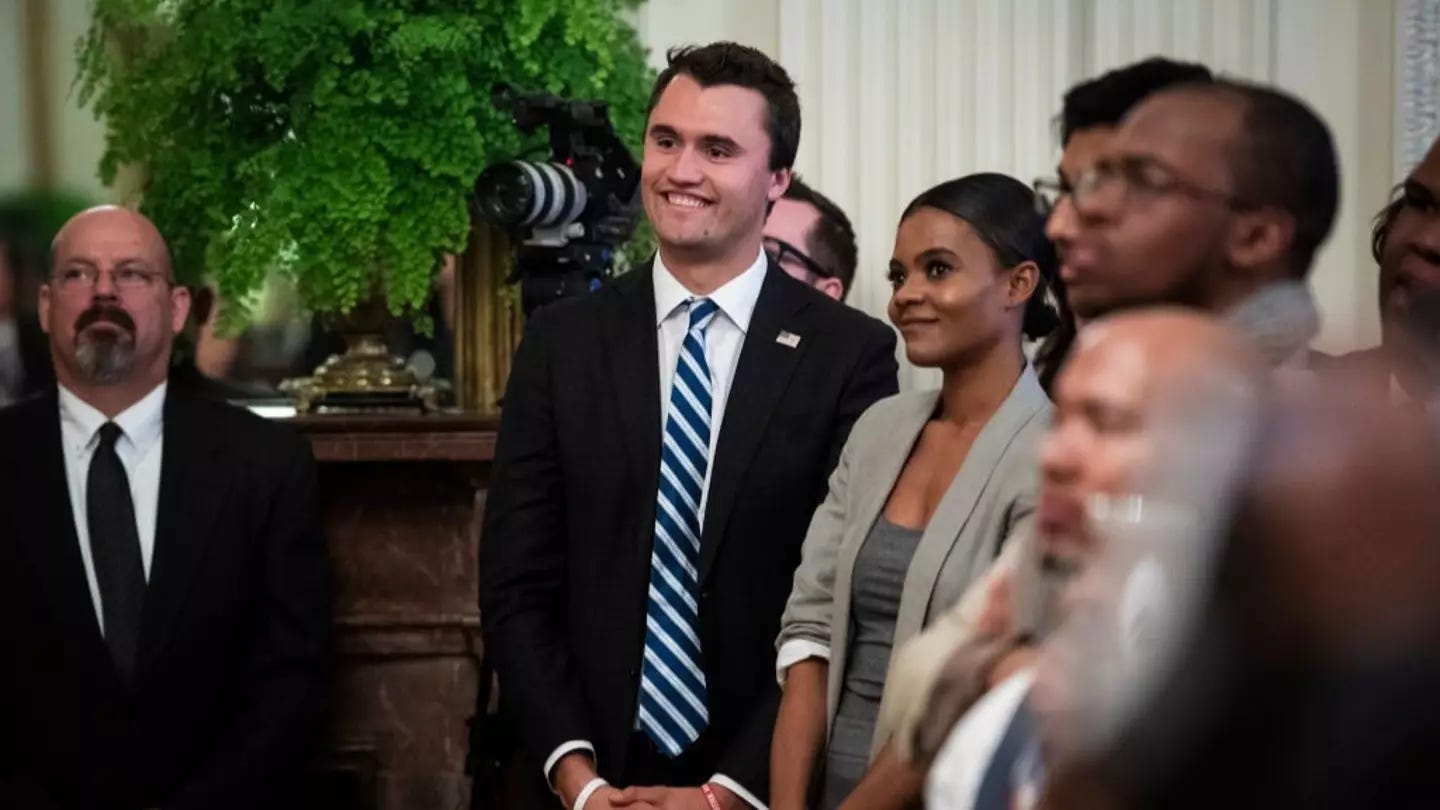
But when other friends of Kirk offer different accounts, they are dismissed as emotionally manipulative. The fact that they worked and traveled with Charlie day after day for years means nothing to her. Meanwhile, Candace cannot produce a single text from Charlie before 2019, attended TPUSA events only sporadically after her 2019 exit, and wasn’t invited to his memorial.
It is conveniently hypocritical, but it works beautifully in this context because the audience has already accepted the premise: Candace knew the real Charlie. Everyone else knew a fake one. Even Charlie himself was fooled, as she suggested on Russell Brand’s podcast: “Charlie’s life could have been The Truman Show. That terrifies me more—that nothing in your life is real.”
What makes this story difficult to write about is that I can’t tell if Candace Owens is sincere, a grifting genius, or creating a devout cult.
I have no doubt that, at first, she was grieving and driven by her own speculative nature, seeking answers. But as I watch the episodes, I notice that she was enjoying this entire production. She swings from indignant anger to taunting.
And while she may be sincerely looking for the person who killed her friend. I have little doubt she is loving the attention and the money. Besides, sincerity is not evidence. Conviction is not verification.
A person can believe something fervently and be wrong. A person can feel something deeply and be mistaken about its cause. The intensity of belief does not elevate the quality of evidence. And the refusal to separate feeling from fact is not a strength; it is a vulnerability.
This applies to everyone. Certainty feels righteous. Questions feel urgent. The resistance from institutions feels like proof that you’re onto something. And I get the last one, I too am very suspicious of the institutions. But none of that makes the underlying claims true.
Erika Kirk, Charlie’s widow, met with Candace Owens yesterday in Nashville.
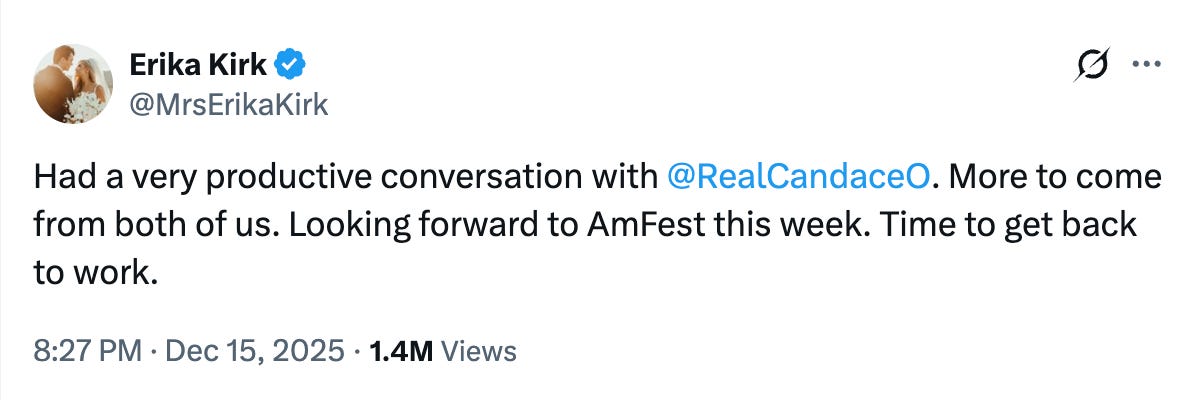
Their updates on this meeting were distinctly different. Erika shared a subdued statement: “Had a very productive conversation with @RealCandaceO. More to come from both of us. Looking forward to AmFest this week. Time to get back to work.”
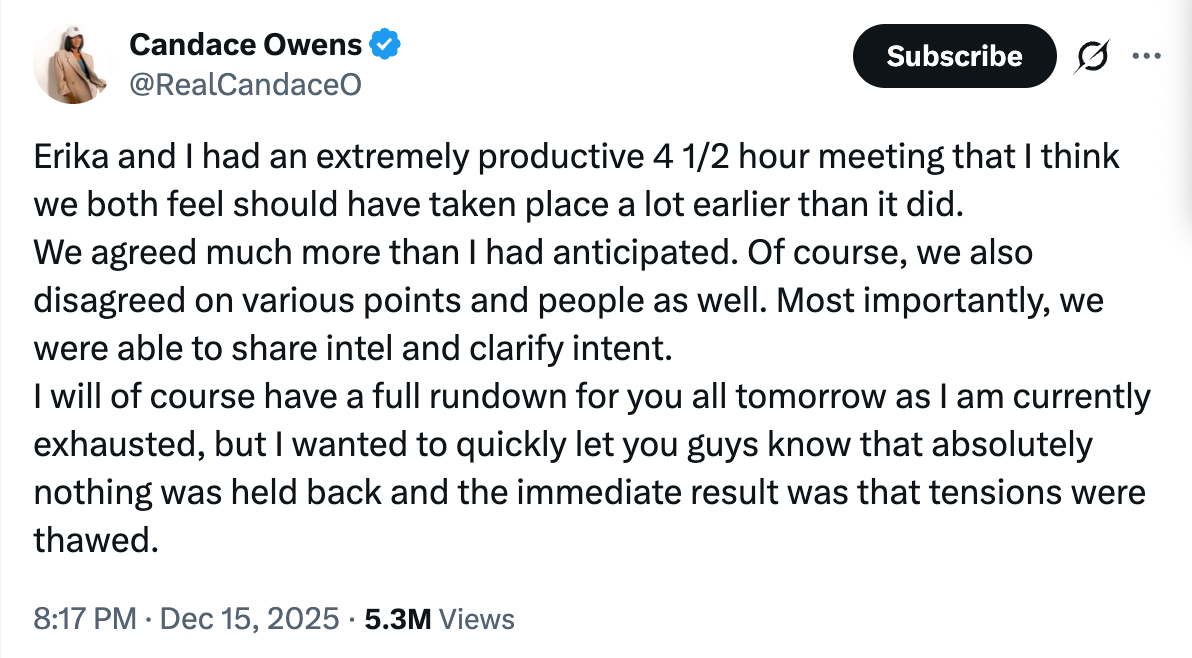
Candace’s post had more flair, accompanied by Instagram stories and shared reels of followers waiting with bated breath: “Erika and I had an extremely productive 4 1/2 hour meeting that I think we both feel should have taken place a lot earlier than it did. We agreed much more than I had anticipated. Of course, we also disagreed on various points and people as well. Most importantly, we were able to share intel and clarify intent... absolutely nothing was held back and the immediate result was that tensions were thawed.”
Erika clearly wants to get back to running and growing her husband’s legacy. Whether Candace will let this go remains to be seen. Did she finally get answers that satisfy the narrative she’s constructed? Will she share this “evidence”? Will the drama finally stop?
“Once doubt becomes evidence of complicity, once silence becomes evidence of guilt, once questions accumulate into conclusions without ever being answered, resolution becomes structurally impossible. The story can grow. It cannot end.”
Not likely.
Here is why: once doubt becomes evidence of complicity, once silence becomes evidence of guilt, once questions accumulate into conclusions without ever being answered, resolution becomes structurally impossible. The story can grow. It cannot end.
The questions Owens asks are worth asking. The distrust she channels is not unfounded. Institutions have lied. Governments have covered things up. The impulse to investigate is healthy.
But investigation requires more than suspicion. It requires the willingness to be wrong. It requires evidence that can be tested, sources that can be verified, and conclusions that can be falsified.
What Candace Owens has built over 40+ episodes is something else entirely. It is a story that explains everything and proves nothing. It is a narrative that cannot be penetrated because it has no surface to penetrate. It is an authority asserted through proximity, conviction, and volume rather than established through evidence.
I do not know who killed Charlie Kirk. Based on the publicly available evidence so far, I suspect it was Tyler Robinson. But I won’t know definitively until all the evidence is presented. Neither will you. And neither, based on the evidentiary standard demonstrated across three exhausting months of broadcasts, does Candace Owens.
But I do know what I’ve watched: a pattern so consistent it’s predictable. Questions that plant implications. Evidence demanded, then absorbed into the conspiracy when it contradicts. Certainty that escalates while proof remains static. Threads introduced with fanfare, then quietly abandoned. And an audience that mistakes the feeling of investigation for investigation itself.
And look, I already know what’s coming in the comments. “But what about the Egyptian planes?” “TPUSA is clearly hiding something!” “You’re just bootlicking the official narrative!”
Fine. Let’s review: After 40+ episodes, Candace has definitively answered zero questions, provided zero independently verifiable evidence, abandoned dozens of sensational threads without explanation, and made bank the entire time.
Meanwhile, if you apply basic common sense, understand how actual criminal investigations work, and—radical thought—read the primary sources yourself instead of accepting her interpretations, you might notice something. The Netanyahu letter isn’t suspicious when you read the whole thing. The Megyn Kelly interview shows exactly what Kirk said, not what Candace claims it shows. The “overlaps” disappear when you check the actual flight data.
One narrative treats Charlie Kirk like he had agency, authentic beliefs, and the intelligence to build the most successful conservative youth organization of our generation. The other treats him like a puppet who had no real convictions except the ones Candace retroactively assigns him.
One narrative seeks truth. The other is optimized for clips and Superchats.
Yes, there are other “suspicious” details people will point to—the missing timestamps on text messages, the tone of certain communications, the timing of various events. And you know what? There are rational explanations for those too that don’t require international assassination conspiracies involving Egyptian jets and French intelligence. But this piece is already stupid long, so if there’s interest and I have the time, I’ll come back to those specifics. Just don’t accuse me of “never watching” or “not doing my research” when you disagree with my conclusions. I’ve done the work. You’re welcome to do it too.
The tragedy is not just that Charlie Kirk is dead. It’s that in the aftermath, a “friend” who claims to seek truth has built a machine that makes truth impossible to reach.
Thank you for watching and breaking down the 40+ episodes so we didn’t have too! 😅 I’ve never believed her outlandish “revelations”.
Makes me think she is the puppet, projecting her situation onto Charlie; in addition to the ideas that she was in love with him. Candace is a mess who happily shared her internal chaos with the entire world. May she seek help.