

Between the Lines | How the Story of a 5-Year-Old Locked In Before the Facts Arrived
Why early headlines, emotional images, and missing context shaped what millions believed

A photo of a child. A blue hat with fuzzy ears. A Spider-Man backpack. An adult’s hand on his shoulder, cropped to exclude the adult’s face.
By the time most Americans encountered this story, they’d already reached a conclusion. The image alone did the narrative work. The headlines confirmed it.

This story went viral before the factual dispute was even established. Before DHS issued a rebuttal. Before anyone explained immigration custody procedures. Before readers learned whether the child was the enforcement target or his father.
That is by design. It’s how media framing operates, and this case is a near-perfect example of how early narrative choices lock in public understanding before corrections can matter.
The goal is to harden the narrative before the details emerge.
Let’s look at what happened.
How the Story Was Initially Framed
The Local Origin: MPR News (January 21–22)
MPR News broke the story with this headline:
“ICE detains 5-year-old Minnesota boy; school leader says agents used him as ‘bait’”

Read it again. The subject of the headline is the 5-year-old boy. Not his father. Not “a family.” Not “the father of a 5-year-old.” The child.
The word “bait” appears in the headline, not as an allegation to be examined, but as a declarative claim attributed later in the article to a school leader. It’s in quotes, but the framing treats it as an established fact.
Now look at the article’s opening:
“The Columbia Heights Public School district says federal agents have detained four of its students in four separate incidents over the last two weeks. One child is a 5-year-old boy who attends a district elementary school and was used as ‘bait’ to draw family members out of their home.”

The father—the actual enforcement target—doesn’t appear until the fourth paragraph. And even then, he’s introduced without clarification that he was who ICE came for:
“According to Stenvik, masked agents apprehended 5-year-old Liam Conejo Ramos in his driveway on Tuesday as he returned home from school with his father.”
What’s the effect? Readers are primed to understand this as child-first enforcement. The father is a peripheral detail. The child is the subject.
Then comes this line:
“Stenvik said Liam’s family has an ‘active asylum case’ with no deportation orders.”
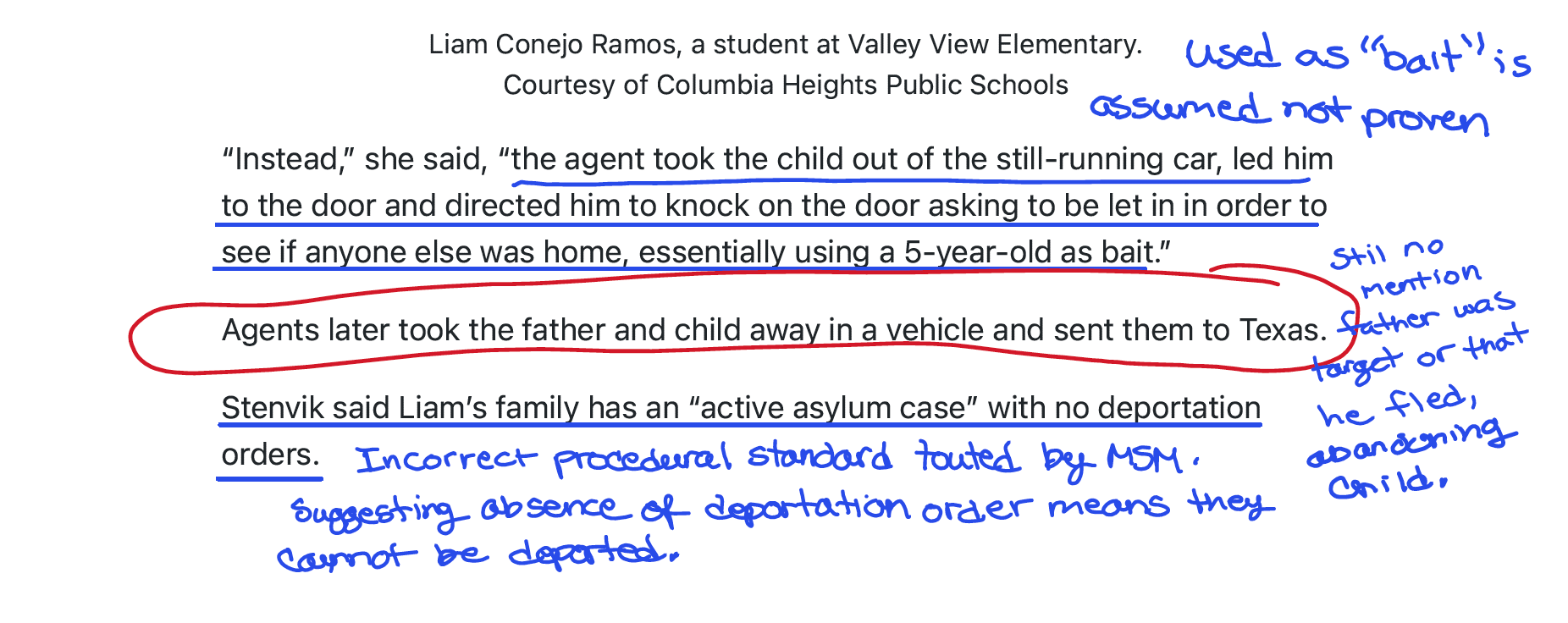
This is presented to absolve the family. But what does “no deportation orders” actually mean? Is a deportation order required for ICE to detain someone? What’s the difference between a pending asylum case and a granted asylum?
None of that is explained. The phrase does narrative work without informing or educating.
National Amplification: The New York Times (January 22)
When the Times picked up the story, it nationalized the local frame without correcting the premise.
“Immigration Agents Detain 5-Year-Old Boy in Minnesota, Prompting Outrage”

The subject: the 5-year-old boy. The verb: detained. The effect: outrage (stated in the headline itself, before readers encounter any facts).
The opening paragraph:
“A 5-year-old boy wearing a Spider-Man backpack and an oversized hat was detained with his father by immigration authorities on Tuesday...”
Notice the construction. The child comes first. The father is mentioned, but only as accompaniment, ”with his father.” There’s no indication here that the father was ICE’s target, not the child.
The emotional detail—Spider-Man backpack—appears before any procedural or factual context. This does narrative work. You’re meant to be emotional before you understand anything, clouding judgment.
To the Times’ credit, the article later acknowledges:
“Exactly what happened during the arrest, on a snow-covered block in Columbia Heights, is in dispute. The small school district and the federal government have given conflicting accounts.”
But this appears after the emotional framing is established. After the photo. After “prompting outrage.” The dispute is presented as secondary to the emotional reality.
The article also includes this:
“In order to detain Liam against his will, agents would need probable cause to believe that he was in the country unlawfully, experts said, but they are allowed to keep the child with an arrested parent if the parent requests it.”
This is crucial context. It’s technically included. It’s also buried deep in the article, long after readers have formed their initial understanding.
CNN’s Framing (January 22)
CNN’s headline: “5-year-old Liam Conejo Ramos taken by ICE in Minnesota”

Again: the child is the grammatical subject. The verb is “taken.” The father doesn’t appear in the headline at all.

CNN’s coverage does eventually include DHS’s statement that the father was the target. But the headline—what most readers see first, and often only—centers the child.
How Later Coverage Tried—and Failed—to Reframe
ABC News & DHS Response (January 23–24)
By the time ABC News covered the story, DHS had issued its rebuttal. ABC’s headline:
“Top ICE official accuses father of detained 5-year-old of ‘abandoning his child’”

The structure presents DHS’s “abandonment” claim as an accusation to be evaluated against the school district’s version. The two narratives are placed in opposition—dueling accounts—without tools to assess either.
What’s missing? No explanation of what happens when a parent flees during enforcement. No explanation of custody protocols when a detained parent has a minor child present. No context about why a mother inside a home might not open the door when federal agents are outside.
Readers are left to choose sides rather than understand the process.
Fox News Counter-Framing (January 23)
Fox’s approach inverted the early coverage:
“DHS releases image of father who abandoned 5-year-old while fleeing ICE”

Here, the father is the subject. “Abandoned” is presented as fact, not allegation. DHS’s frame is adopted wholesale.
Fox also reports a detail no other outlet leads with:
“DHS has no record of him or his family entering the U.S. via the Biden-era CBP One cell phone app as the family attorney had claimed.”

This directly contradicts the family attorney’s account. But it’s presented without corroboration beyond DHS’s statement. Readers can’t evaluate the competing claims; they can only choose which source to trust.
What Readers Were Guided to Conclude
Across outlets, despite different editorial positions, readers were channeled toward one of two simplified conclusions:
Version A (Left / Institutional): ICE is detaining children, abusing discretion, and terrorizing communities. The child is the victim. The enforcement is the crime.
Version B (Right / Defensive): DHS is being unfairly smeared by activists and compliant media. The father abandoned his child. Outrage is manufactured.
Both versions offer certainty. Both versions feel complete. And both versions leave out the same things.
So how did we get from a disputed enforcement action in a Minneapolis suburb to kidnapping 5-year-olds, all within 48 hours?
What none of these outlets explained—and what actually determines how this incident should be understood—is the policy environment ICE was operating under, and how recent changes altered enforcement in ways most readers were never told about.
What follows is the full breakdown, every outlet annotated, the timeline showing exactly when the narrative locked, and the policy context that would have changed everything. Plus a framework for catching this pattern next time, before it catches you.
